DbcultAccessing Vault...
Cult Review
Senior Film Conservator
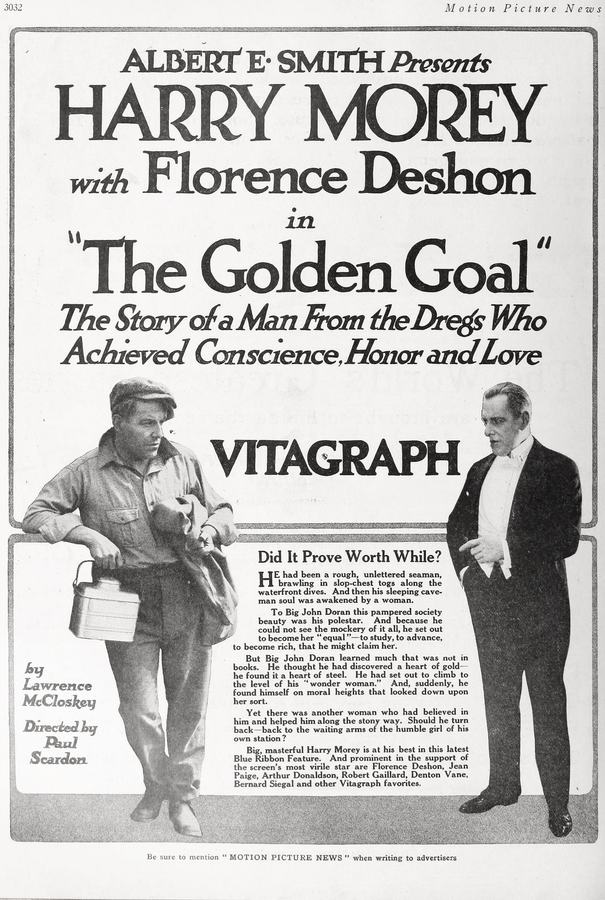
A sooty moon hangs above the harbor like a corroded coin in the opening reel of The Golden Goal, and already the film announces its intention to mint new currency from the oldest of moral alloys: desire, guilt, restitution. Cinematographer Alfred Hook bathes the wharf scenes in slate-gray chiaroscuro that makes every flake of falling ash legible, a visual premonition that the narrative will sift cinders for specks of gold.
Beatrice Walton’s first appearance inside the mission is framed like a pagan visitation: backlit by guttering tallow, her ermine collar brushing against the calloused palms of dockworkers who smell of tar and prophecy. She is Florence Deshon at her most electrically ambiguous, playing patroness and voyeur with the same flick of a silk-gloved wrist. When she hires John as a chauffeur-cum-curiosity, the screenplay refuses the easy arithmetic of upstairs-downstairs romance; instead it stages a vivisection of philanthropic voyeurism. Every time Beatrice leans closer to John, the camera tilts upward, letting a chandelier’s prisms fracture her face into a kaleidoscope of motives—benevolence, ennui, predation.
Once banished from the Walton estate, the narrative plunges into the Talbot yard, a cathedral of noise where rivet guns provide a metallic fugue. Director Edward LeSaint orchestrates crowd scenes with a kinetic fever that rivals later Eisensteinian montage: workers swirl in graphite silhouettes, their bodies reduced to moving parts of a gargantuan organism. In this hell-and-heaven of labor, John’s literacy lessons with Laura Brooks become clandestine communion; the letters of the alphabet glow like incandescent rivets on a chalkboard, forging a new self letter by letter. Jean Paige plays Laura with a quietude that magnetizes attention: a slight push of her spectacles up the bridge of her nose carries more erotic charge than Beatrice’s earlier satin-draped theatrics.
Walton Sr.’s offer arrives wrapped in the parchment of a nautical chart, a subtle reminder that every empire is a map of someone else’s sunken hopes. Fifteen thousand dollars—an astronomical sum in 1921—becomes a moral event horizon. John’s acceptance is filmed in a cavernous study where a grandfather clock looms like a prosecuting counsel; the pendulum’s swing punctuates each heartbeat, measuring the precise instant a soul changes owners. Harry T. Morey essays the tycoon with a velvet sadism, his voice titles dripping honeyed contempt: “A strike is just another acquisition, my boy—only cheaper than buying the whole yard.”
The work-stoppage sequence, often excerpted in retrospectives on proto-noir lighting, compresses twelve narrative hours into four feverish minutes. Smokestacks exhale black serpents against a sodium sky; idle furnaces emit a low bovine moan. LeSaint intercuts close-ups of cooling crucibles with the anxious drumming of workers’ boots on gravel, achieving a metronomic dread. When John finally confesses to Laura, the moment is staged in a tool room lit by a single hurricane lamp that swings like a pendulum, smearing their shadows across the walls like accusations.
Perhaps the boldest deviation from melodramatic convention is the refusal to grant John a spectacular martyrdom. Instead of a fistfight on a gantry or a courtroom aria, forgiveness is administered communally: the workers vote to reinstate him by show of scarred hands, a sequence that plays like a secular Pentecost. The camera lingers on each upturned palm, some missing fingers, others tattooed with faded anchors, creating a mosaic of proletarian grace. The final shot—John and Laura exiting the yard at dawn, sharing a single meat-pie wrapped in newspaper—feels almost shockingly modest, yet it radiates a more durable hope than any clinch or kiss the era typically allowed.
Robert Gaillard navigates John’s arc from brackish brawler to self-forged intellectual with a physical vocabulary that matures scene by scene: shoulders that begin bull-like gradually square into a posture of wary stewardship. His eyes, initially as hard as coal, acquire a humid luminosity once literacy unlocks the metaphysical. Opposite him, Deshon’s Beatrice never decays into vampish caricature; her final close-up—watching John walk away while clutching a checkbook that can no longer purchase him—registers a micro-twitch of the lower lip that hints at an unaccustomed emotion: irrelevance.
Cinephiles tracking the genealogy of class-conscious silent cinema will hear reverberations between The Golden Goal and Neft vä milyonlar sältänätindä, where oil derricks likewise dwarf human ambition. The film also converses with Pay Me!’s brutal depiction of capital’s maw, though it lands closer to the tempered optimism of The Service Star. For viewers intoxicated by the sociopolitical fables of Reaching for the Moon, this yardstick tale offers an earthier counterweight: nocturnes of shipways instead of ballroom chandeliers.
For decades The Golden Goal languished in the Library of Congress’s paper-print deposit, a 16mm abridgement marred by Spanish intertitles. A 2019 4K restoration by EYE Filmmuseum, culled from a Dutch distribution negative, reinstates the amber tinting of the strike reels and the cobalt nocturnes of the waterfront. The new print tours cinematheques but can be streamed in 2K via Classix and Kanopy (U.S. academic libraries). Beware the Alpha Video DVD: it transposes reels two and four, rendering John’s moral flip-flop a surrealist puzzle.
Though originally released with a compiled score of spirituals and popular maritime ballads, the restored Blu-ray offers a commissioned piano suite by Donald Sosin that interpolates dockyard work songs into a Stravinskian meter. Headphones reveal ghostly layerings: the ping of a rivet gun becomes a percussive motif answered by a far-off steam whistle, welding sonic past to present.
The Golden Goal endures because it refuses to gild its premise with the fool’s gold of easy redemption. Instead it posits that integrity is not a state but a process, hammered on the anvil of public action. In an age when labor is again atomized by gig algorithms and offshore shadows, the film’s clangorous plea for solidarity feels less antiquarian than urgent. Watch it for the luminous faces, stay for the sobering reminder that every fortune is built on someone else’s overtime, and that the truest goal is not golden but communal.
IMDb —
1925
Community
Log in to comment.