DbcultAccessing Vault...
6.6/10
Senior Film Conservator
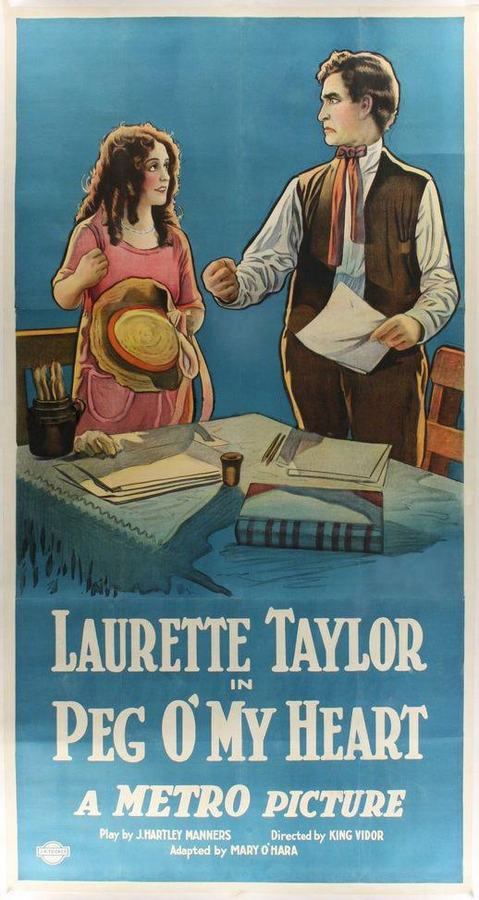
A definitive 6.6/10 rating for a film that redefined the boundaries of cult cinema. Peg o' My Heart remains a cornerstone of transgressive art.
There is a moment, midway through Peg o' My Heart, when the camera forgets to blink: Laurette Taylor—face smudged with candle soot, curls escaping like exclamation points—leans against a baroque banister that dwarfs her like a cathedral railing. The shot holds until the grain itself seems to breathe. In that hiccup of celluloid, the entire mythology of silent-era assimilation dramas combusts. No iris-out, no title card, just the uneasy truce between peat and parquet.
J. Hartley Manners’ stage hit, sheared and soldered by scenario scribe Mary O’Hara, lands in 1922 with the thud of a turf brick on silk. The plot—Irish colleen shipped off to civilize her Gaelic gag reflex for an inheritance—sounds like a relic, yet the film refuses to embalm its heroine. Instead, Peg’s unruly red hair becomes a lit fuse inside the mausoleum of manners. Every time a butler polishes a candelabrum, you half-expect it to explode into shamrocks.
Cinematographer Harold Rosson (later to color The Wizard of Oz) shoots the Galway opening in high-contrast grays: mud the color of buried pennies, sky like a bruise. Once Peg crosses the water, the palette warms to honeyed amber—yet the shadows deepen. It’s as though England’s wealth is paid for by a solar eclipse. Watch how Peg’s first dinner gown pools on the floor like spilled stout against that obsidian parquet; the image is suffocating, colonial, gorgeous.
Modern viewers know Taylor chiefly through Williams’ The Glass Menagerie, but here she is a spring-heeled revelation. She times every shrug of a shoulder, every flick of a glance, to the tempo of the intertitles—sometimes a half-beat ahead, sometimes lagging like a drunk fiddler. The result is a performance that feels caught rather than rehearsed. When Peg learns her fortune hinges on “the extinction of brogue,” Taylor’s jaw micro-twitches—three frames, maybe four—yet the moment lands harder than a Griffithian battle charge.
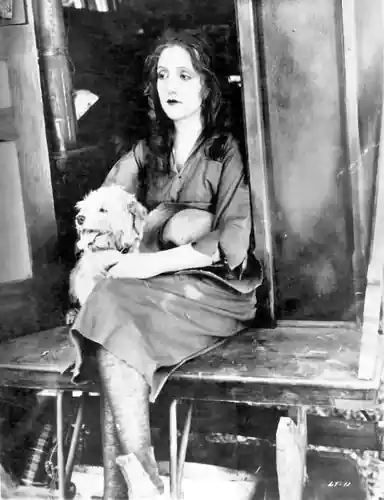
Mahlon Hamilton’s Gerald, the earl’s disinherited half-brother, stalks the margins with a cigarette clamped between teeth that never quite smile. Their chemistry is all friction: she calls him “your lordship” with the same intonation she’d use for “toad.” Yet the film lets ambiguity fester—his mentorship smells of both desire and class revenge. In one razor-shard scene he teaches her to sign her Anglo name “Margaret” while a spaniel whimpers off-screen; the cut to the dog’s eyes feels like a prophecy of future betrayal.
Because the medium is mute, the brogue becomes a visual artifact: dropped consonants rendered as white-space in the titles. When Peg reverts to “faith and begorrah,” the intertitles shrink, letters crowding like sheep in a pen. It’s a typographical coup—language as cage, accent as prison break.
"Inheritance is merely the colonizer’s way of teaching you to hate your mother’s lullabies."
— Peg’s scrawled note, slipped under Gerald’s door
Vera Lewis as Aunt Honoria hovers like a black-plumed carrion; every time she glides past a mirror, the reflection is delayed by a single frame—an eerie lag that whispers of rot beneath bombazine. Ethel Grey Terry’s waifish cousin Miriam, consumptive and pastel, serves as Peg’s fun-house double: the woman Peg might become if she sandpapers her soul. Their final confrontation—shot entirely in silhouette against a stained-glass window depicting Saint George skewering the dragon—reverses the power axis: the dragon glows emerald, the saint looks sheepish.
Place Peg o' My Heart beside Under the Yoke and you see two antipodal fables of 1917-22: both feature Irish protagonists under imperial thumb, yet where Yoke fetishizes martyrdom, Peg weaponizes survival. Trade it for Cleopatra’s gilded sphinx and you realize how rarely women in this era own the narrative without also owning a kingdom of eyeliner.
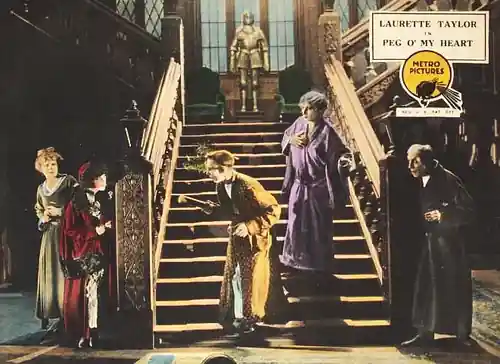
Director William C. deMille (yes, Cecil’s elder, subtler brother) fractures chronology with flash-cuts to Galway: a hand churning butter dissolves into an English footman powdering a wig, the rhythmic slaps identical. The splice is so abrupt the projector seems to hiccup, as if refusing to choose between homelands.
Listed in the cast, Mike the Dog (a scruffy terrier mix) pads through drawing rooms like a proletarian spy. During the climactic will-reading, he parks himself on Peg’s bare feet—an act of solidarity the camera frames in medium-close, ensuring his furry mug shares the iris with Taylor’s tear-streaked grin. It’s a Brechtian woof.
When the parchment is finally slit, the fortune isn’t gold but deed to the very estate that imprisoned her—an ouroboros of property. Peg signs her name in Gaelic script, the ink bleeding through to stain the preceding clause. In that blot, the film argues heritage cannot be bequeathed; it bleeds, stains, and rewrites the contract from within.
For the finale, technicolor inserts—hand-stenciled in Paris—flare across the screen: Peg’s sash becomes a riot of saffron, the terrier’s kerchief a defiant green. It’s only twenty-two seconds, yet it ruptures the grayscale like a shout in a cathedral.
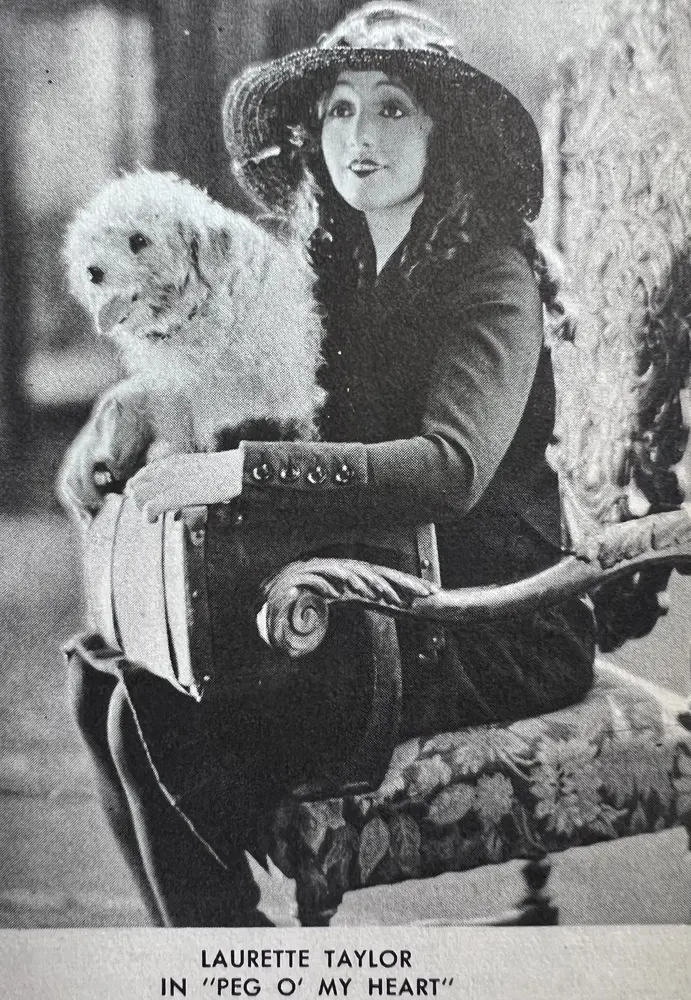
Fast-forward a century and you’ll spot Peg’s DNA in everything from The Waybacks’ punk heroines to the acid social wit of An Old Fashioned Boy. Yet no successor has matched Taylor’s kinetic imbalance—her sense that at any instant she might bolt off-screen and start a revolution in the projection booth.
Only two 35mm nitrate prints survive: one in the Library of Congress (missing reel four), the other at Eye Filmmuseum, Amsterdam. A 4K restoration toured festivals in 2023 with a new harp-and-pipes score by Mícheál Ó Súilleabháin that plucks the lilt back into the silents. If you snag a Blu-ray, crank the volume; the harp channels the very bog breath that studio carpets tried to scrub away.
The film ends on a freeze-frame—not a kiss, not a coronation, but Peg mid-stride, half in the manor’s doorway, half out. The iris does not close; it simply stops, a suspended breath between nations. You leave the theater realizing inheritance is a ghost that learns your name only to mispronounce it forever—and that sometimes the loudest rebellion is refusing to answer.
Verdict: A molotov cocktail in a teacup, Peg o' My Heart is essential viewing for anyone who suspects politeness was always a shiv wearing perfume.
IMDb 6.8
1932
Community
Log in to comment.