DbcultAccessing Vault...
6/10
Senior Film Conservator
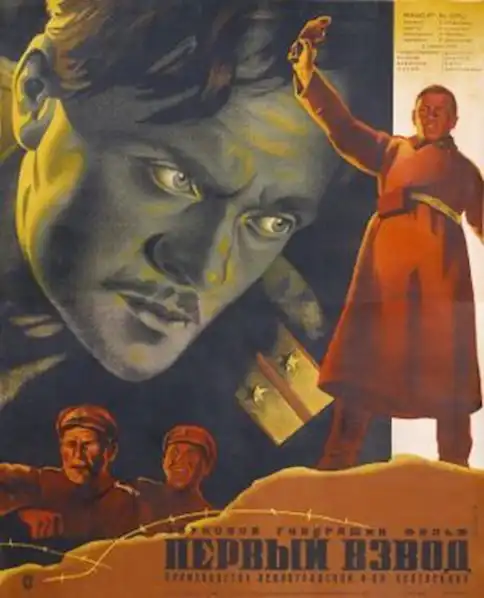
A definitive 6/10 rating for a film that redefined the boundaries of cult cinema. Pervyy vzvod remains a cornerstone of transgressive art.
Alright, let's talk about Pervyy vzvod, or 'First Platoon.' This one's from 1933, straight out of the Soviet Union. So, right off the bat, you know this isn't going to be your typical Hollywood fare. Is it worth watching today? For film historians, anyone curious about early Soviet cinema, or folks who appreciate stark, disciplined storytelling, then yes, absolutely. You'll get a real sense of the era and its filmmaking.
If you're looking for fast-paced action, snappy dialogue, or a character-driven drama in the modern sense, you'll probably find it a bit of a slog. Your mileage will definitely vary here.
The film doesn't waste time on elaborate plot points. It drops you right into the training camp. These young men are learning to be soldiers, and it’s a physical, often brutal, process. You see them digging trenches, marching through fields, and wrestling with their equipment. The camera just lingers on these moments, sometimes for what feels like an eternity.
There's a particular scene where they’re doing rifle drills. The precision, the synchronized movements—it's almost hypnotic. Every rifle snaps into place at the exact same moment. It speaks volumes about the emphasis on collective action, how the individual is subsumed by the unit.
I noticed the dirt, too. Like, really noticed it. When they're crawling or digging, the dust gets everywhere. It's not glamorized. It feels authentic, which is a credit to the filmmakers.
The sense of constant effort is palpable. You don't just hear about their training; you *feel* it through the sheer duration of some shots.
Mikhail Rostovtsev, the director, really knew how to frame these scenes. A lot of wide shots showing the full platoon moving as one. Then, suddenly, a tight close-up on a sweaty face, eyes fixed on some distant goal. It gives you whiplash in the best way. You get the grand scale, then the human struggle.
While it’s not about one single hero, some faces do stand out. Oleg Zhakov, for example, has this kind of earnest intensity. You can see the determination in his eyes, even when he's just staring into the middle distance. He’s not performing; he’s embodying.
Then there’s Fyodor Nikitin. He plays a more seasoned, perhaps a bit gruff, soldier. His presence felt very grounding. He’s the one who silently guides the newer recruits, not with words, but with his very posture.
The interactions are sparse. People don't chat idly. When they speak, it’s usually about duty, about the task at hand. It’s very practical. A lot of the story is told through their actions, through the way they carry themselves.
One moment, a couple of soldiers are sharing a meager meal, and the way they pass the bread, the quick, efficient movements—it shows their camaraderie without needing a long, heartfelt conversation. It's a quiet kind of connection. ❤️
The sound design is rudimentary, as you'd expect from 1933. The marching music, the commands shouted in Russian, the occasional blast of a rifle. It all adds to the period feel. It's not polished, but it doesn't need to be. It has a raw energy.
The film isn't trying to entertain in the modern sense. It's more of an immersive experience. You're observing a historical document, a window into the ideology and daily life of the Red Army in the early 1930s. It’s a testament to the idea of building a new society, one disciplined soldier at a time. It’s a heavy watch, for sure.
This isn't something you'll stumble upon easily, but if you do, and you've got a fondness for old films and Soviet history, give Pervyy vzvod a shot. It might surprise you with its quiet power, even if it tests your patience a bit.
IMDb 6.7
1932
Community
Log in to comment.