DbcultAccessing Vault...
5.8/10
Senior Film Conservator
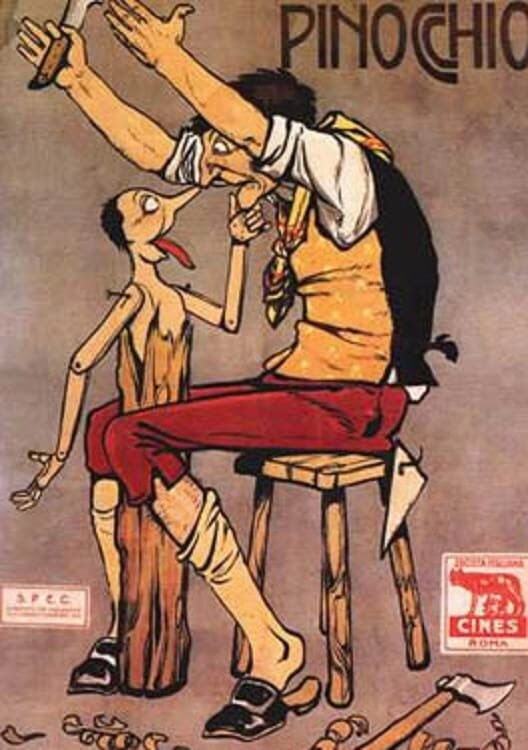
A definitive 5.8/10 rating for a film that redefined the boundaries of cult cinema. Pinocchio remains a cornerstone of transgressive art.
Carved shadows, cannonball skies.
Picture, if you can stand the splinters, a strip of nitrate flickering inside a smoky Ligurian fairground tent in the torrid summer of 1911. The projector clacks like a sewing machine run by furies; on the linen sheet, Geppetto’s chisel splits the grain and a face emerges—half cherub, half gargoyle—its eyes two knots that suddenly bleed light. This is not the cuddly Disney marionette; this is the feral ancestor, a wooden thing born under Saturn, condemned to be judged, hanged, drowned, dismembered, yet always reassembled by the obstinate magic of celluloid.
Within the first reel, the film abandons any pretense of bedtime morality. Pinocchio is tried by a tribunal of barnyard animals in collars too tight for their swollen necks; the verdict is sung by a donkey whose voice warps like a cracked wax cylinder. Sentence: the gallows tree on the town’s outskirts, where wind hisses through rope fibers. The camera lingers on the puppet’s twitching toes until the frame itself appears to asphyxiate. Contemporary leaflets advertised the scene as “suitable for children,” proving that early marketers were either visionaries or sadists.
Salvation arrives not in the shape of a blue fairy but via a squadron of Canadian soldiers—anachronistic, red-coated, their bayonets catching the magnesium glare of the arc lamps. They saw the limp doll down, scatter coins of uncertain currency, then vanish into fog that smells of turpentine. From here the narrative fractures like a dropped mirror: the puppet is sold to a traveling Wild West show, painted gold, exhibited as “the smallest pioneer,” escapes during a shoot-out staged so realistically that several audience members reportedly drew concealed revolvers.
Next comes the whale—an interior cathedral of ribs lacquered with tar, lit by a single lantern that reveals a heap of swallowed saints still murmuring Latin. Pinocchio burns the beast’s tongue to embers, crawls out through the blowhole, and finds himself in a star-drunk sky riding a cannonball lobbed by unseen artillery. The double-exposure shows his silhouette streaking across the Big Dipper, a comet with splayed limbs and a nose sprouting foliage like a cursed topiary. Critics of the era compared the effect to Dante’s ascent through the spheres; viewers in Turin fainted from vertigo.
Back in the village, Geppetto has aged a century in a week. His hair frosts over in real time thanks to stop-motion tinting; each frame hand-painted with powdered zinc so that silver spreads like mildew. When the door bursts open and the puppet—now flesh, or something near it—stumbles in, the old man does not embrace him; he lifts the chisel as if to excise the heart that betrayed him. The film ends on a freeze-frame of trembling lips, neither kiss nor accusation, the moment suspended like a tear that refuses to fall.
Director Giulio Antamoro shoots every scene at oblique angles, as though the camera itself were nailed crookedly inside a ship’s hold. The puppet’s nose-expansion is achieved via a primitive tracking shot: the lens dollies inward while a paper-mâché branch is cranked from behind, creating an uncanny elasticity that predates the theological distortions of Life and Passion of Christ by a full year. Grain swarms like lice; scratches on the print resemble scars from a flogging.
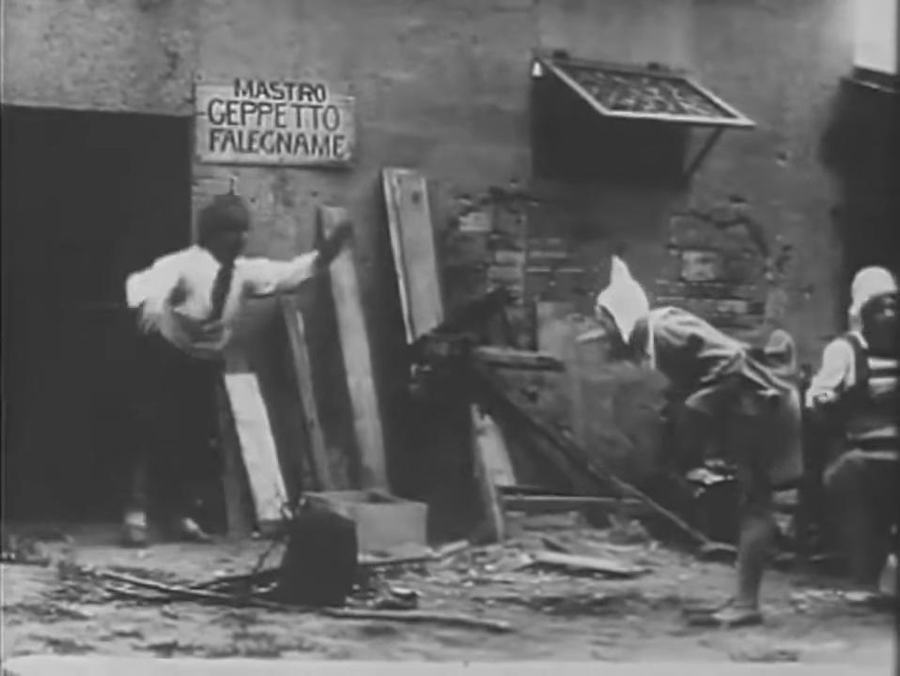
Compare this to the static tableaux of A Procissão da Semana Santa, where sinners remain frozen in pictorial space; Pinocchio instead hurtles through a kinetic fever dream, anticipating the convulsive montage of later European avant-gardes. The tinting palette—sulfur yellow for greed, bruise-blue for despair, arterial red for violence—turns each reel into a stained-glass window smashed by a hurricane.
Though released without official score, exhibitors were encouraged to hire barrel-organists who could grind out Neapolitan laments between gunfire effects produced by coconut shells. Surviving cue sheets recommend inserting the crackle of real pine logs during the hanging scene, a sonic sadism that makes The Corbett-Fitzsimmons Fight’s ringside cheers feel pastoral. One Roman projectionist noted that children screamed louder at the creak of the puppet’s neck than at any lion tamer footage.
Beneath the Grand Guignol lies a veiled indictment of Italy’s colonial misadventures. The fox and cat who swindle Pinocchio wear pith helmets; the salt-mine where boys turn to donkeys is guarded by askari in makeshift uniforms. When Canadian soldiers liberate the protagonist, they inadvertently foreground the era’s imperial shell game—saviors from one empire, oppressors in another. Thus the marionette becomes a crucible of national guilt, his wooden body splintered by the same historical forces that carved up Africa and the Balkans.
Lea Giunchi as the Blue Fairy (here a smoky street-lamp hallucination) drifts across the frame like a photographic double-exposure, her eyes black pinholes. Polidor’s Fox drips oleaginous charm, twirling a cane topped with a child’s skull carved from soap. But the film belongs to the puppet—an uncredited performer whose limbs are jerked by visible wires; the very amateurishness heightens the pathos, as though cinema itself were struggling to animate its own anxieties.
For decades the only extant print was rumored to be a single 35 mm reel hidden inside a Sicilian church altar. When it resurfaced at a 1989 Pordenone retrospective, the whale segment had decomposed into bubbling lava; what remained was a ghostly superimposition of scales and starlight. Digital restoration in 2019 reintegrated missing tinting, yet the scars were preserved—scratches left untouched like wounds too sacred to cauterize.
This is not a quaint fable but a barbaric lullaby hurled from cinema’s cradle. It prefigures the surreal cruelty of Dante’s Inferno, the colonial nausea of Het Estuarium van de Kongostroom, the existential vertigo of Hamlet (1910). To watch it is to feel the splinters under your own fingernails, to sense the noose tighten not around a puppet’s neck but around the fragile idea that childhood was ever innocent.
Essential for archivists, masochists, and anyone who believes that cinema’s first duty is not to comfort but to burn its image onto the soft wood of your brain.
IMDb 6.4
1930
Community
Log in to comment.