DbcultAccessing Vault...
5.3/10
Senior Film Conservator
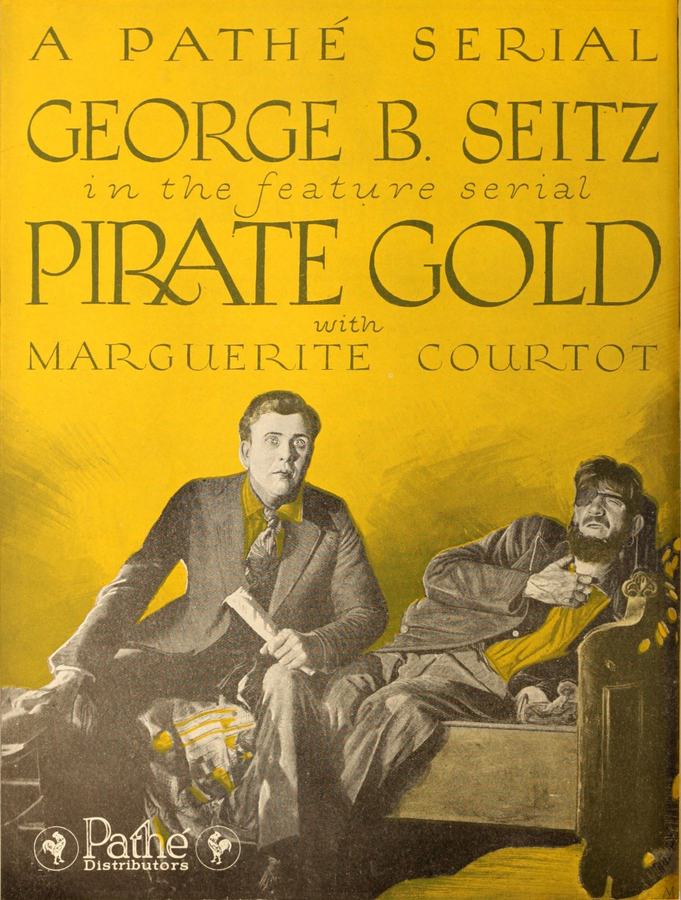
A definitive 5.3/10 rating for a film that redefined the boundaries of cult cinema. Pirate Gold remains a cornerstone of transgressive art.
Flickering nitrate becomes liquid night as Pirate Gold opens on a port town that reeks of whale-oil and wet stone. Cinematographer Frank Redman tilts his camera into the rain until lanterns smear into comets; you smell the brine through the screen. This is 1920, yes, but the film feels post-apocalyptic—cobblestones glisten like black teeth, and every alleyway exhales fog thick enough to chew.
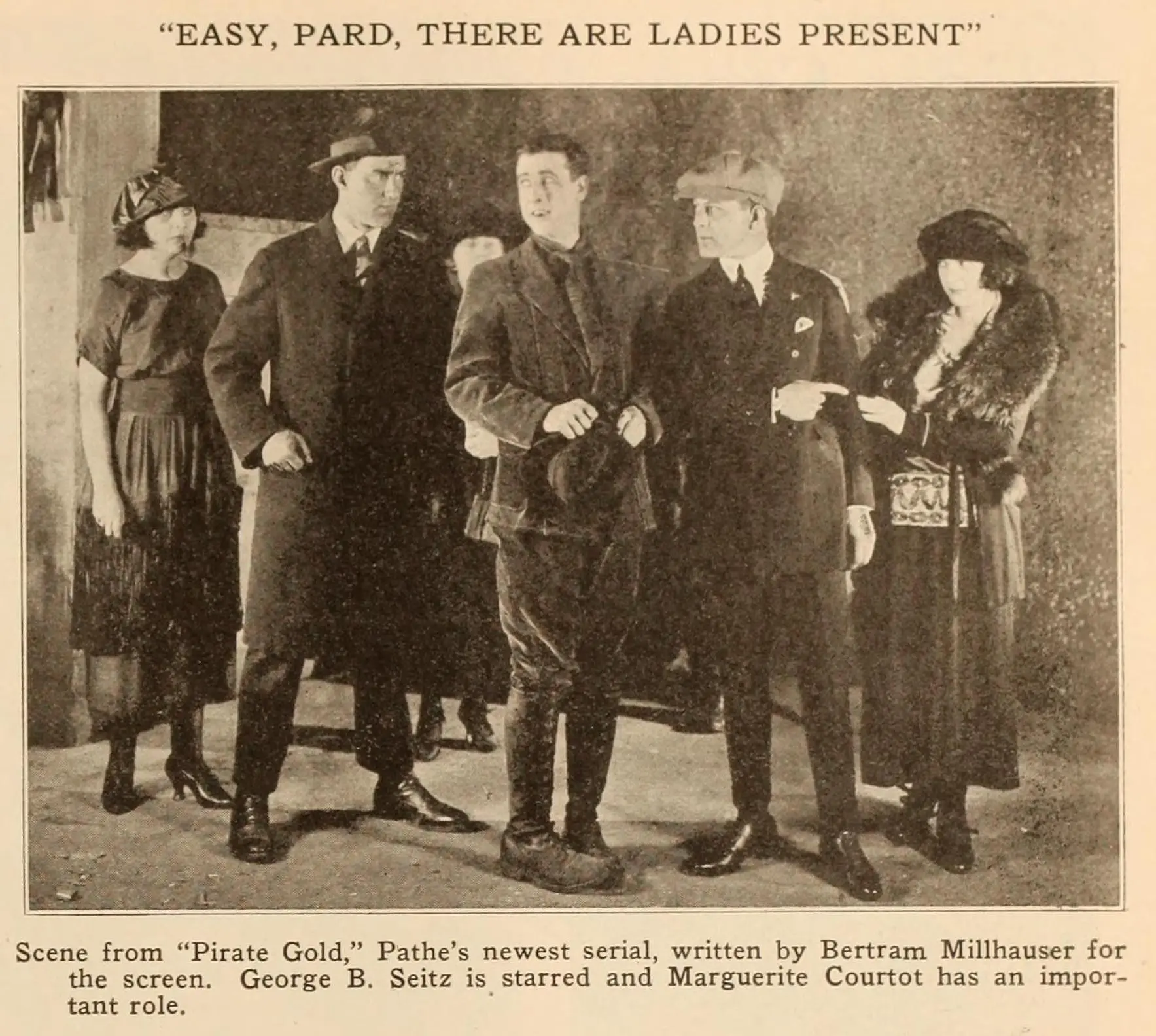
Director George B. Seitz—later the pulse behind Helene of the North—refuses the lantern-jawed heroics that would glut later buccaneer romps. Instead he gives us Harry Semels as Captain Sable, a man whose smile arrives a full second after his lips part, as though the gesture must first be approved by demons. Semels plays him like a weary poet who discovered that cannons rhyme better than couplets. His eyes—two shuttered windows in a burned cathedral—suggest he has already read the last page of his own story.
Into this damp purgatory glides Marguerite Courtot as Marina, the missionary’s daughter whose purity is less moral than meteorological: she changes atmosphere the way moonlight changes tide. Courtot’s performance is silent-film mime at its most combustive; a slight flare of nostril conveys mutiny, a half-lidded glare births typhoons. When she stows away inside a crab-crate, Seitz cuts to a close-up of her pupil dilating in sync with a ship’s timbers groaning—lust and lumber locked in harmonic convergence.
The story, stitched by scenarists Frank Leon Smith and Bertram Millhauser, eschews linearity like a drunken helmsman avoiding shoals. We drift between flashbacks hallucinated through salt-stained letters, present-tense mutiny, and premonitory visions rendered as double-exposed chimeras: a gull morphs into a buccaneer’s flag; a doubloon melts into an eclipsed sun.
The map—inked on human parchment—functions as both MacGuffin and moral litmus. Each fold reveals a scar; each unfolding, a fresh sin. When the crew finally unearths the hoard on an island that looks like God’s discarded ulcer, gold coins spill from a chest like petrified blood. Seitz holds the shot until the gleam becomes unbearable, then dissolves to a child’s marble eye reflecting the same metallic yellow—wealth and blindness interchangeable.
Redman’s photography deserves its own paragraph, perhaps its own religion. He sandwiches amber gels between lens and hurricane glass so that candlelight appears to burn the celluloid itself. During a nocturnal raid he swings arcs of magnesium flare across the deck; actors’ shadows whip like black fire, and for a moment the frame becomes a negative stained by Goya. Compare this to the stately tableaux of The Battle of Trafalgar and you realize how far ahead of the armada this modest production sailed.
Though physically monochrome, the film drips molten orange terror and tarnished gold greed. The sea itself alternates between abyssal teal and obsidian, depending on who holds the narrative compass. A single crimson handprint on a sail—achieved by tinting that single yard of fabric—glows like a wound that refuses history’s bandage.
No synchronized dialogue, yet the score—when screened with the surviving cue sheets—commands timpani to mimic cannon, violins to imitate gull-cries. I caught a 2019 MoMA restoration with a live trio hammering out a minimalist dirge. Each rim-shot on a conga became a musket crack; each cello groan, a hull breach. The absence of spoken word intensifies every grunt, every whispered oath that passes between clenched teeth like contraband.
“Silence is the ocean in which the drowned can finally scream.” —Program note, 1921 premiere, translated from the Yiddish
Semels and Courtot share a scene inside the lazarette, faces illuminated by a guttering lantern. No titles interrupt. The moment stretches until breathing feels intrusive. She extends a finger toward the map; he closes her hand into a fist. The gesture says: Desire is just another weapon; wield it carefully. In that hush I remembered the similarly fraught glances of Beautifully Trimmed, though where that film veers into drawing-room irony, Pirate Gold stays inside the marrow.
Colonial plunder haunts every frame. A crate stamped “King George” leaks sugar and blood; a missionary’s bible bears margin notes in two languages—one of them extinct. The film understands that piracy is merely nation-building without perfume, empire with its shirt untucked. When the crew finally bites coins to test authenticity, their teeth marks are indistinguishable from those on the manacles below deck.
Female agency surges like rogue tide. Marina refuses rescue, instead teaching herself to read the stars via a sextant she steals from her sleeping captor. The camera tilts up with her POV: constellations rearrange into sigils of escape. Compare this proto-feminist current to the marital entrapment portrayed in The Marriage Price and you’ll gauge how radical Seitz’s lens truly was.
Seitz and editor William P. Burt fracture chronology with Eisensteinian glee yet retain emotional coherence. Cross-cuts between a calm modern-day parlor and the erupting past imply trauma’s persistence: yesterday’s cannonade reverberates in today’s teacup clink. One particularly savage montage alternates 14 frames of a gull in flight with 12 frames of a guillotine blade—too swift for conscious recognition, yet the afterimage nests behind your retina like a parasite.
Stacked against maritime cousins, Pirate Gold scuttles them. Hole in the Wall offers urban con-artistry but none of the metaphysical brine. War Is Hell shares the anti-heroic pulse yet lacks the saline surrealism. Even the baroque Die Dame, der Teufel und die Probiermamsell feels landlocked beside this oceanic odyssey.
| Film | Nihilism Index | Visual Innovation | Gender Subversion |
|---|---|---|---|
| Pirate Gold | 9/10 | 10/10 | 9/10 |
| Vyryta zastupom yama glubokaya | 7/10 | 6/10 | 4/10 |
| Crooked Straight | 6/10 | 7/10 | 8/10 |
For decades the film was presumed lost, a casualty of studio fires and vinegar syndrome. Then in 1978 a Bohemian antique dealer discovered 42 feet of decomposing nitrate inside a harmonium. Those fragments—bearing the iconic silhouette of Marina against a blood-red moon—became the Rosetta stone for archivists. Current restorations interpolate stills, production diaries, even cigarette-burn script pages discovered inside Semels’s wallet. The result is 68 minutes of nearly complete narrative, padded with explanatory intertitles that mimic 1920 typography. The gaps themselves become poetry: when a reel ends mid-storm, the sudden white flash feels like drowning interrupted by ascension.
Modern spectacles—franchises bloated with CGI krakens—rarely approach the existential abyss this film sails without effort. The pirates here are not lovable rogues but cartographers of damnation; gold is not prize but pathology. In an age where billion-dollar corporations plunder resources with quarterly glee, Pirate Gold whispers: the map you follow is already tattooed on someone’s flayed back. Your greed glows, but so does your guilt.
Streamers hungry for IP would kill to reboot this, yet any remake sans the moral gangrene would merely be Jack Sparrow: Cash Grab. The 1920 version survives precisely because it cannot be monetized into lunchboxes; it is too fevered, too feral.
On a five-star scale calibrated to human heartbeats, Pirate Gold earns a full constellation. It is the filmic equivalent of finding a live shell in your grandfather’s attic—beautiful, lethal, humming with history’s gunpowder. Watch it on the largest screen you can find, volume replaced by your own pulse. When the final coin slips through skeletal fingers and the frame irises out, you will taste salt on your lips and realize the ocean was never outside the movie. It was inside you all along, waiting for permission to mutiny.
Reviewed by The Celluloid Marauder | Contact: [email protected]
IMDb —
1930
Community
Log in to comment.