DbcultAccessing Vault...
Cult Review
Senior Film Conservator
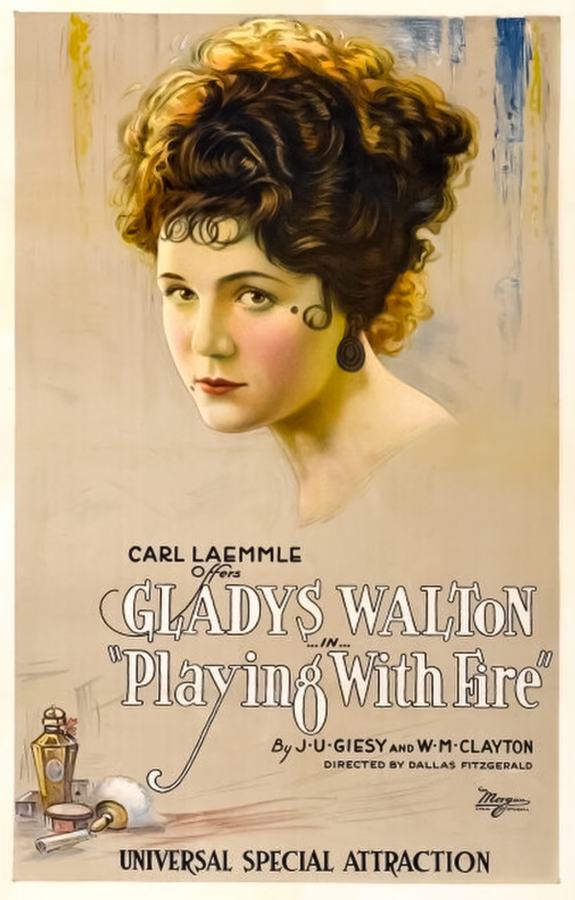
Broadway’s glow has rarely crackled onscreen with such phosphorescent desperation as in Playing with Fire, a 1921 melodrama that chooses combustion—literal and figurative—over polite smolder. Forgotten for a century, the film now re-emerges from nitrate purgatory, its tinting so fever-bright you can almost smell the shellac on the theater seats. Director Dallas M. Fitzgerald, a name unjustly sidelined in chronicles of the teens and twenties, orchestrates class collision like a man juggling nitroglycerin: every social cue wobbles on the brink of detonation.
“Ambition, once uncorked, scorches faster than kerosene on tulle.”
Enid Gregory—played by Gladys Walton with the kinetic snap of a metronome gone rogue—starts the narrative anchored to a department-store piano, her dreams no larger than the span of an octave. Walton’s micro-expressions sell the illusion: the half-second dilation of pupil when Janet’s Paris-label coat swishes past, the twitch of pinkie when a prospective beau mentions Long Island. Silent acting at its apex is the arithmetic of glances, and Walton solves for yearning.
Janet Fenwick, incarnated by Kathryn McGuire with porcelain stoicism cracking at the edges, arrives as both supplicant and catalyst. The boarding-house staircase becomes a ziggurat where privilege kneels before pragmatism. Fitzgerald lingers on a simple visual counterpoint: Janet’s gloved hand sliding along a greasy banister, leaving a snail-trail of frayed silk—status reduced to fiber optics of desperation.
The picture’s middle section plays like Edith Wharton rewritten by a jazz drummer. Enid’s metamorphosis under Janet’s tutelage is charted through costume: hems ascending, collars evaporating, cloche hats swallowing her curls like predatory lilies. Each outfit change cues a fresh musical motif in the new restoration score—a stride-piano motif that mutates into foxtrot frenzy, the sonic equivalent of a champagne bottle losing its cork.
Kent Lloyd (Hallam Cooley) surfaces as the proverbial bronze-haired bait: heir to a plumbing empire, his seduction technique involves sand-sculpted castles and coy references to porcelain fixtures—lavatory innuendo masquerading as courtship. Their beachfront meet-cute, lensed through diffused gauze, feels torn from a Pictorialist photograph, all sea-foam and ankle bracelets. Yet Fitzgerald slyly undercuts romance: in the background, sewage pipes await installation, a reminder that every paradise needs infrastructure.
The plot’s hinge—an affidavit capable of rehabilitating Janet’s disgraced father—functions like Gatsby’s green light, but here the light is red, the color of conflagration. Tilford’s apartment, crammed with Persian rugs and taxidermied hubris, hosts a showdown worthy of Dickens relocated to Jazz-Age Manhattan. Cinematographer Harry Stradling Sr., decades before his Oscar-garlanded prime, chiaroscuros the set into moral vertigo: faces half-lit by oil-lamps, shadows chewing wallpaper like vermin.
When fists fly and lantern glass shatters, the fire starts not with heroic bombast but with the sheepish pop of a lampshade—a banal genesis for apocalypse. Smoke coils across the nitrate in amber-tinted waves; the tinting was restored using analog bleach-dye methods, yielding flames that resemble molten marmalade. Enid rescuing her blackmailer upends melodramatic expectation: altruism weaponized as social leverage. The sequence runs a pulverizing nine minutes, yet time dilates via rhythmic cross-cuts between close-ups of her scorched slippers and long shots of firetrucks mired in traffic—urban futility in celluloid microcosm.
Walton’s physical vocabulary deserves PhD-level annotation. Watch her shoulders telegraph incremental ambition: level for contentment, forward for curiosity, back for manipulative calculation. Meanwhile McGuire’s Janet operates like a silent film within a silent film—her composure is itself a performance to placate creditors. In the boarding-house parlor scene she rehearses a smile in a hand-mirror, the glass fogged by breath that betrays terror.
Eddie Gribbon as comedic relief plumber (yes, there are two plumbing jokes in 1921) supplies vaudeville oxygen, but even he is weaponized for class commentary: his toolbox becomes a scepter of proletariat authenticity against Lloyd’s chrome-plated privilege.
The 4K restoration, completed by the Eclair Laboratory, harvests detail from a Desmet color-toned nitrate positive discovered in the Czech archive. Grain structure remains voluptuous; you can count the sequins on Enid’s post-transformation evening gown—each bead a pixel of nascent consumerism. The tints cycle through burnt umber, malachite, and rose madder, approximating the original Broadway show-house palette. A new score by Monica Henkle leans on period banjo for street scenes, theremin for psychological dissonance, and solo violin for the rescue—an aural triptych that turns the silent film into a talking picture minus dialogue.
Unlike contemporaries such as The Business of Life that treat marriage as corporate merger, Playing with Fire douses that ledger in gasoline. Enid’s final acceptance of Lloyd’s proposal is less romantic capitulation than hostile takeover: she demands a partnership contract, a desk adjacent to the drafting room, and profit-sharing tied to new municipal contracts. The film anticips the flapper-era mantra “earn, own, rule,” predating Striking Models by three years.
Janet’s arc, conversely, traces the limits of reputational capital. Even with the affidavit publicized, newspapers still brand her “the suicide heiress,” proving that social media pillory existed long before Twitter. Her final shot—boarding a trans-Atlantic steamer—leans over the rail, eyes closed, wind stripping the bonnet from her skull: a baptism in anonymity.
Fitzgerald’s infernal imagery predates the phantasmal conflagrations of Die Gespensterstunde yet lacks Germanic nihilism; instead it channels American optimism—every spark promises reinvention. Where Looking for Trouble frames chaos as comedic romp, here it is crucible. Compared with The Whispering Chorus, another morality tale soaked in guilt, Playing with Fire ends not with cosmic punishment but with negotiated restitution—a uniquely New-World spin on sin.
Modern viewers, fattened on three-act safety, may scoff at the tidy epilogue. Yet the film’s candor lies in acknowledging that reinvention is itself a compromise: Enid’s engagement ring doubles as shackles of shareholder expectation. The last tableau—her fingers hovering above keyboard, chord unresolved—leaves an afterburn of ambiguity. Fitzgerald seems to whisper: ambition, once uncorked, scorches faster than kerosene on tulle, but some phoenixes prefer to nest in the embers.
Verdict: essential viewing for anyone tracing the DNA of American self-made mythology, for cinephiles who crave tactile nitrate perfume, and for feminists charting the pre-code heroines who refused to choose between heart and portfolio. Stream it, archive it, lecture on it—just don’t play with this fire unless you’re ready to be singed.
IMDb 5.2
1932
Community
Log in to comment.