DbcultAccessing Vault...
Cult Review
Senior Film Conservator
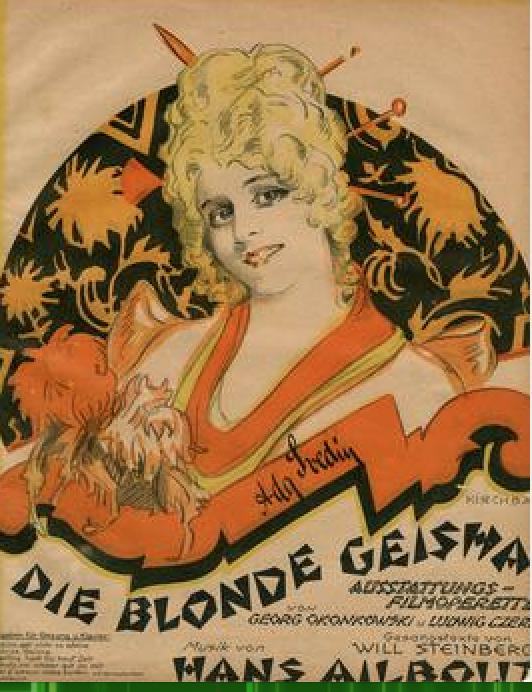
Die blonde Geisha, released in 1923, is a silent film that transcends its era’s orientalist tropes through a hauntingly elegant exploration of identity, otherness, and the paradoxes of cultural exchange. With its stark black-and-white imagery and meticulous attention to the rituals of geisha life, the film constructs a narrative that is as much about the deconstruction of Western exoticism as it is about the protagonist’s personal metamorphosis.
At its core, the film follows a blonde Western woman who infiltrates a Kyoto geisha house. Her arrival is not marked by triumph but by a kind of existential unease—the audience, like her, is thrust into a world where every gesture carries centuries of tradition. The geishas, portrayed with aching precision by Mizzi Schütz and Friedel de Fries, are not mere archetypes; their movements are choreographed to embody both grace and resistance. The film’s visual grammar—long, unbroken takes of the geishas in motion—serves as a counterpoint to the protagonist’s static, almost comically out-of-place presence in these spaces.
What elevates Die blonde Geisha beyond its contemporaries is its refusal to romanticize the East. The geisha house is not a utopian sanctuary but a microcosm of power dynamics. The protagonist’s attempts to assimilate are rendered futile by the very structures she seeks to understand. This is a narrative of failure, where the Western gaze is revealed as inherently destructive. The film’s climax—a silent confrontation between the heroine and a rival geisha—plays out in a sequence of stark close-ups, the camera lingering on the geisha’s unflinching gaze. Here, the film mirrors the work of The Phantom Riders in its use of visual tension to convey internal conflict, though Die blonde Geisha’s stakes are far more introspective.
The cast, led by Charles Willy Kayser and Pawel Markow, navigates the script’s ambiguities with a restraint that is central to the film’s power. Kayser’s performance as the enigmatic patron of the geisha house is particularly noteworthy; his stillness communicates volumes, a technique that would later be echoed in the work of Hold Your Breath (2001), though Die blonde Geisha’s atmosphere is far more stylized. The supporting players, including Friedrich Berger and Karl Harbacher, contribute to a sense of collective unease, their expressions carefully modulated to suggest a society on the brink of unraveling.
Thematically, the film interrogates the myth of the East as a passive muse for Western creativity. This is most evident in the recurring motif of mirrors, which serve as both literal and metaphorical devices. The geishas are often seen preening before these reflective surfaces, their movements a performance of selfhood. In contrast, the protagonist stares into mirrors with a kind of desperate self-interrogation, her reflections fragmented by the camera’s framing. This duality is reminiscent of The Goddess (1935), though Die blonde Geisha’s aesthetic is far more constrained by the silent film format.
The film’s cinematography, a collaboration between Ludwig Czerny and Georg Okonkowski, is its most enduring legacy. The use of shadows and light to delineate cultural boundaries is masterful. One particularly striking scene features the geishas performing a traditional dance in a moonlit garden, their silhouettes rendered in stark contrast against the pale sand. This visual language evokes the stark minimalism of Nude Woman by Waterfall (2023), though Die blonde Geisha’s palette is far more restrained. The camera’s movement is deliberate, almost ritualistic, as if the act of filming itself is an intrusion into a sacred space.
Die blonde Geisha is also a meditation on the fragility of identity. The protagonist’s transformation from outsider to figure of ridicule is rendered through subtle shifts in costume and lighting. Her initial Western garments are gradually replaced by more ornate kimono, yet these garments do not signify integration—they become a prison. The film’s final act, in which she is ostracized by the geisha house, is a masterclass in visual storytelling. Her isolation is conveyed through wide shots that emphasize spatial distance, a technique later refined in Marriage a la Mode (1925). Yet Die blonde Geisha’s emotional depth is unmatched, its silence speaking louder than any dialogue could.
One cannot ignore the historical context in which the film was created. The 1920s were a time of fervent cultural exchange between East and West, yet this exchange was often marked by exploitation. Die blonde Geisha, while not overtly polemical, captures the undercurrents of this tension. The geishas are not portrayed as archaic relics but as individuals navigating a rapidly changing world. Their interactions with the protagonist are tinged with a quiet resistance, a defiance that is both admirable and tragic. This nuanced portrayal is a stark contrast to the more reductive narratives of films like The Family Honor (1920), where Eastern characters often serve as plot devices rather than fully realized people.
The film’s score, though lost to time, would have played a crucial role in shaping its emotional resonance. The use of traditional Japanese instruments in silent films was a contentious issue, with some critics arguing that it reinforced orientalist stereotypes. However, in Die blonde Geisha, the music is implied rather than explicit, its absence allowing the visual elements to take center stage. This restraint is a testament to the film’s confidence in its own aesthetic, a quality that Prunella (1915) could only aspire to.
In conclusion, Die blonde Geisha is a film that defies easy categorization. It is neither a straightforward critique of Western imperialism nor a celebration of Japanese culture. Instead, it offers a complex, often uncomfortable examination of the intersections between gender, race, and power. Its legacy lies in its ability to provoke reflection rather than provide answers. For modern audiences, it serves as both a window into the cultural anxieties of the 1920s and a timeless reminder of the perils of exoticism. The film’s enduring relevance is perhaps best understood when compared to Get-Rich-Quick Peggy (1925), where the commodification of identity is similarly interrogated, albeit in a more comedic context.
IMDb 5.8
1935
Community
Log in to comment.