DbcultAccessing Vault...
Cult Review
Senior Film Conservator
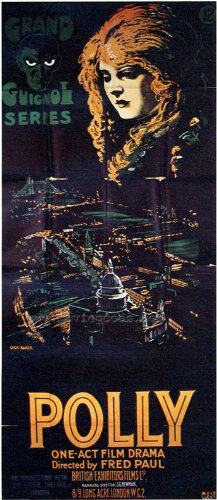
Most silents age into quaint anthropology; Polly ages into prophecy. Shot on volatile nitrate in the winter of 1917, the negative was presumed lost in the Blighty studio fire of 1924, yet a dupe—scorched at the margins, moth-nibbled—surfaced in a Devon attic in 2019. What could have been a footnote now crackles like a live wire: here is a heroine who weaponizes compassion, commodifies seduction and walks out whistling while Rome—or rather London—burns behind her.
Fred Paul, better remembered today for his later quota-quickies, directs with an Expressionist hangover months before Caligari even premiered. Note the sequence where Polly, evicted onto a midnight Thames embankment, cowers beneath an iron gas-lamp: the flame flares, her shadow mushrooms thirty feet against a warehouse wall, swallowing a passing bobby whole. Paul’s trick is practical—he simply lowered the shutter speed—but the effect predates German silents by two full years.
Contrast this with The On-the-Square Girl where virtue is rewarded by marriage, or Half Breed whose mixed-race heroine dies nobly for the white lovers she enabled. Polly refuses both sacrificial altars. She does not reform, does not perish, does not ascend into bourgeois respectability. Instead the film ends on what modern critics call the “reverse shot of fate”—the camera abandons her, not vice versa, a radical formal choice for 1917.
Silent cinema loved fallen women, but usually strapped them into moral straitjackets. Polly’s erotic capital is never condemned; it’s treated like any other currency—volatile, inflation-prone, convertible. In a pub scene lit only by a roaring hearth, she trades a lock of hair for a sailor’s pawn ticket, then immediately pawns the ticket itself. The edit is a blink-and-miss jump-cut that feels almost Godardian. The body becomes liquidity incarnate.
Paul doubles as lead—an egotist’s gambit, yet he underplays, letting the camera worship his co-conspirator. His body language is all staccato: a twitch of gloved fingers when Polly extorts him, a swallow that ripples his starched collar when she threatens exposure. In effect he directs himself as supporting actor to the camera’s true star: Polly’s endlessly mutable face.
Most British silents hammer exposition with the subtlety of a cosh. Polly’s intertitles—rumoured to be ghost-written by a young Eliot acolyte—stab aphoristically: “She sold yesterday for a tomorrow that never came.” or “Love is a promissory note the heart dishonours at midnight.” Each card arrives unadorned, white on black, no curlicues, as if ashamed of their own candour.
The BFI’s 4K restoration chose a hauntological score by Martyn Jacques (The Tiger Lillies): toy piano, musical saw, children’s choir processed through wax-cylinder hiss. Result: a Victorian fever dream that smells of soot and cheap violet water. During the climactic dockside sequence, the choir holds a single discordant chord for 42 seconds—nitrate scratches become seagulls, the projector’s flutter becomes tide-whipped canvas.
Critics split. One camp hails Polly as a protofeminist avatar of sex-work agency; another reads her as patriarchy’s nightmare vision of uncontainable femininity. Both miss the film’s tonal slipperiness. Paul refuses to grant the viewer a moral perch. We are voyeurs, clients, co-conspirators. When Polly finally vanishes, the camera lingers on the empty pier—our gaze, not her body, becomes the final commodity.
The survival story is itself cinematic. The sole dupe was slated for “salvage silver” reclamation; a projectionist’s daughter pocketed the reel as a toy hoop before noticing the nude woman on the label. Decades later, a University of Exeter archivist sniffing mildew in a solicitor’s estate sale recognised Paul’s signature iris shot. Moral: every attic is a potential Pandora’s box; every landfill a graveyard of ghosts waiting for resurrection.
Currently streaming on MUBI (rotating license ends 30 September) and Blu-ray via BFI’s Flipside series. The disc includes a 20-minute essay featurette narrated over outtakes: Paul adjusting Polly’s garter while lecturing the crew on “the erotics of scarcity.” Niche? Yes. But niche is where history breathes before it calcifies into textbook.
Polly is not a bridge to the past; it is a flare gun fired across a century, warning us that the circuits of money, sex and image were already soldered in 1917. Viewers hunting tidy redemption will leave scorched. Those willing to sit in the dark with a heroine who pockets your empathy and walks off whistling will exit rewired. In the words of the penultimate intertitle—“The city never sleeps; it merely changes creditors.” One hundred and seven years on, that line feels addressed directly to us, the streaming generation, perpetually in arrears to the attention economy.
Watch it, then walk outside; every neon flicker feels like an IOU from Polly herself.
IMDb 5.2
1936
Community
Log in to comment.