DbcultAccessing Vault...
Cult Review
Senior Film Conservator
Elisabet: A Silent Film That Speaks Volumes
A 1920s Swedish Drama of Despair
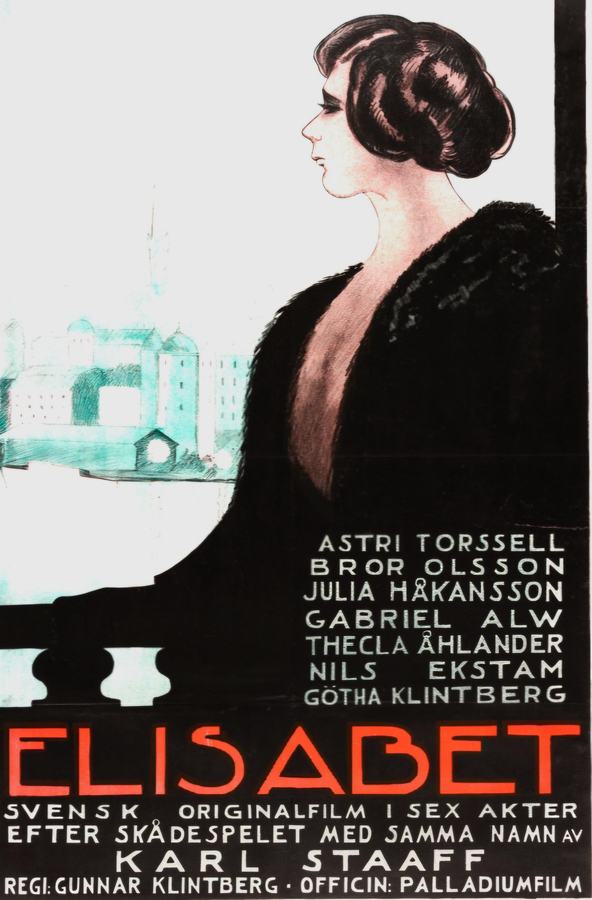
Elisabet (1922) is a film that lingers like the echo of a sob in an empty room. Director Gunnar Klintberg, working with co-screenwriter Jarl Östman, crafts a harrowing portrait of early 20th-century Sweden's rigid social mores through the lens of a woman's private tragedy. The film's power lies in its refusal to sanitize its protagonist's suffering, instead using the stark language of silent cinema to expose the corrosive effects of societal judgment on the human psyche.
Thecla Åhander's performance as Elisabeth is a masterclass in nonverbal storytelling. Her face becomes a canvas of conflicting emotions: the lingering hope of youth battling the encroaching shadows of despair. In one haunting scene, she cradles her infant while her eyes drift toward the window, where the world outside remains blissfully unaware of her secret. These moments—simple yet devastating—elevate the film beyond mere melodrama into the realm of profound human observation.
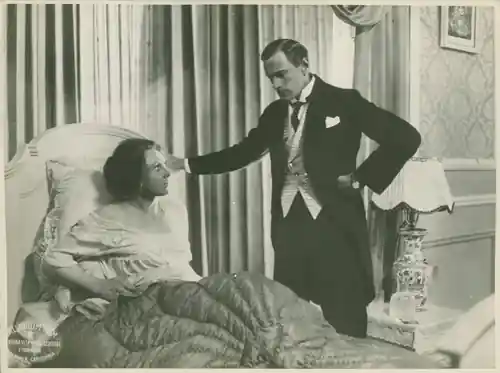
The film's most striking visual motif is the recurring image of medical instruments—sterile, precise, and ultimately inadequate. Dr. Bärn, played with measured intensity by Nils Ekstam, embodies the era's misplaced faith in scientific solutions. His earnest attempts to treat Elisabeth's depression are rendered futile by the film's central realization: some wounds are not of the body, but of the soul.
For contemporary audiences, Elisabet serves as a powerful reminder of how social stigma manifests in physical deterioration. The film's depiction of Elisabeth's failing health—pallid complexion, labored breathing, and erratic movements—parallels the deterioration of her mental state. This physicalization of psychological distress anticipates the symbolic imagery of later films like The Bottom of the Well (1959), though Elisabet's approach is more clinical in its observation.
The film's most innovative technique is its use of intertitle cards, which are not mere narrative devices but emotional barometers. The bold, serif fonts shift from warm gold to cold gray as Elisabeth's mental state deteriorates, an early example of visual symbolism that would become more common in German Expressionist films like Über den Wolken (1920).
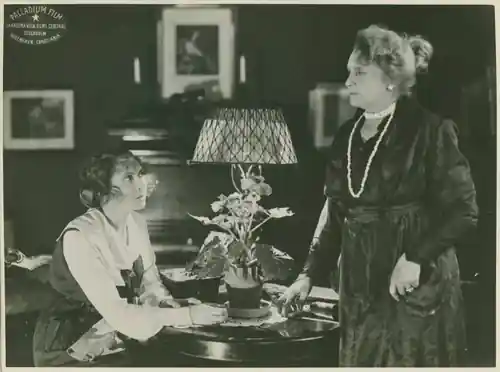
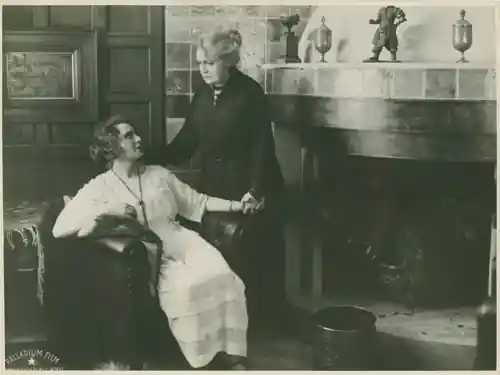
The supporting cast, particularly Eva Alw as the mother and Bror Olsson as the conflicted father figure, provide strong counterpoints to Elisabeth's central journey. Their interactions are marked by subtle glances and restrained gestures that speak volumes about the era's social constraints. The claustrophobic settings—dimly lit parlors, narrow staircases—mirror the emotional confinement of the characters.
Technically, the film is a marvel of early cinema. The use of chiaroscuro lighting in key scenes—such as the sequence where Elisabeth confronts her mother in a candlelit room—anticipates the shadow play of film noir. The camera work, though limited by the era's technology, is purposeful and evocative, often lingering on objects that symbolize Elisabeth's emotional state: a wilted flower, a cracked mirror, a half-empty glass.
The film's pacing is deliberate, allowing the tension to build like a slow tide. This measured approach, while occasionally testing modern viewers' patience, creates a sense of inevitability that mirrors Elisabeth's own path toward despair. The sound of footsteps echoing in the background, the distant church bells—these auditory details (reconstructed from period music) add layers of meaning to the silent visuals.
Comparisons can be drawn to The Scarlet Letter (1926), though Elisabet lacks the latter's narrative resolution. Instead, it embraces an open-ended ambiguity that feels more authentic to the era's cinematic treatment of social issues. The film avoids didacticism, letting the characters' actions and the physical environment convey its message.
What makes Elisabet particularly resonant today is its unflinching look at maternal mental health. The film's depiction of postpartum depression, though filtered through early 20th-century medical understanding, remains strikingly modern in its emotional truth. The sequence where Elisabeth's mother (Eva Alw) weeps over her daughter's condition is one of cinema's earliest portrayals of the guilt and helplessness that often accompany maternal depression.
The film's final act is particularly memorable, as the narrative shifts from social critique to existential meditation. In a sequence echoing the later works of Ingmar Bergman, the camera circles Elisabeth as she sits in a dimly lit room, her face half in shadow. This visual metaphor—light and darkness in constant struggle—captures the film's central theme: the impossible balance between societal expectations and individual suffering.
While Elisabet doesn't have the technical polish of later Swedish cinema, its raw emotional power and innovative narrative techniques mark it as a significant milestone. The film's exploration of mental health, though limited by its era's understanding, remains profoundly human. In an age where mental health discourse is more open but still fraught with stigma, Elisabet serves as both a historical artifact and a timeless cautionary tale.
The film's enduring legacy lies in its ability to make the personal political. By focusing on one woman's story, Klintberg and Östman expose the systemic oppression that underpins societal judgment. This theme continues to resonate in modern films like Milestones of Life (1945), though Elisabet's approach is more restrained in its critique.
For cinephiles interested in the evolution of cinematic language, Elisabet offers fascinating study material. The film's use of negative space—rooms where characters are dwarfed by their surroundings—prefigures the existential concerns that would dominate 1940s and 1950s cinema. The visual composition often mirrors the psychological states of the characters, a technique that would later be refined by filmmakers like Ingmar Bergman and Andrei Tarkovsky.
One cannot discuss Elisabet without acknowledging its influence on Swedish cinema's treatment of women's issues. The film's unflinching portrayal of female suffering echoes through subsequent works like Little Fox (1983), though Elisabet's approach is more clinical in its observation. This focus on female psychology would become a hallmark of Swedish cinema in the mid-20th century.
The film's historical context adds another layer of interest. Produced during a time of significant social change in Sweden, Elisabet reflects the tensions between traditional values and modernizing forces. The character of Dr. Bärn, with his faith in medical solutions, represents the hubris of early 20th-century scientific optimism—a theme that would be explored more cynically in later films like Why Cooks Go Cuckoo (1929).
In conclusion, Elisabet remains a powerful testament to the possibilities of silent cinema. Its exploration of mental health, maternal relationships, and social stigma is as relevant today as it was nearly a century ago. While some may find the pacing slow by modern standards, this measured approach allows the emotional weight of the narrative to fully register. For those willing to engage with its unflinching portrayal of human suffering, Elisabet offers a profoundly moving cinematic experience that continues to resonate across generations.

IMDb 5.1
1934
Community
Log in to comment.