DbcultAccessing Vault...
5.4/10
Senior Film Conservator
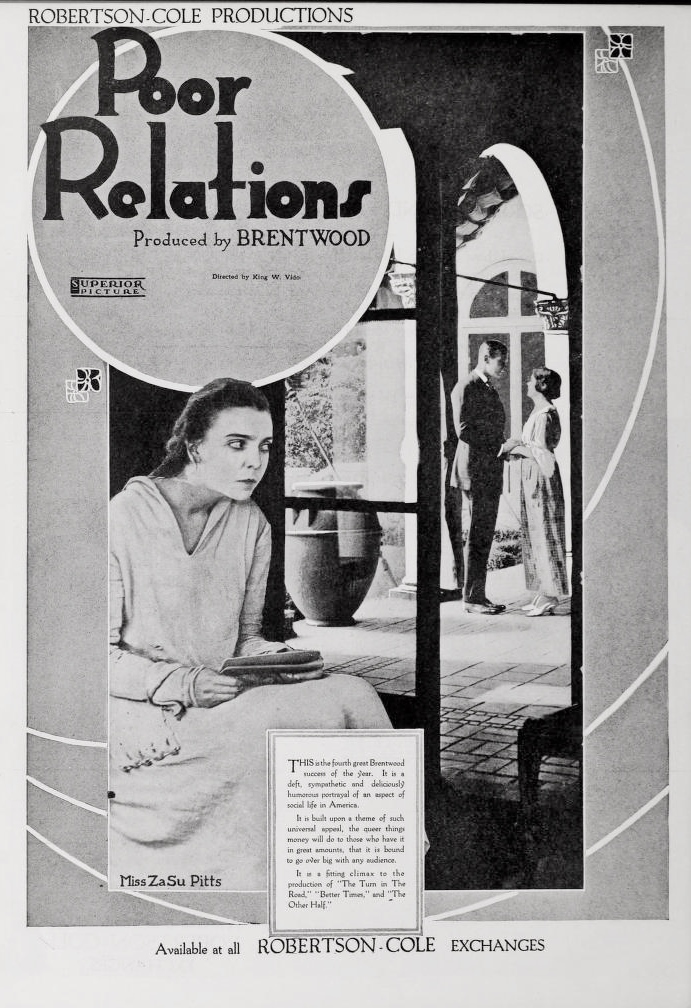
A definitive 5.4/10 rating for a film that redefined the boundaries of cult cinema. Poor Relations remains a cornerstone of transgressive art.
In the annals of early American cinema, few filmmakers possessed the keen sociological eye and narrative dexterity of King Vidor. His 1919 silent drama, Poor Relations, stands as a testament to his burgeoning talent, a poignant and surprisingly prescient exploration of class distinctions, personal ambition, and the search for genuine happiness amidst the rigid strictures of societal expectation. Released at a time of immense social flux, when the industrial age was rapidly reshaping the American landscape and blurring traditional lines of privilege, Vidor’s film acts as both a mirror and a critique, reflecting the anxieties and aspirations of an evolving nation. It’s a narrative that, despite its century-old vintage, retains a striking immediacy, compelling us to consider the enduring human cost of snobbery and the profound value of unvarnished affection.
The film introduces us to Dorothy Perkins, portrayed with an exquisite blend of innocence and burgeoning strength by Florence Vidor. Dorothy is the eldest daughter of a humble, yet undeniably wholesome, country family. Their lives are characterized by simplicity, hard work, and an abundance of mutual support – a stark contrast to the sophisticated, often superficial, world she is destined to encounter. Driven by an innate ambition and a remarkable talent, Dorothy makes the courageous decision to leave the bucolic comforts of her rural home for the bustling, often unforgiving, metropolis. Her goal is audacious for a woman of her era: to study architecture, a field traditionally dominated by men. This initial leap of faith immediately establishes Dorothy as a protagonist of considerable fortitude, a woman not content to be circumscribed by her origins or gender expectations. Her journey into the city is not merely a physical relocation but a symbolic passage into a new phase of self-discovery and professional actualization.
Dorothy's urban sojourn is not without its trials, but her talent is undeniable. She achieves a significant breakthrough, winning a prestigious architectural competition, a moment that solidifies her professional success and elevates her social standing, at least within the meritocratic circles of her chosen profession. This success, however, also propels her into a different social stratum, one where lineage often trumps achievement. It is in this new milieu that she encounters Monty Rhodes, played by Charles Meredith, the scion of an aristocratic family. Their connection is immediate and powerful, transcending the unspoken boundaries of their disparate backgrounds. Monty, perhaps weary of the stifling conventions of his own class, is drawn to Dorothy’s authenticity, her intelligence, and her refreshing lack of artifice. Their romance blossoms, a testament to the idea that love can indeed bridge divides, at least initially. Vidor masterfully portrays the nascent stages of their affection, allowing the audience to invest in their burgeoning relationship before the inevitable storm clouds gather on the horizon.
The marriage between Monty and Dorothy, despite their genuine affection, is met with vehement opposition from Monty's parents, particularly his mother, Mrs. Rhodes. Here, Lillian Leighton delivers a chilling performance as the quintessential society matriarch, embodying the entrenched prejudices of the upper class. For Mrs. Rhodes, Dorothy’s lack of "breeding" is an unforgivable transgression, a stain on the family's immaculate lineage. Her objections are not rooted in any personal failing of Dorothy's, but solely in her humble origins. This conflict forms the emotional core of the film, transforming a romantic drama into a searing critique of social snobbery. Mrs. Rhodes embarks on a relentless campaign of psychological warfare, systematically humiliating Dorothy at every turn. Her tactics are subtle yet devastating, designed to chip away at Dorothy's self-esteem and drive a wedge between her and Monty. The film brilliantly illustrates how class prejudice, far from being a benign social construct, can be a profoundly destructive force, capable of inflicting deep emotional wounds.
The relentless barrage of slights and condescension takes its toll on Dorothy. Despite her earlier resilience and professional triumphs, the constant erosion of her dignity proves to be an unbearable burden. Florence Vidor's portrayal of Dorothy's heartbreak is deeply affecting, conveying a profound sense of isolation and despair without uttering a single word. Her eyes, often downcast, speak volumes of the emotional torment she endures. The city, once a symbol of opportunity and success, becomes a gilded cage, its opulence failing to compensate for the emotional poverty she experiences within Monty's family home. This struggle for identity amidst overwhelming social pressure resonates with themes explored in other films of the era, such as The Woman Thou Gavest Me, where female protagonists often grappled with societal expectations and personal fulfillment. Dorothy's eventual decision to retreat from this toxic environment is not a defeat, but an act of self-preservation, a desperate yearning to return to a place where her inherent worth is recognized and cherished.
When Mrs. Rhodes finally succeeds in driving the heartbroken Dorothy back to her own family in the countryside, a profound shift occurs. Monty, initially torn between his wife and his mother's expectations, is forced to confront the true cost of his family's snobbery. His realization is gradual but impactful, a dawning awareness that the superficial trappings of aristocratic life are hollow without genuine human connection. Charles Meredith's performance here is crucial, depicting Monty's internal struggle and ultimate epiphany with quiet conviction. He recognizes his mistake, not merely in allowing his mother's cruelty to fester, but in failing to fully appreciate Dorothy's intrinsic value. This moment of clarity propels him to follow her, abandoning the stifling world of inherited wealth for the promise of authentic happiness. His journey to the countryside is, in essence, a quest for redemption and a re-evaluation of what truly constitutes a rich life.
Upon arriving in the country, Monty finds not only his wife but also a profound sense of belonging with her "poor relations." The film's title, initially a descriptor of Dorothy's humble origins, is recontextualized. These relations, though lacking material wealth, are rich in spirit, warmth, and genuine affection. Their lives, though simple, are imbued with a profound sense of purpose and community, a stark contrast to the emotional sterility of the Rhodes' aristocratic world. William De Vaull and Zasu Pitts, in their supporting roles, contribute significantly to the portrayal of this loving, salt-of-the-earth family, their performances adding layers of warmth and authenticity that highlight the film's central thematic contrast. Here, Monty discovers true happiness, not in the grand estates or social standing of his birthright, but in the unpretentious love and acceptance of Dorothy and her family. This resolution is not merely a happy ending but a profound statement on the ultimate triumph of intrinsic worth over superficial status, a sentiment that echoes through films like Each to His Kind, which often explored the challenges of social integration and the search for genuine connection.
King Vidor’s direction in Poor Relations is remarkably sophisticated for its time. He employs visual storytelling with masterful precision, using contrasting mise-en-scène to underscore the thematic divide between urban aristocracy and rural simplicity. The opulent, yet emotionally cold, interiors of the Rhodes' mansion stand in stark relief to the warm, inviting, albeit modest, farmhouse of the Perkins family. Vidor’s use of close-ups allows the audience to intimately connect with the characters' emotional states, particularly Dorothy's silent suffering and Monty's gradual awakening. The pacing is deliberate, allowing the emotional beats of the narrative to unfold naturally, building tension through Mrs. Rhodes's insidious manipulations and culminating in Monty’s decisive action. Even without spoken dialogue, the emotional arc is crystal clear, a testament to Vidor's skill and the power of silent cinema when executed with such artistry.
The ensemble cast, under Vidor's guidance, delivers performances that elevate the material beyond simple melodrama. Florence Vidor, as Dorothy, is the undeniable heart of the film. Her ability to convey resilience, vulnerability, and ultimately, a quiet strength, makes Dorothy a profoundly empathetic figure. Her journey is the audience's journey, and her silent suffering feels deeply personal. Lillian Leighton's Mrs. Rhodes is a formidable antagonist, her cold demeanor and cutting glances effectively communicating the cruelty of class prejudice. She is not a caricature but a chilling representation of a societal ill. Charles Meredith's Monty undergoes a significant transformation, evolving from a somewhat passive figure to a man of conviction, a testament to the power of love to instigate personal growth. The supporting cast, including Roscoe Karns, William De Vaull, and Zasu Pitts, flesh out the rural community with genuine warmth and charm, providing a vital counterpoint to the sterile world of the aristocracy. Their performances, though perhaps less central, are crucial in establishing the authentic, life-affirming atmosphere of the countryside.
Thematically, Poor Relations can be viewed as a proto-feminist text, celebrating Dorothy’s ambition and agency in a period when women’s roles were largely circumscribed. Her pursuit of architecture, her initial success, and her ultimate decision to prioritize her emotional well-being over societal status speak to a burgeoning sense of female independence. This echoes the spirit of other films of the era that featured strong female leads navigating challenging circumstances, such as The Iron Woman, where protagonists often defied conventional expectations. Moreover, the film’s critique of the superficiality of high society and its embrace of genuine human connection over material wealth remains powerfully relevant. It’s a timeless narrative about the search for belonging and the courage to forge one’s own path, even when it means challenging deeply ingrained social norms. The contrast between the 'painted lips' of society and the 'naked soul' of authentic emotion, a theme perhaps explored in films like Painted Lips or A Naked Soul, finds a compelling articulation here through Vidor's lens.
In conclusion, Poor Relations is far more than a historical curiosity; it is a vibrant, emotionally resonant film that speaks to universal truths about class, love, and the pursuit of happiness. King Vidor's early work demonstrates a profound understanding of human nature and a remarkable ability to craft compelling narratives that resonate beyond their immediate social context. The film’s message – that true wealth lies not in inherited privilege or material possessions, but in the warmth of genuine human connection and the acceptance of one's authentic self – remains as potent today as it was a century ago. It’s a powerful reminder that while societal structures may attempt to dictate our worth, it is our intrinsic character and the love we share that ultimately define us. For enthusiasts of silent cinema, social dramas, or simply compelling storytelling, Poor Relations offers a rich and rewarding viewing experience, a true gem from the early days of Hollywood that continues to shine brightly, illuminating the enduring struggles and triumphs of the human spirit.
IMDb —
1928
Community
Log in to comment.