DbcultAccessing Vault...
Cult Review
Senior Film Conservator
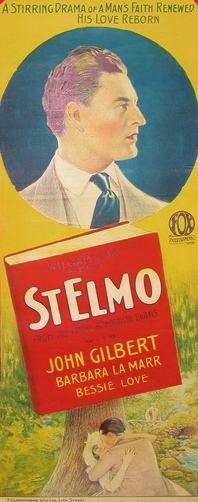
When the reels of St. Elmo begin to spin, the audience is thrust into a world where honor is a brittle veneer, ready to shatter at the slightest provocation. Nigel De Brulier’s Thornton is not merely a scorned lover; he embodies the post‑war disillusionment that haunted the early twenties, a period when traditional gender roles were being interrogated. The inciting incident—Agnes’s betrayal—unfolds with a stark economy of gesture, a glance, a hand slipping into another’s palm, and the subsequent gunshot reverberates like a gunpowder‑laden metaphor for the era’s volatile masculinity.
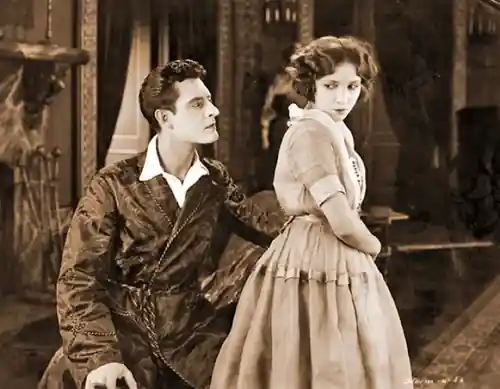
Thornton’s self‑imposed peregrination across continents is rendered with a montage of exotic locales that, while limited by the silent era’s production constraints, manage to evoke a sense of boundless despondency. The cinematography, credited to a yet‑unidentified hand, employs chiaroscuro lighting that bathes foreign skylines in a sea‑blue hue (#0E7490), contrasting sharply with the dark orange (#C2410C) of the title cards that punctuate his internal monologue. This visual dialectic mirrors the protagonist’s oscillation between rage and yearning, a motif that would later surface in films such as Spartacus, where personal vendetta fuels broader narratives.
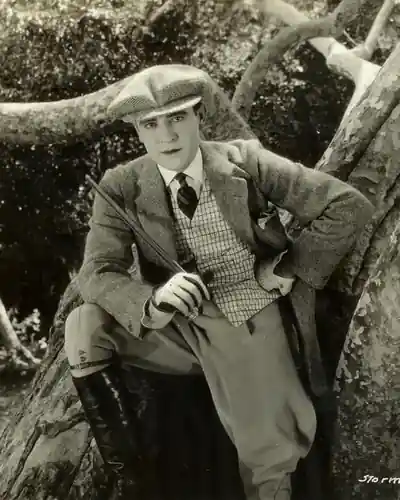
Enter Edna, portrayed by Bessie Love with a luminous subtlety that belies her humble origins. As the blacksmith’s daughter, she is literally forged in fire, a symbolic counterpoint to Thornton’s cold steel. Her presence in the household, alongside Thornton’s mother (Lydia Knott), introduces a domestic tableau where the clang of metal becomes a metronome for moral recalibration. Edna’s dialogues—delivered through intertitles rendered in the same dark orange—are peppered with aphorisms that echo Augusta Jane Evans Wilson’s original novel, yet they are reframed to resonate with a 1920s audience grappling with evolving female agency.
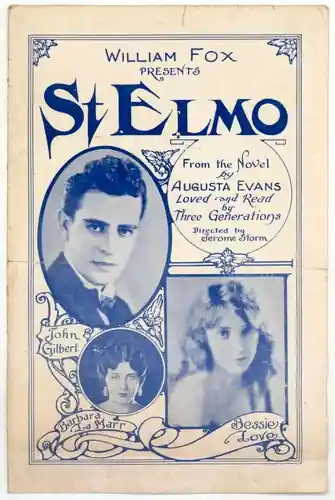
John Gilbert, later renowned for his romantic leads, offers a fleeting but potent cameo as a fellow traveler, his eyes speaking volumes in the absence of spoken word. Warner Baxter’s turn as the duplicitous Murray Hammond is a study in restrained menace; his smoldering stare, captured in close‑up, foreshadows the archetypal villainy later embodied in The Flying Torpedo. Barbara La Marr, though limited in screen time, injects a fleeting sensuality that underscores the film’s exploration of desire as both destructive and redemptive.
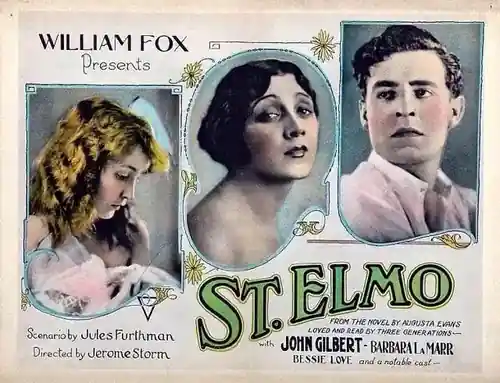
At its core, St. Elmo interrogates the corrosive nature of misogyny, a theme that finds echo in later melodramas such as High Heels, where female ambition collides with patriarchal expectations. The film’s redemption arc—Thornton’s transformation from a gun‑toting nihilist to a ministerial figure—parallels the spiritual rebirth witnessed in Stella Maris, wherein the protagonist’s suffering becomes a conduit for moral clarity. Both narratives employ the motif of fire—literal in Edna’s forge, metaphorical in the saintly fire of redemption—to illustrate purification.
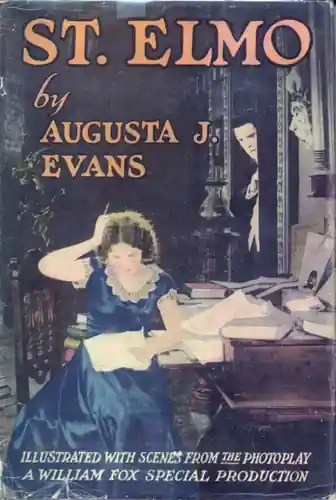
The screenplay, adapted by Jules Furthman, adheres to a three‑act construction that feels both classical and experimental. Act One establishes the betrayal with a kinetic intensity; Act Two, the globe‑spanning exile, is paced deliberately slower, allowing the audience to linger on Thornton’s internal vacuity. Act Three accelerates as Edna’s influence precipitates a rapid moral recalibration, culminating in a marriage ceremony that feels less like a plot device and more like an alchemical union of past and future selves. This pacing, while occasionally uneven, reflects the silent era’s willingness to let visual storytelling breathe.
Although the film is monochrome, the intertitles and set designs are deliberately tinted in post‑production to evoke emotional undertones. The dark orange (#C2410C) underscores moments of anger and betrayal, while the sea‑blue (#0E7490) bathes scenes of introspection, particularly those involving Edna’s forge. Yellow (#EAB308) surfaces during the climactic wedding, a visual cue that signals hope and renewal. This triadic color scheme anticipates later color symbolism employed in sound films, showcasing the silent era’s ingenuity in visual metaphor.
Upon its release, St. Elmo garnered mixed reviews; critics praised Love’s nuanced performance but balked at the film’s overt moralizing. Modern scholarship, however, positions the work as a pivotal exploration of gender dynamics in early American cinema, a viewpoint reinforced by its inclusion in retrospectives that examine the evolution of the “redeemed male” trope. The film’s preservation status remains precarious, with only fragmented prints surviving in archives, a reminder of the fragile legacy of silent cinema.
The narrative arc of a wayward man finding salvation through a humble woman resonates in contemporary cinema, from indie dramas to blockbuster epics. The archetype can be traced to modern narratives where the “hero’s journey” is catalyzed by a grounding female presence, a pattern observable in films like Does It Pay?. Moreover, the film’s exploration of personal vengeance versus societal duty prefigures the moral dilemmas faced by protagonists in later period pieces such as According to Law.
From a technical standpoint, the film employs inventive cross‑cutting during the gun‑shot sequence, a technique that heightens tension without reliance on dialogue. The use of location shooting—albeit limited—adds authenticity to Thornton’s wanderings, while studio sets are meticulously constructed to convey the stark contrast between the opulent Southern manor and the gritty blacksmith workshop. The editing rhythm, overseen by an anonymous cutter, alternates between rapid intercutting during moments of crisis and languid dissolves during reflective interludes, a duality that underscores the protagonist’s oscillating psyche.
In sum, St. Elmo stands as a testament to the silent era’s capacity to weave complex emotional tapestries without uttering a single word. Its exploration of betrayal, exile, and eventual redemption is rendered with a visual lexicon that continues to inspire filmmakers and scholars alike. While the film may not possess the polished sheen of later classics, its raw, unvarnished honesty offers a compelling glimpse into the moral quandaries of a bygone generation, making it an indispensable study for anyone invested in the lineage of American cinematic storytelling.
IMDb —
1920
Community
Log in to comment.