DbcultAccessing Vault...
Cult Review
Senior Film Conservator
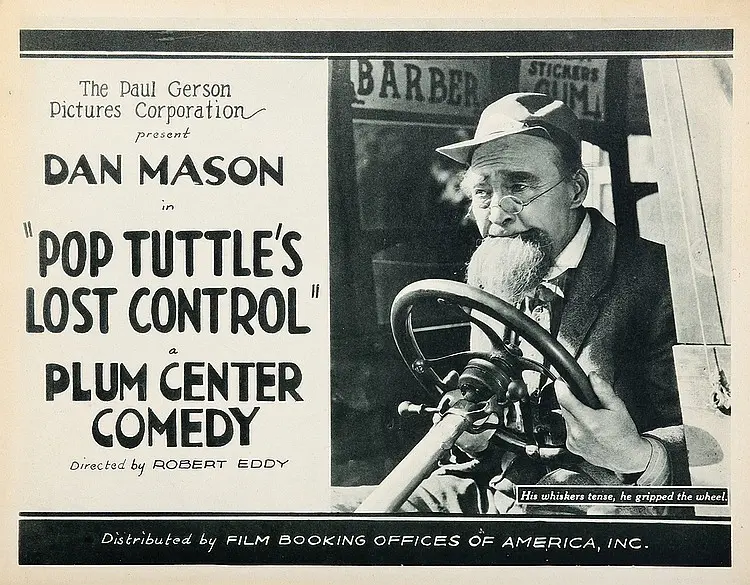
Stepping into the world of Pop Tuttle's Lost Control is akin to unearthing a delightful time capsule, a vibrant snapshot from an era when the horseless carriage was still a marvel, and the very concept of public transport in a sleepy village was nothing short of revolutionary. This silent-era comedy, penned by the inventive Al Giebler, offers a surprisingly nuanced, albeit uproarious, contemplation on progress, community, and the often-hilarious friction that arises when modern innovation collides with established rural rhythms. It's a testament to the enduring power of simple storytelling and physical comedy, proving that laughter transcends the spoken word.
At the heart of this cinematic confection is Pop Tuttle, portrayed with an endearing blend of earnestness and wide-eyed bewilderment by the inimitable Dan Mason. Mason, a fixture in early American cinema, imbues Pop with a palpable sense of well-meaning ambition. Pop isn't a malicious character; he's simply a man with a vision, albeit one perhaps slightly ahead of his village's readiness. His journey to the bustling city, a stark contrast to his tranquil home, is itself a microcosm of the film's central theme: the collision of two disparate worlds. The city represents the future, a crucible of invention and speed, while Pop's village embodies tradition, a slower pace, and a reliance on familiar, time-tested methods. Mason's physical comedy, his expressions oscillating between hopeful determination and utter exasperation, forms the bedrock of the film's humor. His every gesture, from the careful handling of his newly acquired flivver to the frantic attempts to control its unpredictable movements, speaks volumes without uttering a single syllable.
The true star, arguably, of Pop Tuttle's Lost Control is not a person but a machine: the humble flivver. This primitive automobile, a symbol of burgeoning modernity in the early 20th century, becomes the central comedic engine. Pop's intention is noble: to provide his community with a bus, a communal mode of transport that would bridge distances and perhaps even foster a greater sense of connection. However, the film brilliantly subverts this utopian vision, transforming the flivver into a source of delightful disarray. It bucks, it lurches, it refuses to cooperate, often taking on a personality of its own. This anthropomorphization of the machine is a classic comedic trope, and Al Giebler's script leverages it to full effect. The flivver isn't just a prop; it's an active participant in the chaos, a character whose unpredictable behavior drives much of the narrative's mirth.
The visual gags stemming from the flivver's antics are plentiful and expertly executed. We see villagers scattering, chickens squawking, and the general peaceful order of the village giving way to a new, exhilarating, and often frightening, dynamism. The humor isn't just in the machine's failures, but in the human reactions to it – the fear, the awe, the eventual, often reluctant, acceptance. It's a gentle satire on humanity's sometimes clumsy embrace of progress, a reminder that new technologies, no matter how promising, often come with a learning curve that can be both frustrating and incredibly funny.
Al Giebler, the creative force behind the screenplay, demonstrates a keen understanding of silent film mechanics. His narrative doesn't rely on intricate dialogue or complex subplots; instead, it prioritizes clear visual storytelling and escalating comedic situations. The premise is elegantly simple, yet its execution allows for a wealth of opportunities for physical humor and character-driven gags. Giebler crafts a world where the stakes are low but the comedic payoff is high, ensuring that the audience remains invested in Pop's plight and the village's evolving relationship with its new 'bus'. The pacing is brisk, a necessary attribute for silent comedies, ensuring that the audience's attention never wanes. Each scene builds upon the last, leading to a crescendo of comedic pandemonium that ultimately resolves with a satisfying, if slightly chaotic, conclusion. His writing is a foundational element, providing the framework upon which Mason's performance and the film's overall charm are built.
While Dan Mason's Pop Tuttle is undoubtedly the magnetic center, the film benefits greatly from its supporting cast, including Wilna Wilde. Though their roles might be less prominent, the reactions and interactions of the villagers are crucial to establishing the film's comedic environment. Wilde, often playing a spirited if somewhat bewildered villager, contributes to the overall tapestry of rural life depicted. Her expressions of surprise, alarm, or amusement serve as excellent foils to Pop's determined efforts. The collective response of the community to the flivver – a mix of curiosity, apprehension, and eventual grudging acceptance – highlights the communal aspect of the narrative. It's not just Pop's story; it's the story of a village grappling with change, and the ensemble cast effectively conveys this collective experience through their expressive performances, a hallmark of silent cinema where exaggerated gestures and facial expressions were paramount.
Beyond the slapstick and guffaws, Pop Tuttle's Lost Control subtly explores themes that resonate even today. It's a whimsical commentary on the relentless march of modernity and its impact on traditional communities. Pop's desire to bring a 'bus' to his village reflects a broader societal yearning for progress and efficiency that swept through the early 20th century. Yet, the film doesn't shy away from depicting the initial awkwardness and resistance that often accompany such changes. It celebrates the resilience of community while gently poking fun at its occasional provincialism. The flivver, in its erratic movements, can be seen as a metaphor for progress itself – exciting, promising, but often unpredictable and challenging to control. This underlying layer of social commentary elevates the film beyond mere entertainment, giving it a lasting cultural resonance.
In the landscape of early 20th-century cinema, Pop Tuttle's Lost Control finds itself in good company, sharing thematic elements and comedic sensibilities with other silent-era gems. One could draw parallels to films like Live Wires (1923) or Good Gracious, Bobby, which also relied heavily on physical comedy and the humorous predicaments arising from relatable human foibles. While the specific plots differ, the shared DNA lies in their capacity to extract humor from everyday situations, often involving characters navigating new challenges or simply being in the wrong place at the right time for a gag. The innocence and charm of these films, including Pop Tuttle's, speak to a particular era of filmmaking where visual storytelling was paramount, and the ability to convey emotion and humor through gesture and expression was a highly prized skill. The character of Pop Tuttle, a well-meaning but often bewildered individual, shares a spiritual kinship with other protagonists of the era who found themselves a bit out of their depth, yet persevered with an endearing spirit. This film, much like its contemporaries, captures a fleeting moment in cinematic history where the narrative possibilities of the moving image were still being explored and defined.
Watching Pop Tuttle's Lost Control today is a delightful reminder of the artistry inherent in silent filmmaking. Without the crutch of dialogue, filmmakers like Al Giebler and performers like Dan Mason had to rely on a heightened sense of visual communication. Every prop, every set design, every facial expression, and every physical movement carried immense narrative weight. The exaggerated gestures, the dramatic shifts in expression, and the ingenious use of intertitles not only communicated the plot but also amplified the comedic effect. The film serves as an excellent entry point for those curious about silent cinema, offering a digestible and thoroughly entertaining experience that showcases the genre's strengths. It's a testament to the universal language of laughter, proving that a well-timed pratfall or a bewildered glance can transcend decades and technological advancements to elicit genuine amusement.
The film's legacy, while not as widely celebrated as some of its more famous contemporaries, lies in its representation of a transitional period – both in cinema and in society. It captures the quaintness of a bygone era, yet its themes of adapting to change and the humorous struggles that accompany it remain remarkably pertinent. The charm of Pop Tuttle and his unruly flivver is timeless, a quiet reminder that sometimes, losing control can be the most entertaining journey of all. It’s a small, perfect gem that reminds us of the foundational joy and ingenious simplicity that characterized the nascent years of the silver screen. The dedication of the cast and crew to convey such a clear and engaging story without spoken words is truly commendable, marking it as a significant piece in the mosaic of early cinematic achievements. The film invites us to reflect on our own relationship with technology and how it continually reshapes our communities, often with unforeseen, yet frequently amusing, consequences.
In essence, Pop Tuttle's Lost Control is more than just a historical artifact; it's a vibrant, living piece of comedic art that continues to charm and entertain. It encapsulates the spirit of an age, the innocence of burgeoning technology, and the enduring appeal of a good-hearted character simply trying to do his best. The sheer ingenuity of its visual gags and the expressive power of its performers speak volumes, cementing its place as a delightful, if understated, classic from the silent era. It’s a film that asks us to slow down, appreciate the craft, and find the humor in life’s unexpected detours, especially when a well-meaning village elder attempts to wrangle a rebellious automobile into communal service. A truly delightful cinematic experience that resonates with a universal sense of playful chaos.
IMDb —
1916
Community
Log in to comment.