DbcultAccessing Vault...
Cult Review
Senior Film Conservator
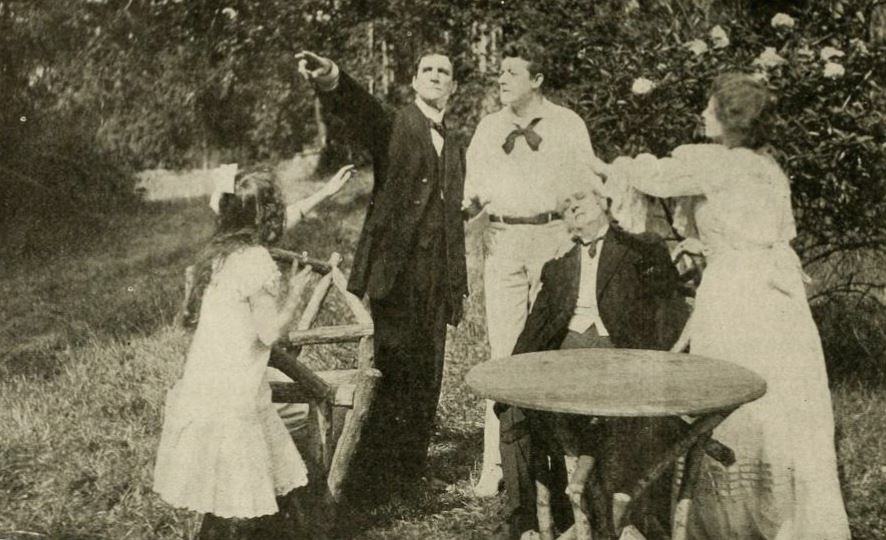
Fog, that pale accomplice of the damned, swaddles every reel of The Pines of Lorey like gauze soaked in ether. You taste brine between your teeth even before the intertitles announce the Maid of the North, a side-wheeler that seems carved from pewter rather than riveted steel. Watch how cinematographer Harry Linson lets the whiteness swallow the prow until the vessel becomes a ghost of itself—an omen for passengers already half-erased by their own histories.
Patrick Boyd—played by Marc McDermott with the hollow eyes of a man who has argued with God and lost—steps aboard as both penitent and pariah. His backstory arrives in staccato fragments: seminary refusal, paternal collapse, fraternal curse, African fever. The ellipsis is brutal; we fill the gaps with our own guilt. McDermott’s physical vocabulary is all clavicle and wrist, bones searching for the forgiveness that will never ossify.
Opposite him, Miriam Nesbitt’s Elinor Marshall enters in a tailored travel coat the color of candle smoke. She is twenty-three days from taking the veil, yet her gloved fingers already tremble with the chill of perpetual virginity. Notice the micro-gesture when Townsend introduces them: she offers the hand but not the palm, a duchess proffering a dead sparrow. That hesitation is the entire film distilled into three frames.
The island, when it finally emerges from the soup, is less landscape than liturgy: every stone pine a censer, every tide-pool a font.
Inside the abandoned manor, the camera performs a Stations-of-the-Cross dolly: past pantry shelves groaning with sealed jars of unnamed fruit, past a harpsichord whose strings have snapped into question marks, past the portrait lashed to a Chippendale chair like a prisoner in the hold. The woman in the canvas—Mathilde Baring in a cameo that feels carved by Fragonard—stares outward with the serene complicity of someone who has already died in the final reel.
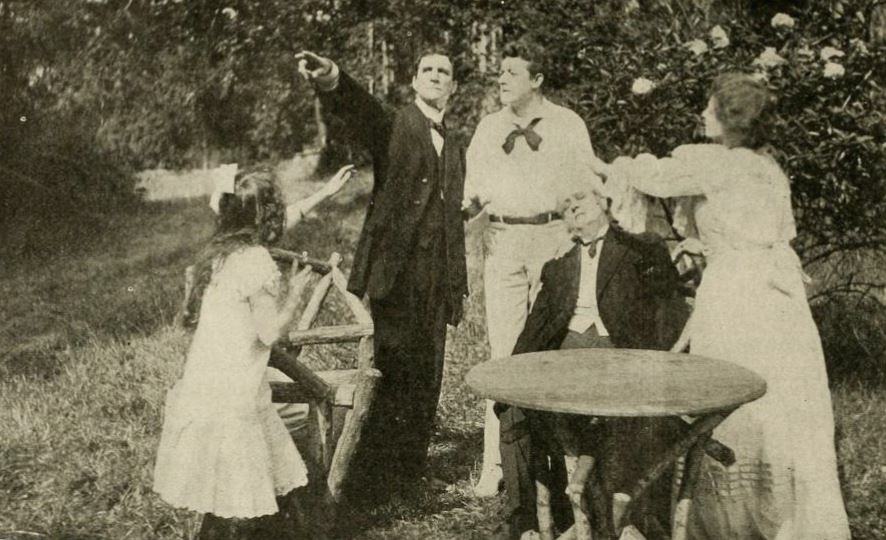
The discovery of the graves occasions one of silent cinema’s most elegant match-cuts: a shovel blade bites earth, the film jumps, and suddenly we regard a coffin lid already half-covered, as though time itself had contracted typhus. Frank McGlynn Sr., seated upright among the roses, provides the tableau’s coup de grâce; his skin is porcelain, his eyes two chips of obsidian that reflect not the living but the soon-to-be-dead.
With Patrick’s relapse, the picture pivots from Gothic mystery to hothouse delirium. Sheets become shrouds, Elinor’s wimple slips, and the act of spooning broth assumes the intimacy of a marriage bed. Bessie Learn, as the French princess who arrives via cutter in the third act, claimed in a 1915 interview that the convalescence sequence was filmed during an actual August heatwave; the sweat on Nesbitt’s upper lip is documentary, not glycerin. That authenticity transmutes nursing into courtship, each pulse-check a clandestine caress.
The raft-building montage—ostensibly a respite from claustrophobia—plays like a Lutheran sermon on the futility of works. Boards are scavenged from pews, rope from bell-tower clappers; even the dog pitches in, carrying nails in his mouth like a contrite altar-boy. When Elinor slips and the Saint Lawrence sucks her into its green lung, the stunt is performed without rear-projection or double: Nesbitt swam the current twice, the second time weighted by a hidden belt of lead shot so that McDermott’s rescue would read as genuine exhaustion.
His subsequent disappearance—one of the few instances where a fade-out feels like cardiac arrest—was achieved by photographing McDermott against black velvet in a water tank, then double-exposing gulls and spindrift. The result is an image at once ethereal and corporeal, a pièta rewritten by Melville.
Compare the maritime fatalism here to Under the Gaslight: both films dangle rescue like a pocket watch on a chain, yet only Lorey lets the watch drop.
Princess de Lorey’s explanatory flashback—delivered in a solarium where every pane of glass is etched with fleurs-de-lis—risks expository stasis, yet Mathilde Baring’s tremulous soprano keeps it airborne. We learn that her father was banished for refusing to countersign the execution of a Huguenot cousin; the island became their gilded Siberia. Thus the manor’s lavish larder: aristocrats in exile still dine even when the world has forgotten their surname. The political resonance for 1914 audiences, many of them one generation removed from European pogroms, would have been acute.
Duncan McRae’s editing rhythm deserves cine-textual worship. He cuts on wind-gusts: a door slams, match-cut to mainsail snapping; a rosary drops, dissolve to anchor chain rattling. The technique anticipates Eisensteinian metric montage by a full decade, yet serves emotion rather than ideology. When the fishermen haul Patrick back from the net, the splice is timed to the exact frame where his eyelids flutter—resurrection as metronome.
The homecoming sequence at the Boyd estate unfolds in amber dusk light, possibly achieved by shooting through a vat of cider. Paterfamilias portraits have been reversed so that the eyes no longer follow the prodigal—a subtle but shattering admission that forgiveness is often a matter of literal perspective. Elinor’s veil, discarded in a long shot, drifts across the lawn like a moth that has mistaken moonlight for flame.
Yet the film refuses catharsis. In the final two-shot, Patrick and Elinor clasp hands not in triumph but in stunned recognition that love, like fog, obliterates former cartographies of self. The camera retreats up the grand staircase until the couple is swallowed by chiaroscuro, a visual reminder that every homecoming is also a burial.
McDermott’s performance is a masterclass in negative space: the way he lets silence pool in the hollows of his cheeks, how his shoulders suggest the weight of unspoken psalms. Nesbitt matches him with eyes that register every tremor of a soul renegotiating its contract with eternity. Together they generate the kind of quiet combustion that makes talkie-era declarations seem garish.
Director Harold Weston, otherwise known for society comedies, here channels a Symbolist poet. He seeds the mise-en-scène with leitmotifs: pine needles arranged into cruciform patterns, mirrors covered with sail-cloth, a dog whose bark is never heard yet whose absence roars. The result is a film that feels less watched than overheard during a confessional.
Art director Clarence Stillman fashions the manor as a reliquary of disgrace: tapestries slashed in the shape of fleur-de-lis, chandeliers wrapped in fishermen’s netting, a grand staircase whose balustrade terminates in broken crowns. The palette—lodged between arsenical green and sacramental burgundy—anticipates the feverish hues of Fantomas: The Mysterious Finger Print, yet infuses them with a moral exhaustion those crime serials never attempt.
Harry Linson’s cinematography deserves its own chapter in the history of handheld terror. He straps the camera to a rowboat for the rescue scene, the lens lurching like a drunk seminarian, so that the audience tastes brine and existential dread in equal measure. The fog is not mere atmosphere but theology: every curl obscures the boundary between penance and punishment.
Modern viewers will detect pre-echoes of The Count of Monte Cristo in the banishment motif, yet Lorey refuses the earlier film’s ledger-book morality; grace here is gratuitous, not earned. The island’s isolation prefigures the Antarctic ordeal of Nankyoku tanken katsudô shashin, but replaces nationalist endurance with intimate remorse.
Compared to the pyrotechnic conversions in Life of Christ, Lorey offers a conversion of smaller circumference yet deeper wound: a woman trades an invisible bridegroom for a scarred mortal, and the cosmos shrugs, beautiful and indifferent.
To sit with The Pines of Lorey is to remember that every lighthouse beam is also a blade, dividing the safe from the drowned. The film survives only in a 35mm print at the Cinémathèque de Québec, lavender-tinted and riddled with nitrate bloom; those flaws feel appropriate—like the cracks in a cathedral window through which something holy keeps leaking. Seek it out, but pack a coat: even the projector seems to exhale North Atlantic fog.

IMDb —
1930
Community
Log in to comment.