DbcultAccessing Vault...
6.4/10
Senior Film Conservator
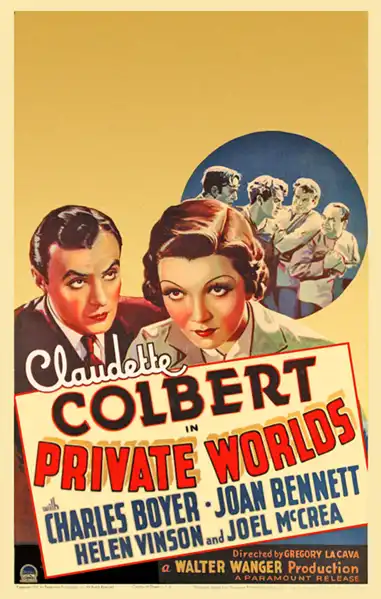
A definitive 6.4/10 rating for a film that redefined the boundaries of cult cinema. Private Worlds remains a cornerstone of transgressive art.
If you like old movies where people talk fast and have very intense facial expressions, then yes. It is worth a watch just to see Claudette Colbert be a boss. 🧠
People who love 1930s dramas or stories about women fighting the 'old boys club' will dig it. If you want a fast-paced thriller or a scary asylum movie, you will probably be bored out of your mind.
Private Worlds is one of those movies that feels like it’s trying to be very important, but mostly it’s just a really solid workplace drama. It is set in a mental hospital, which in 1935 usually meant a lot of screaming and shadows, but this is different.
Claudette Colbert plays Dr. Jane Everest. She has this way of looking at people like she’s already figured out their childhood trauma before they even sit down.
She is professional and calm. She actually seems to care about the patients, which is nice to see in a movie this old.
Then Charles Boyer walks in as the new superintendant, Dr. Monet. He is... well, he’s a bit of a jerk. 🤨
He has this thick accent and a very thick bias against women in his field. He basically tells Jane that she should probably just go home and leave the doctoring to the men.
It’s the kind of sexism that is so blunt it almost feels funny now, but you can tell the movie wants you to be mad about it. And it works!
I found myself really rooting for Jane to just trip him in the hallway or something. She doesn't, of course, because she’s a professional.
The hospital itself feels strangely quiet. Usually, movies about 'insane asylums' (their word, not mine) are loud and chaotic.
Here, it’s mostly just people in white coats talking in rooms with very tall windows. It feels more like a library sometimes.
There is this one scene where a patient has a breakdown, and the camera stays on Jane’s face for a long time. You can see her trying to stay clinical while her heart is clearly breaking.
Colbert is really good at that. She doesn't need to do much with her face to show you everything she’s thinking.
Joel McCrea is also there. He plays another doctor, Alex. He is basically the 'nice guy' colleague who supports Jane.
He’s fine, I guess. He’s very handsome and has a good chin, but he doesn't have much to do other than look worried.
The movie gets a bit messy when it tries to handle the personal lives of the doctors. There’s a subplot about Alex’s sister that felt like it belonged in a different movie. 🙄
It’s like the writers were worried the hospital stuff wasn't dramatic enough, so they threw in some extra family drama. It didn't really need it.
I kept wanting to go back to the power struggle between Jane and Monet. That’s where the real energy is.
There is a moment near the end involving a surgery (or a treatment, it's a bit vague) where the tension is actually pretty high. You can feel the sweat on everyone's forehead.
The lighting in that scene is perfect. Lots of sharp shadows that make Boyer look even more intimidating than he already is.
Speaking of Boyer, his performance is interesting. He’s playing a villain, but he thinks he’s the hero.
He thinks he is 'saving' the hospital from 'emotional' women. It’s infuriating to watch, which means he did a good job.
The way he says "Mademoiselle" sounds like an insult every single time. I don't know how Colbert didn't slap him.
It reminds me a little bit of the gender tension you see in Dangerous to Men, though that one is much more of a comedy. This one wants you to think.
The medical stuff is... dated. Let’s just say that. They talk about "nerves" and "shocks" in a way that would make a modern doctor laugh.
But for 1935, it was actually pretty progressive. It focuses on talking to patients instead of just locking them away.
The sets are also worth mentioning. The hospital feels big and cold.
It makes the characters look small, which adds to that feeling of being trapped in a system. Even the doctors are trapped by the rules.
One thing that bugged me was the music. It’s very loud and dramatic during moments that don't really need it.
Like, someone will just walk into a room and the orchestra goes DUN DUN DUN! It’s a bit much.
I also think the ending happens a little too fast. Everything gets wrapped up in a neat little bow that didn't feel totally earned.
But I suppose that’s just how movies were back then. They couldn't leave you feeling too miserable.
If you enjoy seeing how Hollywood used to tackle "serious" subjects, this is a great example. It’s not a masterpiece like The Crucible but it’s got heart.
Actually, it’s more like A Little Girl in a Big City in the way it treats its female lead—except she’s a grown woman with a medical degree. Same energy of 'woman vs. the world' though.
Anyway, I liked it more than I thought I would. It’s a bit of a slow burn, but Colbert makes it worth the wait.
Just don't expect any big twists or jump scares. It’s just people in nice clothes being very stressed out about psychaitry. 🩺
One last thing: look out for the scene with the cat. It’s a very small moment, but it’s weirdly sweet and feels real.
It’s those little human moments that make these old movies stay with you. Even if the rest of it is a bit theatrical.
IMDb 5.1
1930
Community
Log in to comment.