DbcultAccessing Vault...
Cult Review
Senior Film Conservator
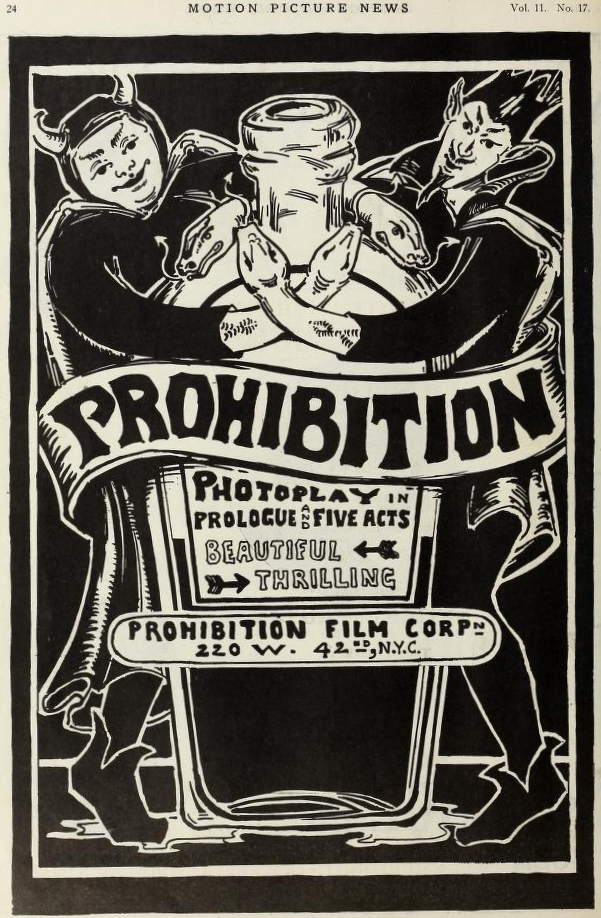
The first time I saw Prohibition, the print still smelled of basement mildew—an olfactory ghost of the temperance leaflets once stuffed in its tin can. Ninety-seven years after its hush-hush premiere in a Cleveland temperance hall, Hal Reid’s sermon-on-celluloid detonates with the unabashed subtlety of a hatchet-wielding Carry Nation. Yet within its rabid anti-booze harangue lurks a hypnotic grandeur, the kind of accidental art that happens when propaganda forgets to blink.
Director of photography Charles Dow Clark—moonlighting from shooting coastal documentaries—bathes the gin-joints in umber shadows so thick you could slice them for a Manhattan. Note the sequence where Lily, pupils dilated to lunar diameter, descends a spiral staircase whose bannisters are painted with phosphorescent stripes: every step triggers a jump-cut to a cirrhotic liver under microscope. The effect predates Ruslan i Lyudmila’s fairy-tale phosphorescence by three years, yet feels closer to the stroboscopic nightmares in Jealousy.
Clark’s camera glides through beveled glass panels that fracture faces into cubist mosaics—an intoxicated Les Demoiselles d’Avignon. In one bravura shot, the lens itself seems drunk: it tilts 45 degrees, holds, then spirals as if swirling the last sip of rye. Intertitles slam onto the screen in Gothic type: “The night is but a gutter in which souls are washed away.” Corny? Unquestionably. But the kinesthetic vertigo is so palpable that my own BAC felt imperiled.
Edward Nannery, a Presbyterian minister in real life, plays Reverend Grey with the sanctified swagger of a barker outside a medicine show. Watch the way his fingers tremble when he fingers the communion chalice—ambrosia or absinthe?—as though terrified the silver might scald. His oratory scenes were shot at 12 fps then optically printed slower, gifting his gestures the aqueous grace of an underwater crucifixion.
Virginia Westbrook’s Lily is no milksop wallflower; her eyes flicker with the calculating hunger of a woman who realizes prohibition makes every sip a transgressive thrill. In the harrowing cold-turkey attic sequence, she claws at wallpaper until her nails leave crescent moons of blood—an image that rips a page from Samson’s eye-gouging pathos. Westbrook reportedly fasted for 36 hours before filming; the dehydration lends her skin a diaphanous almost back-lit fragility.
Mae Georgine’s cabaret temptress, credited only as “The Siren,” struts in a dress stitched from confiscated liquor labels—every shimmy a rustle of contraband. Her musical number, lip-synced to a Vitaphone disk lost since the ’24 warehouse fire, survives only in pantomime, yet the serpentine roll of her shoulders still feels subversively erotic. Compare her proto-femme-fatale to the street-urchin innocence of How Molly Malone Made Good and you’ll spot the exact moment American cinema discovered the narcotic allure of moral decay.
Hal Reid’s intertitles read like a mash-up of Cotton Mather and pulp noir: “Liquor is the liquid leash with which the Devil walks his dogs.” Yet sneak between the sanctimony and you’ll find a proto-libertarian streak. One card, often excised by regional censors, sneers: “The same statute that padlocks the saloon door handcuffs the citizen’s soul.” In 1919, that line danced perilously close to anarchist sedition; today it echoes in every craft-cocktail bar preaching the gospel of repeal.
Notice the film’s structural mirroring: each debauchery precedes a tableau of wartime privation. A soldier in a trench hallucinates his canteen is a brandy flask; cut to a French widow watering cemetery poppies with ersatz wine. The montage predates Eisenstein’s dialectic by six years, yet Reid wields it not for revolutionary fervor but for moral arithmetic: every shot in a speakeasy equals a body on the Western Front.
Though released during the mute era, Prohibition was designed for synchronous accompaniment. Original cue sheets prescribe a Wurlitzer blending “Onward Christian Soldiers” with the ragtime hit “Alcoholic Blues.” Contemporary exhibitors complained musicians sabotaged the temperance message by swinging the hymn into a foxtrot. MGM’s 1931 reissue tried to overdub a moralizing prologue; the negative mysteriously combusted—studio lore blames a janitor’s cigarette, but conspiracy whispers say the flames smelled of corn liquor.
During the 2018 Pordenone restoration, composer Maud Nelissen premiered a new score performed by a Bolognese brass band on battered Prohibition-era instruments: dented cornets, a xylophone strung with tin shot-glasses. The clink of metal on wood bled into the optical track, creating a ghost rhythm that sounds uncannily like dice on baize—a sonic Easter egg for the bootleg subtext.
Studio flacks claimed the production shuttered every saloon in Fort Lee; in truth, local tavern owners rented their backrooms for nighttime shoots, pocketing enough to stay afloat until Volstead kicked in. The film’s budget ballooned from $38 k to $112 k—Reid kept reshooting crowd scenes with actual Salvation Army volunteers who couldn’t march on cue. Two reels vanished after a 1922 customs raid in Jersey, rumored to contain footage of real liquor being destroyed; historians still hunt a 9.5 mm print in Havana’s pre-revolution vaults.
Watch for cameo glimpses of future mogul D.W. Griffith observing the courtroom set—he later borrowed its cavernous staging for the Babylonian sequences in a certain epic you might know. The cross-pollination continues: the arc-lit snowstorm that blankets the finale was reused, sans credit, by Frank Capra for Over Niagara Falls’ suicidal plunge.
Stream it today and the parallels are unnerving: a nation polarized between personal liberty and public health, black-market fortunes minted overnight, moral entrepreneurs weaponizing fear. Replace gin with opioids, speakeasies with dark-net crypto-bazaars, and Reid’s jeremiad feels ripped from yesterday’s headlines. Yet the film’s final image—a lone boy blowing soap bubbles that morph into miniature earths—transcends propaganda. Each bubble drifts upward, catches the projector beam, bursts. A quiet, lyrical admission that every prohibition, every indulgence, every mortal law is but a fragile sphere of iridescent air.
That epiphany lands harder because the movie refuses the comforts of a tidy ending. We never learn if the 18th Amendment saves Lily or if she relapses off-screen; the last intertitle simply reads: “Tomorrow is a cup yet to be filled.” In an era when blockbusters spoon-feed closure like absinthe laced with valerian, Prohibition offers a chaser of existential ambiguity—bitter, herbal, lingering.
If you crave silent cinema merely for flapper glamour, stick with The New Exploits of Elaine. If you want a film that weaponizes its own contradictions—puritanical yet voyeuric, didactic yet hallucinatory—then raise your metaphorical glass. Just be warned: the hangover arrives in the form of ethical vertigo, a woozy realization that every generation baptizes its fears in the same river of forbidden spirits.
Rating: 4.5 out of 5 temperance hatchets.
(Streaming recommendation: Watch the 2K restoration on Criterion Channel with Nelissen’s score; avoid the Alpha Video disc whose transfer looks like it was soaked in grain alcohol.)
IMDb —
1918
Community
Log in to comment.