DbcultAccessing Vault...
Cult Review
Senior Film Conservator
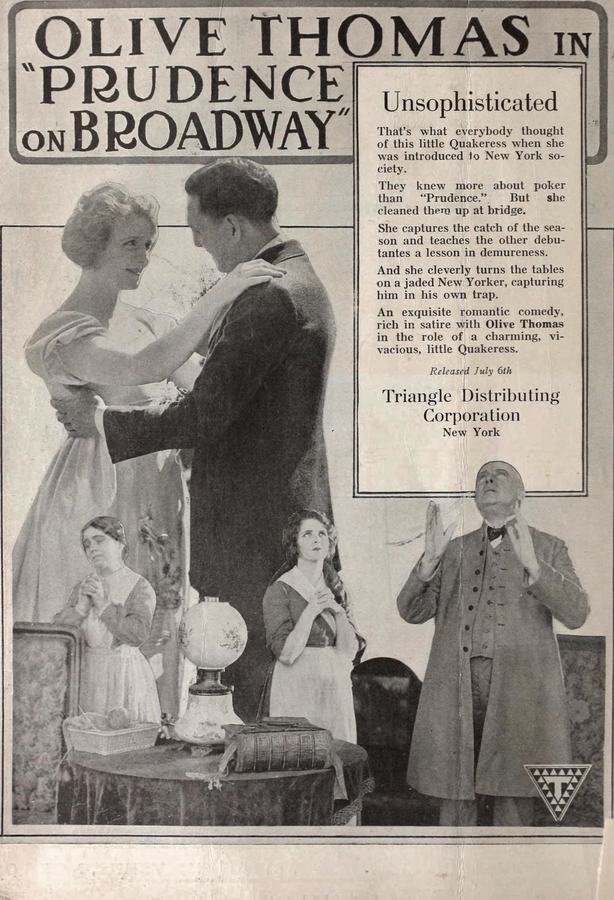
Stepping back into the glittering, often tumultuous world of early 20th-century cinema, one occasionally unearths a gem that resonates with surprising contemporary relevance. ‘Prudence on Broadway’, a 1919 silent film starring the luminous Olive Thomas, is precisely such a discovery. Far from being a mere period piece, this film, penned by Catherine Carr, offers a nuanced exploration of female agency, societal hypocrisy, and the enduring power of wit. It’s a narrative that, despite its sepia tones and lack of spoken dialogue, speaks volumes about the challenges and triumphs of women navigating a rapidly modernizing world. For those accustomed to the more overt melodrama of the era, Prudence presents a refreshing, almost subversive, take on the ingenue archetype, transforming her from passive object to active agent in her own destiny.
The premise itself is a fascinating collision of worlds: Prudence, a young woman from a sheltered Pennsylvania Quaker colony, is sent by her earnestly concerned parents to a fashionable girls' seminary. Their intention? To arm her with knowledge of 'the devil's tricks.' The irony, delicious and palpable, is that Prudence, played by Thomas with an exquisite blend of innocence and latent mischief, doesn't learn about evil so much as she masters the art of deflection. Her pure, unblemished appearance becomes her shield, allowing her to engage in girlish pranks and escapades while sidestepping blame with an almost preternatural grace. This initial sequence establishes her character not as a paragon of virtue, but as a clever individual capable of strategic self-preservation, a trait that will serve her remarkably well in the urban jungle of New York.
The shift from the seminary to New York City marks a pivotal transformation, not just for Prudence, but for the film's thematic scope. Visiting her sophisticated aunt, a society matron, Prudence is plunged into a world of opulent parties, social maneuvering, and a dizzying array of male admirers. It’s here that the film truly begins to sparkle, showcasing Thomas's ability to convey complex emotions and quick-witted intelligence through subtle gestures and expressive eyes. Her character, though still retaining a veneer of demureness, quickly adapts to the societal currents, demonstrating an adaptability that belies her sheltered upbringing. This rapid assimilation into high society, without losing her essential self, is one of the film's most compelling aspects. It suggests that true character isn't defined by one's origin, but by one's choices and resilience in the face of new challenges.
The narrative soon introduces the central conflict: Prudence falls for the genuinely wealthy and honorable Grayson Mills, a romantic interest who promises stability and affection. However, the path to true love is seldom smooth, especially in silent cinema. Enter John Melbourne, portrayed by Francis McDonald with a suitably smarmy demeanor. Melbourne is a classic cinematic cad, a man who lives off his wife's wealth and views women as mere playthings. His predatory gaze falls upon Prudence, setting in motion a plot to seduce her, a common trope of the era but one that 'Prudence on Broadway' handles with an unexpected twist. Unlike many damsels in distress of the period, Prudence is no shrinking violet; her Quaker upbringing, far from making her susceptible, seems to have instilled in her a pragmatic resourcefulness.
Melbourne's scheme begins with a seemingly innocuous act: he loans Prudence $200 to cover a gambling debt. This financial entanglement is then weaponized, as he threatens to expose the canceled check to her stern father, thus forcing her into a compromising situation at a secluded roadhouse. This particular plot device, the use of a perceived moral transgression as blackmail, was a popular narrative engine in silent films, often leading to tragic outcomes for female protagonists. However, 'Prudence on Broadway' deviates sharply from this conventional trajectory. Instead of succumbing to despair, Prudence demonstrates an extraordinary capacity for strategic thinking, turning the tables on her would-be seducer with remarkable aplomb.
The climactic dinner scene at the roadhouse is where Prudence truly shines. With a composure that belies her youth and the precariousness of her situation, she produces a love letter that Melbourne had previously written to an actress. Her ultimatum is delivered with quiet authority: if she isn't safely back at her hotel by midnight, her hotel clerk will deliver not just one, but nineteen other such incriminating letters to Melbourne's wife. The sheer audacity of this bluff, delivered with such conviction by Thomas, is a masterclass in cinematic suspense and character development. Melbourne, panicked by the threat of exposure and ruin, hurries her back, only to discover, post-haste, that Prudence possessed but the single letter. It's a moment of pure, unadulterated triumph for the character, and a deeply satisfying narrative resolution for the audience.
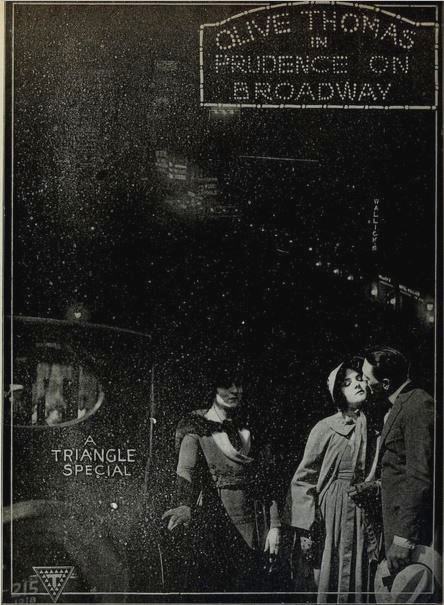
Olive Thomas, whose tragic early death cut short a burgeoning career, is the undisputed heart of 'Prudence on Broadway.' Her performance is a delicate balance of vulnerability and strength, conveying a spirited intelligence that transcends the limitations of silent film acting. She doesn't just play Prudence; she embodies her, infusing the character with a vivacity that makes her struggles and triumphs feel genuinely earned. Thomas had a unique screen presence, often playing characters who, while outwardly innocent, possessed an inner steel. This film is a testament to her particular magnetism, making her character's journey from sheltered Quaker to savvy New Yorker utterly believable and engaging. Her ability to convey complex emotional states through subtle facial expressions and body language is truly remarkable, solidifying her place as one of the silent era's most compelling stars. One can draw parallels to the spirited independence seen in characters from other silent features, such as those in The Princess of Patches or A Sister of Six, where female protagonists similarly navigate challenging circumstances with resourcefulness.
The supporting cast, including Edward Peil Sr., J.P. Wild, Lillian Langdon, and the aforementioned Francis McDonald, all contribute effectively to the film's tapestry. McDonald, in particular, delivers a villainous turn that perfectly underscores Prudence's cleverness. His bluster and eventual humiliation are vital to the film's comedic and dramatic success. Director Maurice Campbell, working from Catherine Carr's astute screenplay, crafts a narrative that moves with a brisk pace, avoiding the languor that sometimes plagued silent features. The cinematography, while perhaps not groundbreaking for its time, effectively captures the contrasting aesthetics of the Quaker community, the seminary, and the bustling energy of New York, providing a visual backdrop that enhances Prudence's journey.
At its core, 'Prudence on Broadway' is a compelling commentary on morality and agency in an era undergoing significant social shifts. Prudence's journey challenges the notion that innocence equates to naiveté, or that a sheltered upbringing necessarily prepares one poorly for the world. Instead, it suggests that an intelligent mind, coupled with a strong will, can navigate even the most treacherous social landscapes. The film implicitly critiques the double standards prevalent in society, where men like Melbourne could operate with relative impunity, preying on women, while women were expected to maintain an unblemished reputation at all costs. Prudence's ingenious counter-attack is not just a personal victory, but a symbolic strike against these patriarchal expectations, echoing the struggles for independence seen in other silent films like The Price of Silence, which often explored the consequences of hidden truths and societal pressures.
The film’s resolution, with Prudence’s engagement to Grayson Mills, feels earned and satisfying. It’s not simply a triumph of love, but a triumph of character. She secures her future not through passive waiting or rescue, but through her own quick thinking and daring. This depiction of a resourceful heroine was, and remains, incredibly powerful. It offers a counter-narrative to the more common depictions of women as either fragile victims or manipulative vamps. Prudence is neither; she is a complex, intelligent woman who uses her wits to protect herself and secure her happiness. This spirit of resilience and cleverness can also be observed in films like Fedora, which presented strong female leads challenging conventions.
While 'Prudence on Broadway' may not be as widely known as some of its silent era contemporaries, its thematic richness and Olive Thomas's captivating performance ensure its enduring value. It’s a film that speaks to the timeless struggle of maintaining one's integrity in the face of temptation and coercion, and the liberating power of intellect. In an age where discussions around female empowerment and consent are ever-present, a film from over a century ago that champions a woman's right to defend herself with intelligence rather than force feels remarkably prescient. It avoids simplistic moralizing, instead presenting a nuanced view of a young woman's journey of self-discovery and assertion. This nuanced approach to character and morality sets it apart from more straightforward melodramas of the time, such as those that might focus more on overt physical conflict or tragic ends, perhaps seen in films like Fighting Back or Under Galgen.
The film's exploration of appearances versus reality—Prudence's pure facade masking a sharp mind, Melbourne's gentlemanly exterior hiding a predatory nature—is a theme that continues to resonate. It reminds us that surface impressions can be deceiving and that true strength often lies beneath a carefully constructed veneer. For silent film enthusiasts and those interested in the evolution of female representation in cinema, 'Prudence on Broadway' is an essential watch. It's a testament to the fact that even without spoken words, a story can convey profound truths and entertain with equal measure. The ingenuity of Catherine Carr’s writing, brought to life so vividly by Olive Thomas and the ensemble cast including Lillian West, Mary Warren, Harvey Clark, Alberta Lee, and Claire McDowell, ensures that Prudence’s journey remains a compelling and ultimately uplifting cinematic experience. It reminds us that sometimes, the sharpest weapon is not a sword, but a well-timed bluff and an unyielding spirit.
IMDb 4.6
1923
Community
Log in to comment.