DbcultAccessing Vault...
Cult Review
Senior Film Conservator
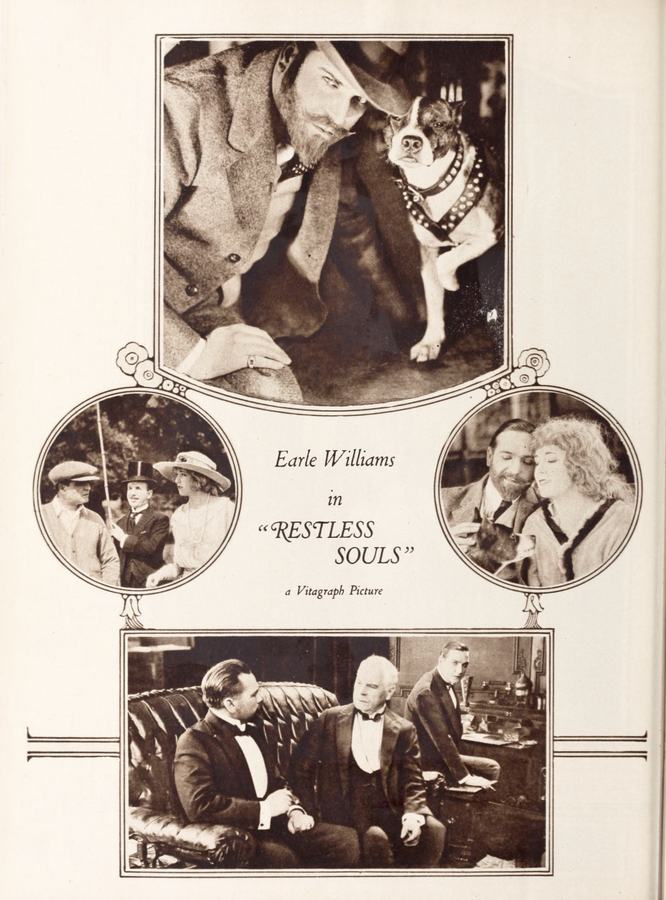
Restless Souls is not a film; it is a séance on celluloid, a nitrate fever dream where love wears the mask of death and even the dog knows the scent of deceit.
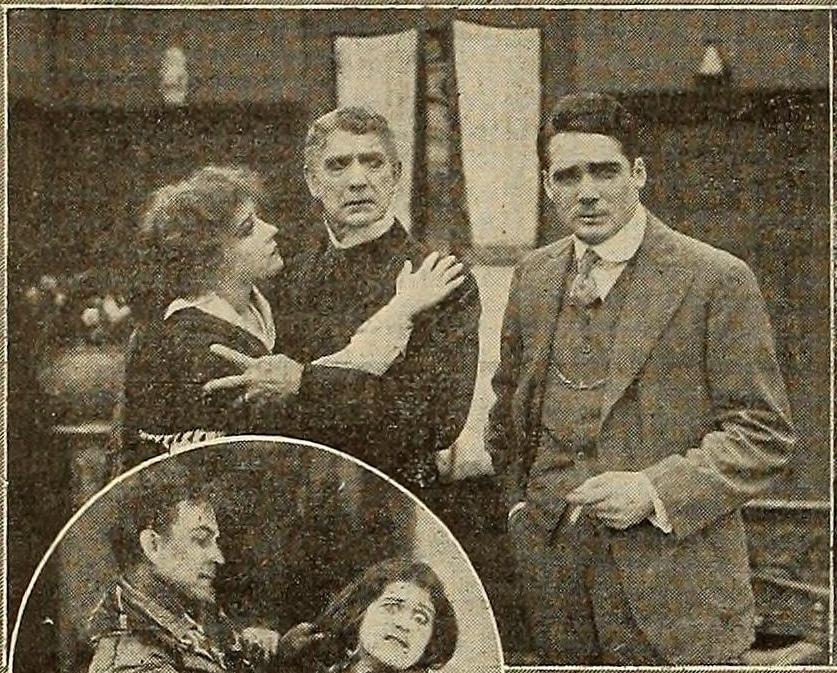
Calder Johnstone’s screenplay—adapted from a slither of Richard Harding Davis cosmopolitan dread—treats the bourgeois drawing room like a shark tank lined with Persian rugs. Every cigarette curl, every tremor of lace curtains, vibrates with the unspoken: what if marriage itself is the original forgery? The film’s first act unspools like a satin ribbon yanked from a throat. Earle Williams, all cheekbones and wounded entitlement, plays Parkington with the brittle grace of a man who has memorized every stanza of betrayal but never imagined himself its author. When he watches Lida (Francelia Billington) lean toward Swetson’s lectern, the camera—not yet capable of sync sound—somehow makes us hear the wet click of her swallow. It is 1922, yet the moment feels older than salt.
Neosymbolism, that fin-de-siècle perfume sprayed onto post-war ennui, is Swetson’s weapon of mass seduction.
Arthur Hoyt plays him like a man who has read too much Schopenhauer between the sheets. His hair is center-parted with geometric cruelty; his voice, though unheard, seems to echo in the intertitles: “The heart is a blood-orange; squeeze and it stains your cuffs.” When he shifts his voracious gaze from Lida to Maria Fortescue (Martha Mattox, whose face could halt a locomotive), the film performs a pirouette of moral vertigo. Suddenly the widow’s weeds are traded for wedding veils, and the estate—this cavernous mausoleum of mahogany and chandeliers—becomes the prize in a game where the rules are rewritten nightly.
The disguised resurrection of Parkington is the film’s volta, a narrative hinge that creaks like a crypt door. Williams adopts the stooped gait of a gardener whose only confidant is the soil. But Pal the Dog—cinema’s first four-legged deus ex machina—sniffs through the ruse. Watch the mastiff’s ears flick backward, the low-throttle growl that vibrates through the soundtrack of silence. In that instant, interspecies loyalty becomes the last honest contract left standing. The dog’s recognition scene is shot in a single iris-in, a black halo tightening around man and beast until the world outside ceases to exist. If you blink, you will still feel hot breath on your ankle.
What follows is a midnight tour of moral architecture: secret drawers, candle-wax seals, a second will folded like a love letter inside a hollowed-out Oxford Shakespeare.
Parkington, face half-lit by lantern, replaces the forged parchment with the original, his fingers trembling as if handling sacred scripture. The moment is lit like a Caravaggio—chiaroscuro so severe you could slice bread with it. When Maria and Swetson discover him, the film refuses the comfort of pistol or gavel. Instead, expulsion is decreed by the sheer force of presence: “Leave this house; you have forfeited the right to breathe its dust.” The line, delivered via intertitle, lands with the thud of a gavel on coffin-lid.
Yet the final sting is marital, not mortal. Swetson’s reveal—he and Maria have already wed—collapses the triangle into a Möbius strip of legal bed-hopping. The estate is theirs by law, yet they skulk away like beaten dogs, defeated by something older than parchment: the scent of truth recognized by a creature who cannot read. Parkington and Lida’s reconciliation is wordless. They stand framed in a doorway, winter light pouring over them like liquid mercury. Pal settles between their feet, tail thumping once—applause from the universe.
Director Fred Schaefer, never again heralded, orchestrates visual rhymes that would make Lang blush. Note the recurring motif of mirrors cracked by gunshot: first in the marital bedroom, lastly in the foyer, each fracture a cartography of broken vows. The estate’s grand staircase is shot from a bottom-angle so steep it becomes an Escher ascent—every step a year off a life. When Maria descends in widow’s black, the camera tilts ever so slightly, as if the house itself were leaning toward damnation.
Shadows are not mere absence; they are characters.
Swetson’s silhouette, projected onto Lida’s boudoir wall, elongates into devil horns when she blows out the lamp. Later, Parkington’s shadow—disguised in gardener’s cap—shrinks to child-size, a visual confession of emasculation. These effects were achieved with nothing more than carbon-arc lights and mirrors salvaged from a bankrupt vaudeville house, yet they prefigure German Expressionism by a full lunar cycle.
Earle Williams, once hailed as the Valentino of the East Coast, performs here like a man who has already seen his obituary. His eyes—ringed by kohl applied to catch the key-light—carry the resignation of someone dismantling his own myth. Watch the micro-gesture when he fingers the rim of his top-hat before the fake suicide: a thumb rubs the felt twice, the nervous tic of a gambler about to wager his soul. Francelia Billington counterbalances with the porous vulnerability of tissue paper soaked in brine; her close-ups seem to breathe. In the scene where she receives the forged letter announcing Parkington’s death, she does not clutch her heart—she cups her clavicle, as if protecting the hollow where love once nested.
Martha Mattox, veteran of The Marked Woman, weaponizes stillness. Her Maria never raises a hand; she simply occupies space like a statue that has decided to grow fangs. When she murmurs (via title card) “The law is a blunt instrument, my dear; I prefer embroidery,” the line is punctuated by a smile so minute it could be a muscle spasm—yet it chills the marrow.
Johnstone’s intertitles refuse the utilitarian. They bloom like poison flowers: “He dove into the river’s black mouth, leaving behind only the echo of a marriage unbuttoning.” The font—art-nouveau tendrils designed by a Broadway poster artist—bleeds into the frame, making words themselves pictorial. Meanwhile, the absence of synchronized sound becomes a compositional tool. The creak of a floorboard, the rustle of taffeta, the distant bark of a dog—these exist solely in the spectator’s mind, rendering each viewer a co-author.
Musical accompaniment in 1922 varied by venue, yet surviving cue sheets suggest a motif of Debussy paired with the slow drag of a bow across a double bass during revelation scenes. One imagines the theater pianist sweating through Clair de Lune while the audience collectively forgets to exhale.
Restless Souls shares DNA with Chained to the Past—both hinge on a forged document that rewrites lineage. Yet where Chained wallows in Dickensian squalor, Souls opts for the chill marble of high society. Likewise, the marital masochism on display here finds a distant cousin in Extravagance (1921), though that film punishes its heroine where Souls ultimately absolves its couple, albeit through canine jurisprudence.
Meanwhile, Pal’s role as moral arbiter anticipates the cross-species loyalty in Patsy’s Jim, yet predates it by nearly a decade. One could even read the estate’s descent from marital Eden to legal battleground as a microcosm of the same imperial rot depicted in Die Herrin der Welt 3. Teil, though here the colonial spoils are merely a townhouse on Washington Square.
Today, only one 35mm print survives, housed in a Bologna archive where nitrate whisperers freeze-frame it every decade. The images online—grainy, water-marked—feel like memories smuggled out of a burning house. Yet the film’s DNA persists. You can spot its outline in Hitchcock’s Vertigo manhandling of identity, in Kubrick’s Barry Lyndon candle-lit greed, even in Kurosawa’s use of weather as moral barometer. Most notably, the “dog as truth detector” trope resurfaces from Lassie to John Wick, proving that cinematic justice sometimes needs four legs, not two.
To watch Restless Souls is to be reminded that every marriage is a contested will, every home a courtroom, every bark a verdict.
Seek it out if you can—preferably at 2 a.m., headphones on, your own dog asleep at your feet. When Pal’s ears twitch in recognition, you’ll feel your pet stir in sympathetic vibration across a century. That is the uncanny gift of 1922: it turns viewers into co-conspirators, the past into a hallway you can still pace at night, waiting for a bark that never comes.
References for further viewing:
IMDb 5
1927
Community
Log in to comment.