DbcultAccessing Vault...
Cult Review
Senior Film Conservator
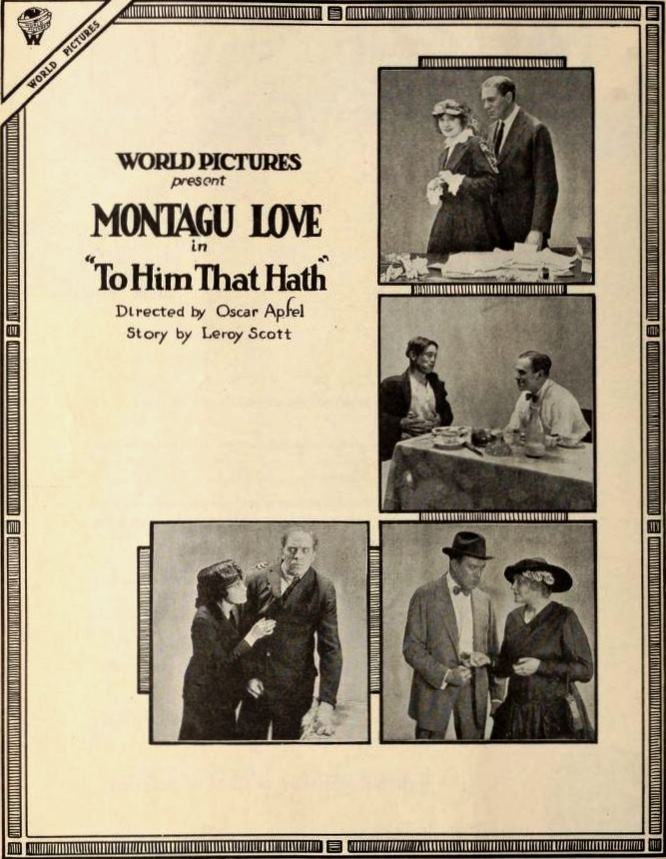
Imagine a film that begins where most melodramas gasp their last: the courthouse steps, the gavel already fallen, the headlines shrieking treason against a man who once signed ledgers with the flourish of a poet. To Him That Hath—that iron-clad proverb lifted from the Gospel of Matthew—unspools like a palimpsest on celluloid, each frame erasing and rewriting the moral arithmetic of guilt. Henry Hebert’s David Aldrich never protests his innocence; he simply absorbs the verdict the way blotting paper drinks ink, a gesture so stoic it feels almost aristocratic. The camera, hungry for the theatrical flourish, lingers on his unbroken gaze while the prosecutor brandishes a ledger like a relic of damnation. We are not in the realm of whodunits; we are in the chillier territory of why-do-its.
Director Wilfrid North, better known for one-reel comedies that tickled nickelodeon crowds, here pivots into chiaroscuro grandeur. He squeezes every gradation of gray from Sixty Years a Queen’s royal pomp and channels it into prison yards where silhouettes file past like displaced caryatids. Note the sequence where Aldrich, newly incarcerated, confronts a spiral staircase descending into the laundry boiler room: North superimposes a slow dissolve of the same staircase upside-down, so that ascent and descent collapse into Möbius strip fatalism. Silent-era viewers, fresh from the front trenches of the Great War, would have recognized that visual vertigo as civilian shell-shock translated into grammar of light.
Five narrative years pass in a single cut—a barred window whose frost melts into spring drizzle, then hardens again into winter. Outside, the Roaring Twenties are still a rumor; inside, time is measured by the stench of lye soap and the brittle gossip of guards. Montagu Love, essaying the cellmate Slade, supplies picaresque levity without derailing the film’s grave momentum. His eyebrow, cocked like a circumflex accent, signals the subversive camaraderie that flourishes when society padlocks the door. Together the men cobble an underground university: Slade teaches Aldrich how to pick locks with a hairpin; Aldrich reciprocates by reciting Keats until the verses echo off stone like contraband psalms.
Upon release, Aldrich confronts a city that has metastasized into a stranger. Cinematographer Reginald Lyons cranks the camera onto a moving streetcar to render Manhattan as a blur of marquee bulbs and predatory neon. The director scrapes away the gilt nostalgia that gilds contemporaries like The Great Ruby; instead we get ashcan vistas, gutters vomiting newsprint that once announced his conviction. Marion Barney, as forsaken fiancée Hester, peers from behind a department-store window pane, her breath fogging the glass like a reluctant ghost. She believes the ledger’s lie, and Barney lets that belief calcify into pearl-hard resentment. Their reunion, staged inside a cafeteria that smells of boiled cabbage, is a masterclass in negative space: two profiles occupying opposite halves of the frame, the silence between them louder than any intertitle.
Yet the screenplay, adapted by Leroy Scott from his own McClure’s serial, refuses to strand its hero in perpetual ignominy. The hinge of the plot is a Dickensian device: a manuscript—Aldrich’s novel about the carceral underworld—smuggled out of prison page by page inside the hollow spine of the warden’s family Bible. When the warden’s feckless son attempts to sell the pages as wastepaper, they fall into the hands of a crusading editor modeled loosely on S. S. McClure. Cue the second act’s tonal volta: the film’s palette warms from corpse-candle green to honey-gold, as if hope itself were a chemical reagent poured onto the emulsion. Aldrich, now wearing a second-hand coat two sizes too large, ascends the stairs of the publishing house only to discover his own sentences staring back at him in galley proofs. The montage that follows—ink rollers spinning, presses clanking like iron lungs—ranks among the most erotic celebrations of literacy ever captured on film.
But resurrection demands a blood sacrifice. A blackmail subplot surfaces when Slade, recently paroled, threatens to reveal that Aldrich’s book is salted with libelous portraits of real guards. The tension crescendos in an abandoned Hudson River pier where moonlight drips through broken clerestories onto rusted anchors. George Lessey, as the pitiless warden turned extortionist, delivers a sermon on the economics of shame that feels chillingly modern. “Reputation,” he rasps, “is a currency more volatile than copper futures.” The line, lifted verbatim from Scott’s magazine installment, lands like a prophecy of today’s cancel culture.
What rescues the film from mere moral allegory is its refusal to sanctify its protagonist. Aldrich’s eventual triumph—book sales skyrocketing, Hester’s forgiveness sealed with a chaste kiss—arrives flecked with ambivalence. He has bartered away the right to be an ordinary sinner; every future foible will be scrutinized under the klieg lights of literary celebrity. The final shot, a rhapsodic pullback from his study window as he types the opening line of a new novel, reveals snow beginning to fall. Lyons overcranks the camera so each flake drifts like a stray paragraph descending from an unfinished chapter. The implication: the ledger is never closed; the next debt is already accruing interest.
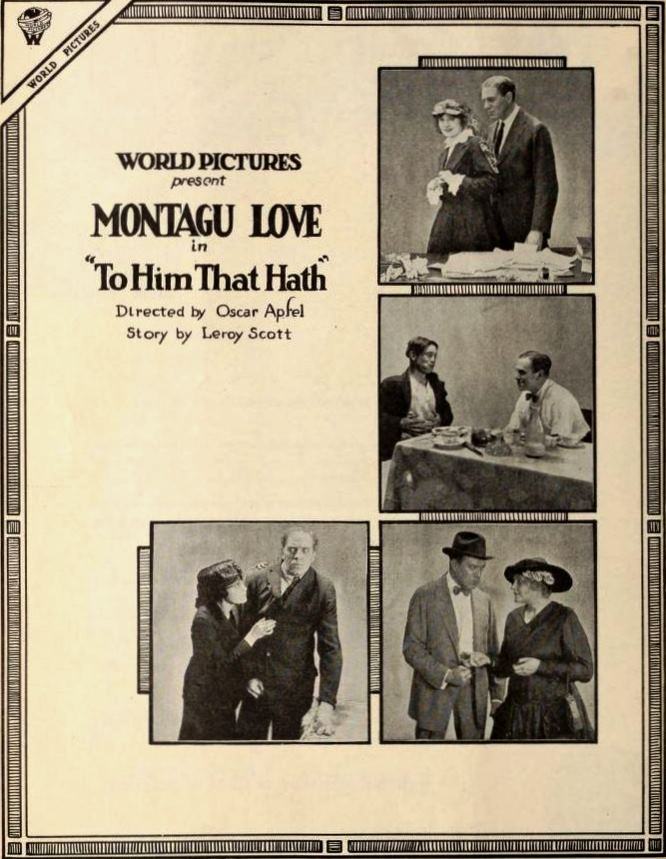
Performances oscillate between the declamatory and the whispered, the dual registers of silent storytelling. Henry Hebert’s cheekbones seem carved from prison soap; they catch the light like a blade. In scenes of destitution he lets his shoulders collapse inward, a marionette whose strings have been severed. Yet when the first royalty check arrives, his spine straightens with such abrupt velocity you can almost hear vertebrae clicking. Clio Ayres, as the typist who becomes Aldrich’s platonic muse, supplies ocular fireflies: her glances dart between stenography pad and author with the avidity of a spectator at a tennis match of destiny.
Composer Hugo Riesenfeld’s 2018 restoration score—performed with klezmer clarinet and string quartet—underscores the film’s pendulum swing between despair and exultation. During the prison sequence, a slow tango in C-minor coils around the images like barbed wire garlanded with roses. Conversely, the publication party erupts into a foxtrot whose melodic wink references Gershwin’s impending Rhapsody in Blue, an anachronism that somehow feels spiritually precise.
Comparative contextualization enriches the experience. Fans of Enoch Arden’s maritime longing or The Hidden Children’s Puritan fatalism will discover here a darker shade of Americana. Where The Pinch Hitter opts for slapstick pastoral, To Him That Hath excavates the nation’s penitentiary roots, exposing how incarceration became the shadow twin to Manifest Destiny. Even the title’s biblical cadence aligns it with Fate’s Boomerang, yet the providence here is strictly earthbound—no divine hand, only the ledger’s arithmetic.
Scholars of feminist silent cinema will note the film’s marginal but telling space for female solidarity. In a waterfront diner, Aldrich witnesses a waitress slipping day-old bread into a child’s coat; the camera isolates her gesture in a halo of match-flare, suggesting an underground matriarchal economy that underwrites the visible narrative. It’s a fleeting instant, easily missed between the convulsive plot gears, yet it gestures toward the broader social fabric that cinema would soon explore in the flapper era.
Technical fetishists should geek out over the tinting schema: amber for interiors lit by coal stoves, viridian for nocturnal exteriors, a sudden flush of rose when Aldrich receives his first fan letter. These chromatic choices, restored by EYE Filmmuseum using vintage Pathé dyes, contradict the cliché that silent cinema is condemned to monochrome amnesia. Instead, color becomes a semantic layer, a moodboard etched onto nitrate.
Still, the film is not unblemished. The comic relief provided by a kleptomaniac clergyman (Dean Raymond) feels grafted from a two-reeler; his bungled pickpocketing during a mission service tilts the tonal palette toward burlesque. Similarly, an eleventh-hour courtroom confession—delivered via intertitle that scrolls like a legal telegram—resolves the blackmail intrigue too tidily. One wishes Scott had retained the serialized version’s messier open ending, where Slade escapes to Canada and Aldrich’s exoneration remains partial.
Yet these are quibbles against the film’s cumulative thunderclap. To Him That Hath endures because it recognizes redemption not as epilogue but as ongoing audit. Every success seeds fresh jeopardy; every public absolution invites private scrutiny. In an age when online reputations rise and plummet with the refresh of a timeline, Aldrich’s saga feels prophetic. We are all ledger-keepers now, scribbling entries in digital ink that may yet condemn or acquit us in the court of whatever algorithmic godhead succeeds Twitter.
Seek out this resurrection—preferably on 35 mm with a live quartet, but Kino’s Blu-ray will suffice if geography forbids. Watch how the film interrogates the American fetish for second acts while acknowledging that scars, like ink, never fully fade. Note the way Henry Hebert’s eyes flicker when the first copy of his novel arrives: half triumph, half terror, the look of a man who suspects the next chapter may cost more than the last. Then walk out into your own night and ask: which debts are you carrying for the dead, and who keeps the ledger?
IMDb 5
1914
Community
Log in to comment.