DbcultAccessing Vault...
Cult Review
Senior Film Conservator
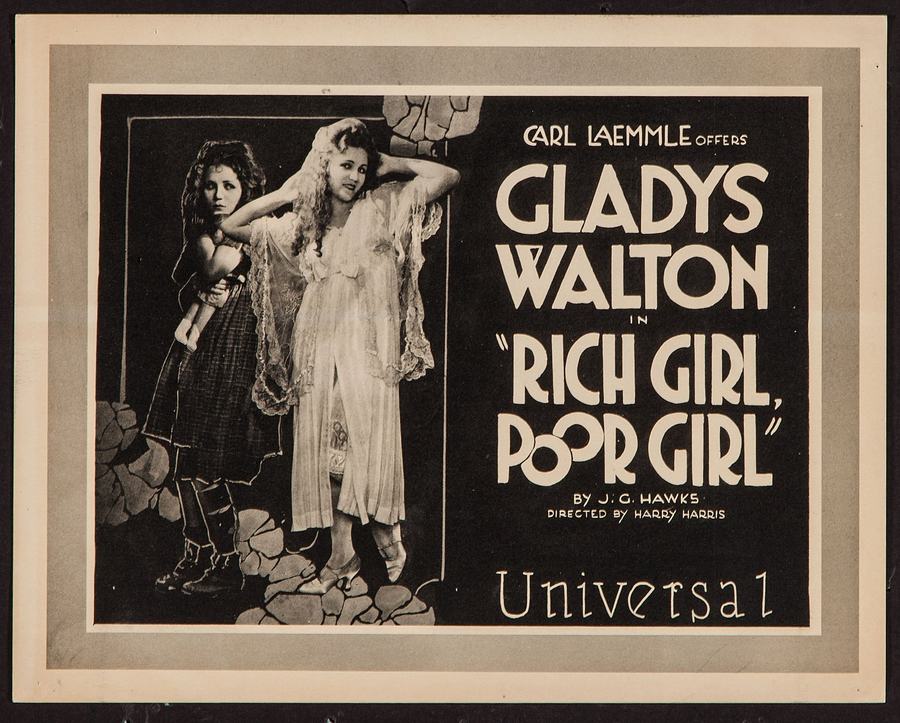
Imagine a negative space where two silhouettes fit together like jigsaw pieces carved from the same photographic plate: that is the eerie genesis of Rich Girl, Poor Girl. Directed with proto-noir fatalism by J.G. Hawks and scripted by Andrew Percival Younger, this 1917 one-reeler distills class rage into a fairy-tale shot through with arsenic. The film’s 63-minute runtime feels paradoxically longer than some three-hour sagas, because every iris-in tightens like a garrote around the viewer’s complacency.
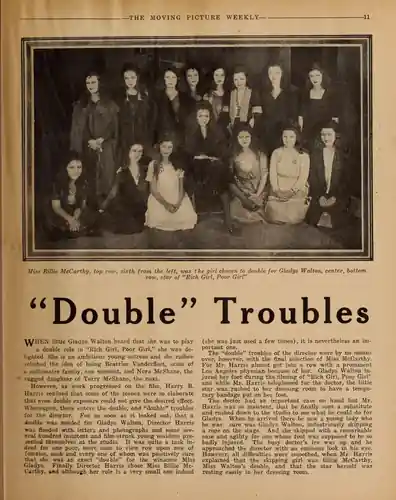
While Griffith was erecting Babylonian elephants, Hawks and Younger opted for a claustrophobic chamber piece. Their weapon is symmetry: two actresses—Antrim Short as the feral Nora and Gladys Walton as the languid Beatrice—share not merely facial contours but a kinetic vocabulary of shoulder twitches and eyelid flutters. The camera, perhaps accidentally, frames them in split-screen via reflective silverware and polished escutcheons, so the viewer becomes complicit in the switch long before the characters dare speak it aloud.
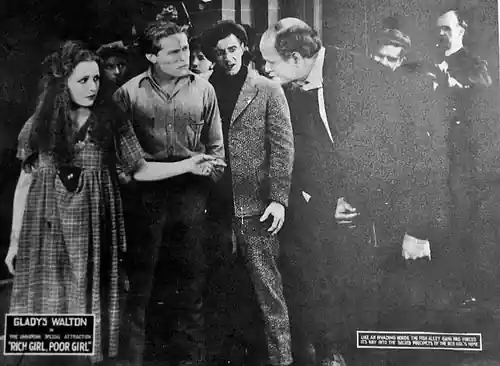
Note the year: America is months from entering the Great War; suffragists chain themselves to White House gates; the film industry itself teeters between East-Coast respectability and West-Coast carnival. Into this breach steps a parable about interchangeable women, as if the nation itself were asking whether identity is portable property.
Antrim Short’s Nora arrives first, scurrying across the sand-dusted backlot that passes for a coastal road. Her gait is bird-like yet burdened, shoulders hiked toward ears as though permanently flinching. When she spies Beatrice’s estate, her pupils dilate not with greed but with the reflexive arithmetic of survival: shelter = life. In close-up, Short’s nostrils flare like a prey animal scenting hay in the stable of the damned.
Walton’s Beatrice, by contrast, enters in a static tableau: seated beneath a parasol embroidered with her monogram, she pets a lapdog that looks as bored as she does. Yet Walton lets micro-tremors betray the performance: a thumb rubbing the same spot on the dog’s head until the animal whimpers, a tongue clicking against teeth in Morse code for get me out. The moment the girls stand shoulder-to-shoulder, the film slices to a profile two-shot so exact that their hairlines fuse into one ridge—an eclipse of social strata.
Younger’s intertitles flirt with aphorism: "Poverty teaches hunger; wealth teaches thirst." But the real dialogue is choreographed through props. Nora has never seen a grapefruit; Beatrice has never seen a flatiron. When they trade garments, the fabrics themselves seem to resist—cotton that balks at pearl buttons, chiffon that snags on calloused palms. The screenplay’s brilliance lies in refusing to grant either girl a triumphant arc; instead, each environment weaponizes its own etiquette. In the manor, Nora is nearly undone by a soup spoon placed at the wrong azimuth; in the tenement, Beatrice is almost trampled by a horse she fails to bribe because she offers a coin minted for the 1893 Exposition—foreign currency in her own homeland.
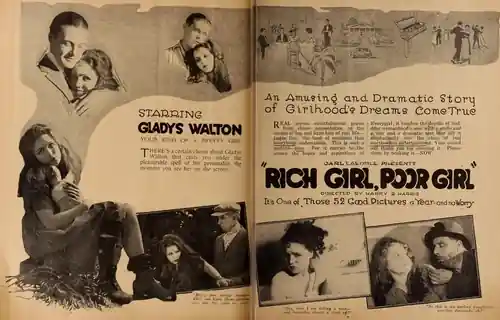
Cinematographer Charles Stumar (uncredited in most surviving prints) shoots the estate interiors like a cathedral of debt: every candelabra doubled by its reflection in mahogany, suggesting a ledger that never balances. Shadows are not merely absence but litigation—claiming walls, faces, even the negative space between lovers. When Nora-as-Beatrice descends a staircase for her debut dinner, the banister’s shadow shackles her wrist in a visual forecast of the legal trap tightening.
Contrast this with the dockside sequences: handheld, almost documentary, where the camera itself seems to smell of kerosene. The aspect ratio appears to shrink, as though poverty were a letterbox squeezing the world into a peephole.

Surviving exhibition notes indicate the film toured with a cue sheet calling for "Scriabin études during the switch, a single bass drum hit when each girl recognizes her mirror." Contemporary restorations often substitute a pastiche of Debussy, but the true score is the caesura—the splice where the celluloid itself gasps. Listen to that splice: it sounds like a guillotine made of sprockets.
Place Rich Girl, Poor Girl beside its 1917 doppelgängers and its DNA proliferates. Where One Every Minute uses mistaken identity for slapstick, Hawks weaponizes it for class autopsy. The moorlands of The Secret of the Moor trade on Gothic fog; here the fog is cigar smoke in a mahogany billiard room, just as obscuring, twice as carcinogenic.
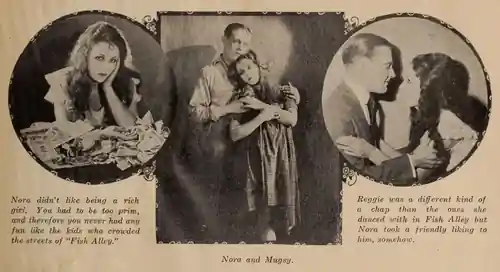
Meanwhile, the gender vertigo of A Virtuous Vamp feels featherweight compared to the ruthless materiality of this film’s body swap: uterine cramps, corset bruises, the copper stink of menstrual rags reused ad infinitum. Even Das Grand Hotel Babylon, for all its continental opulence, never confesses that luxury is merely violence upholstered in damask.
Joe Neary’s district attorney, Charles Herzinger’s lecherous uncle, Gordon McGregor’s blackmailing chauffeur—each man circles the swapped girls like hyenas sniffing for weakness. Yet the film’s radical coup is denying them narrative restitution. When Neary’s character attempts to expose Nora’s imposture via a courtroom crescendo, the film cuts away to Beatrice—now broken-nailed and fevered—too ill to corroborate either story. Justice, like a coin spun on a bar, simply wobbles into silence.
The lone surviving 35 mm nitrate print—rescued from a flooded basement in Paducah—was transferred by LoC in 2019. The 2K scan reveals hairline cracks that resemble lightning over the mansion’s façade: serendipitous visual thunder. Streaming on niche services (Kanopy, Criterion Channel rotating slate) but best experienced via Blu from GarageScreen Editions, whose booklet folds out into a replica of the girls’ dual-sided calling card: Beatrice’s name in raised gold, Nora’s penciled on the reverse.
Great films leave scars; this one leaves fingerprints burned into the glass of a mirror you swear you never looked into. Long after the projector’s click subsides, you will find yourself checking your own reflection for signs of forgery—wondering which version of you cashed the paycheck, kissed the spouse, bore the bruise. In 1917, two anonymous women asked if identity were a garment you could shrug off; in 2024, the question still itches like a collar made of nettles. Rich Girl, Poor Girl endures because it refuses to answer—only to accuse.
IMDb —
1917
Community
Log in to comment.