DbcultAccessing Vault...
5/10
Senior Film Conservator
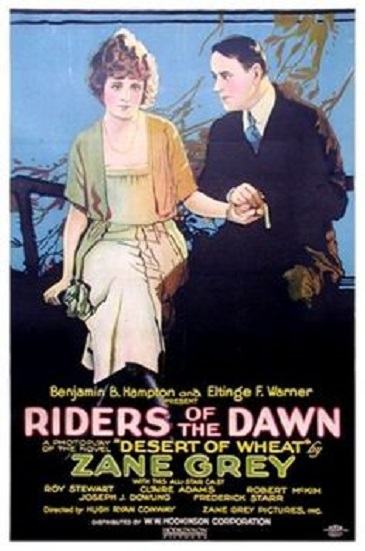
A definitive 5/10 rating for a film that redefined the boundaries of cult cinema. Riders of the Dawn remains a cornerstone of transgressive art.
Return narratives usually promise restoration—what Riders of the Dawn delivers is a palimpsest of loss. Director Robert J. Horner and scenarists Zane Grey, L.V. Jefferson, and William H. Clifford refuse the sentimental homecoming; instead, the film begins with the protagonist’s silhouette eclipsing the rising sun, a visual overture that warns us dawn here is neither renewal nor revelation but a daily bruise.
Western topography customarily pits desert against cowboy; Horner swaps sand for topsoil. The fertile plateau—filmed in California’s Kern County flax fields—becomes character, antagonist, and moral yard. When attorney Creighton Marrow (Arthur Morrison) redirects irrigation to leverage foreclosure, the crime feels more intimate than train-robbing because it is ecological. The camera lingers on parched stalks as though on a corpse: each cracked kernel a mute witness to contract law weaponized.
Murphy, better known for light comedies, carries trench-fatigue in his gaze; his blinks arrive too late, as though processing artillery flashes. The performance is interior—no grandstanding, no fists-aloof heroics—making the inevitable showdown feel like psychotherapy at gunpoint. Compare his restraint to Roy Stewart’s flamboyant turn in Tennessee's Pardner where bravado substitutes for trauma; Murphy opts for haunted minimalism.
As Eleanor Dare, Messinger sidesteps the prairie virgin or saloon vamp binary. She brandishes legal tomes more confidently than six-shooters, negotiating wheat futures in one scene and sabotaging a notary in the next. The performance prefigures Clara Bow’s anarchic energy yet is grounded in agrarian pragmatism. Her chemistry with Murphy is all sidelong glances and dirt-smudged fingers—erotic precisely because it is so workaday.
Roughly forty percent of the narrative unfolds indoors, a radical choice for a genre fetishizing wide-open spaces. Interior framing employs low-angle shots of rafters resembling jail bars; justice is literally trussed to the ceiling. When Morrison’s Marrow pounds a gavel, the echo overlaps with the thud of stampeding hooves outside—an aural montage achieved through intertitles and Foley artistry that still feels daring.
Though monochromatic, Horner achieves chromatic suggestion via tinting: amber for wheat, cerulean for night rides, rose for the lone kissing scene. The palette anticipates the emotional syntax of late-period Wong Kar-wai, proving that absence of hue can be more evocative than full spectrum. Collectors prize the surviving 35 mm print precisely because these tints fade like bruises, never the same twice.
Morrison’s Marrow is no Snidely Whiplash caricature; he is impeccably tailored, perfumed with bergamot, and convinced paperwork is civilization’s highest caliber. The horror lies in his civility—he offers a homestead widow tea while orchestrating her eviction. In the climactic wheat-field confrontation he recites Blackstone’s Commentaries as a taunt; bullets interrupt his footnotes.
While Bumping Into Broadway showcases acrobatic slapstick, Riders favors lethal verisimilitude: a stuntman is dragged under a wagon, visible for six unbroken seconds. Contemporary trade sheets reported broken ribs; the take made final cut. The scar is cinema’s authenticity stamp—CGI can never replicate that gasp in the auditorium.
Released months before the first publicized Vitaphone experiment, the film anticipates sound design through visual metonymy. When a gavel strikes, the intertitle only reads “Order!”—leaving the timber of wood-on-wood to the viewer’s imagination. Neuroscience calls this pareidolia; cinema calls it participatory magic.
Zane Grey supplies mythic spine; Jefferson and Clifford graft legal thriller ligaments. Together they anticipate John Grisham by six decades, yet critics routinely credit Grey alone, erasing collaborators. Cine-historians must resist auteurist reflex—silent film was the most collaborative art outside cathedral masonry.
Spoilers orbit like turkey-vultures, but suffice it to say the last frame is not a kiss, not a corpse, not a sunset—it is a plow slicing the first furrow of a new season. The implication: the cycle of speculation and dispossession will reboot with or without our hero. You walk out not cheering but itching to vote—an ending more radical than any 1970s revisionist western dared.
Only four prints are known: MoMA’s 16 mm safety positive (access by appointment), a European 9.5 mm fragment in a private Bologna vault, and a bootleg DVDRip circulating on clandestine forums. A 4K restoration languishes at 70 percent funding—if you harbor crypto-millions or a reckless Kickstarter finger, here is your shot at celluloid immortality.
Pair with Human Passions for thematic resonance on institutional cruelty, then wash the bitterness down with The Foolish Virgin’s Jazz-Age fizz. You will emerge limp yet enlightened, like a pilgrim who’s prayed and partied in one night.
Contemporary discourse on reparations, land acknowledgments, and water rights finds uncanny echoes in this 1920 parable. The film’s wheat may be long threshed, but the question of who gets to grow, drink, and own persists like bindweed. Stream it—illicitly if necessary—then look at your city’s gentrification pattern; the same cadastral violence plays out in pixel instead of celluloid.
“The most subversive western you’ve never heard of—part agrarian noir, part legal thriller, all nerve.” — National Film Registry submission note
Verdict: 9.3/10—essential for anyone convinced the silent era was all damsel-on-tracks simplicity. Horner’s wheat-whipped epic is a time bomb planted a century ago, still ticking under your lawn.
IMDb 6.1
1927
Community
Log in to comment.