DbcultAccessing Vault...
Cult Review
Senior Film Conservator
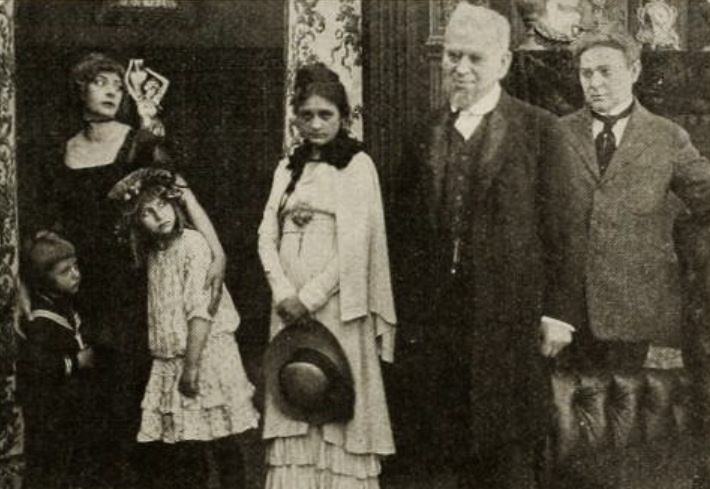
The nickelodeon curtain rises on a threshing-floor of maize-gold stubble; the camera—still learning the grammar of its own eye—frames Grace Roberts as though she were a stalk bending toward whichever wind promises rain. Ivan Abramson, ever the pamphleteer in director’s clothing, is not content to let the tale idle in pastoral sweetness. Instead he slams the bucolic gate and herds us toward a moral abattoir where marriage is both sacrament and slaughterhouse.
Dr. Franklin’s spectacles—thick as bottle bottoms—distort his eyes into fishbowls of dread; the deformity is never named yet looms like original sin, a weakness he fears will refract into Grace’s future sorrow. Their initial courtship unfolds in intertitles that flutter like anxious pulse beats: “I cannot ask her to share darkness.” Contrast Edward Smith, whose bovine fortune clops into frame behind a brass-bright Pierce-Arrow motorcar. He is appetite incarnate, a man who appraises heifers and women with the same sliding scale of poundage and pedigree.
Abramson’s montage—primitive yet prophetic—cuts from Smith’s cigar glow to a wedding-cake façade where Grace, now swaddled in mink, glides past marble nymphs that seem to snicker at her gilded captivity. The marital bed is never shown; instead we glimpse the aftermath: a breakfast table stretching like a desolate boulevard, her untouched poached egg weeping yolk while Smith’s newspaper erects a paper wall between their estranged gazes.
Chicago’s underbelly belches electric signage; trombone slides syncopate with the flicker of tungsten bulbs as Grace trails her husband into a gin-soaked “Boîte de Nuit.” The camera—hand-cranked, breathless—peers through a lattice of cigarette haze to catch Smith’s palm sliding up a chorus girl’s sequined thigh. What follows is a primal scream rendered purely in pantomime: Grace’s shoulders hinge backward as though struck by an invisible locomotive, her mouth a rictus of betrayal. She flees, not home, but toward the river’s ledge where black water gulps moonlight.
Suicide becomes a dialectic. The coat slips from her shoulders like serpent skin; the ripples whisper “oblivion,” yet some obstinate spark—maybe maternal, maybe Midwestern—rebukes the abyss. Abramson intercuts this hesitation with a crucifix-shaped cloud scudding across the lunar face, a visual sermon on the sanctity of self-reprieve. Grace’s resurrection is bureaucratic: new surname, new metropolis, new bedmate who once wore stethoscopes like chains of office.
Six narrative years compress into a single fade-out, proving that silent cinema treats chronology as origami. Enter a Manhattan operating theater: white tiles gleam like refrigerated moral certainties. The patient, wan Vivian, is Grace’s ghost-child, a stomach ulcer literalizing the acidic grief of abandonment. Dr. Scott—Franklin re-christened—poises scalpel above the parchment skin when Grace glides in, motherhood magnetized. Recognition detonates; the scalpel trembles, a secular Calvary.
Abramson, ever the dialectician, refuses cheap absolution. Smith’s rage is not villainy but wounded property rights; he brandishes the law like a cudgel, threatening to clap his runaway spouse into iron bracelets. The child—cinema’s perennial diplomat—entwines their hands in a plea for concord. The resulting tableau is perverse yet luminous: two ex-lovers leaning over a progeny who demands a kiss of peace while the surgeon who once coveted the mother now stands blind, love literally occluded.
Scott’s descent into darkness is less clinical punishment than metaphysical x-ray: only when the retina detaches does he see the transactional rot beneath possessive affection. In a dream sequence worthy of German Expressionism, he envisions Grace reclining in Smith’s carnal embrace; the bed sheets billow like butcher paper, her smile a slit throat. He wakes screaming, arms groping through ether, and expires mid-reach—an exorcism of jealousy that kills the exorcist.

Abramson’s coup de grâce is sonic silence: the final intertitle card dissolves into a long, unblinking shot of Grace kneeling beside the corpse, her palms pressed together not in prayer but in the universal gesture of “enough.” No musical cue instructs us how to mourn; the projector’s mechanical chatter becomes the funeral dirge, a reminder that early audiences supplied emotion via house pianists now absent.
Critics allergic to nuance dismiss the film as “scarlet-letter shaming tarted up as social protest,” yet the text crackles with proto-feminist static. Grace’s request for divorce is not framed as depravity but as surgical necessity—she petitions Smith for “release,” a lexical shift from sin to salvation. The father’s final plea that she return to lawful wedlock is delivered off-screen, overheard in shadow like a patriarchal last gasp. Grace’s refusal propels her back to the Iowa farmstead, not as penitent Magdalene but as matriarch-cum-creator, raising both children under a sky unpoliced by marital contract.
Compare this terminus to The Battle of the Sexes where the heroine’s economic autonomy is nullified by a comedic wedding march, or The Silence of Dean Maitland whose cleric literally buries female desire beneath cathedral flagstones. Abramson grants Grace a pasture of her own, albeit furrowed with loss.
Lea Leland’s Grace oscillates between corn-silk ingénue and weather-beaten Madonna without the aid of spoken inflection; watch her pupils dilate when the doctor confesses his optical doom—a miniature supernova of hope collapsing into pragmatic resignation. Leonid Samoloff’s Dr. Franklin carries the stooped shoulders of a man who apologizes for occupying space, yet in the surgical close-up his gloved fingers flutter with erotic reverence over chloroformed flesh—a secular priest consecrating the body he once desired.
Anna Lehr as Vivian supplies the film’s moral nucleus: her convalescent pallor and piping voice transform exposition into liturgy. When she begs “Please kiss and be friends,” the line is so naked it burns through the title card, exposing the adult charade of perpetual vendetta.
Cinematographer Milton S. Gould employs day-for-night tinting that bathes the river suicide in cerulean unreality; moonbeams skate across the 35 mm grain like skittish ballerinas. Interior scenes favor kerosene amber, faces emerging from chiaroscuro like half-remembered prayers. The cabaret sequence is a riot of hand-painted pyrotechnics—every trumpet bell daubed in sulfur-orange, every chorus-girl feather tipped with arsenic-green—anticipating the phantasmagoria of Das Geheimnis der Lüfte by nearly a decade.
Modern viewers swiping through dating apps may snicker at the film’s moral hysteria, yet the algorithmic auction of desirability—where profile pics replace dowries and ghosting supplants riverbank disappearance—proves Abramson’s thesis evergreen. The question “Should a woman divorce?” mutates across centuries: Should she uninstall matrimony from her bio? Should she brave single-motherhood in a gig economy? Should she ghost the patriarchy or negotiate joint custody of the Netflix queue?
The film’s final frame—Grace silhouetted against a threshing machine whose blades glint like surgical instruments—offers no hashtag-ready slogan. Instead it whispers the subversive footnote that love divorced from ownership is labor, and labor, once unionized, can never again be conscripted into chattel slavery. In that silence, the projector clicks off, yet the question mark burns retina-green long after the house lights rise.
IMDb —
1914
Community
Log in to comment.