DbcultAccessing Vault...
Cult Review
Senior Film Conservator
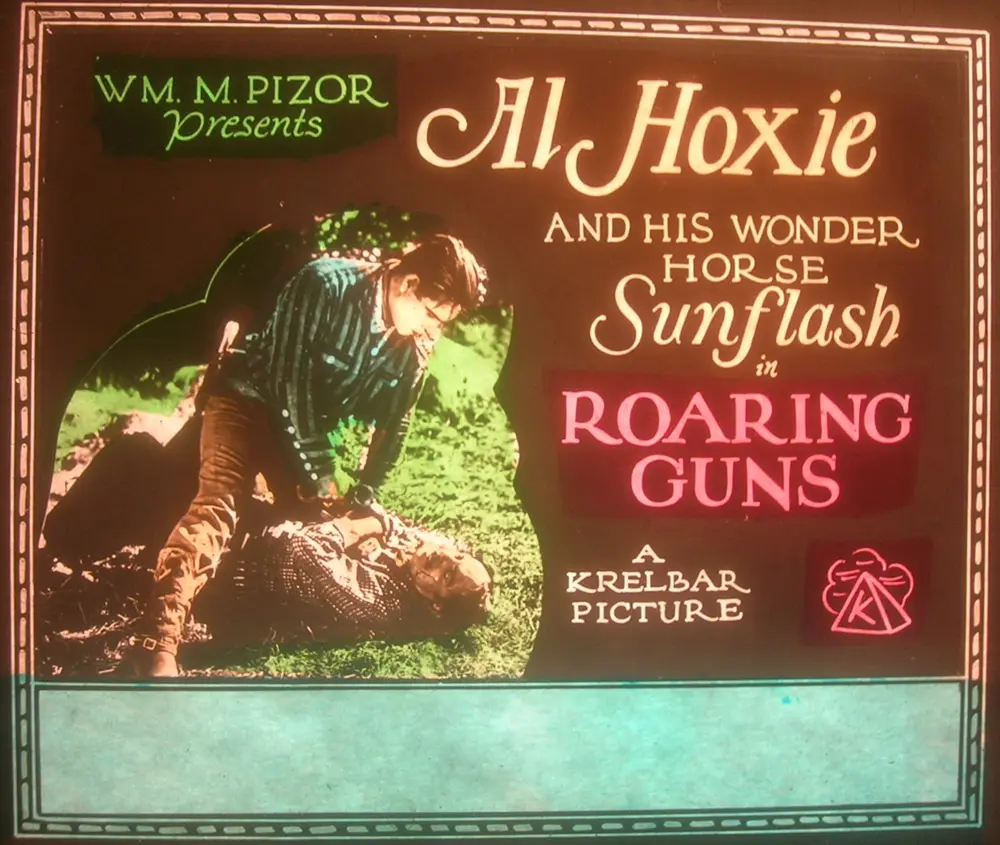
No, Roaring Guns is not a film for everyone today. This silent Western offers a raw, unpolished experience, making it a niche watch primarily for dedicated historians and those fascinated by the evolution of stunt work, but a difficult recommendation for casual viewers seeking a compelling narrative or emotional depth.
It’s a peculiar artifact, less a fully realized film and more a dynamic showcase for physical prowess. If you arrive expecting anything beyond relentless, if somewhat repetitive, action sequences, you will likely find yourself bored. However, for those with a specific interest in the mechanics of early filmmaking and the sheer daring of its performers, it holds a certain, gritty allure.
This film works because... it delivers genuinely thrilling horse stunts and a relentless, if simplistic, pace that captures the raw energy of early Westerns. The physical daring on display is undeniable.
This film fails because... its narrative is threadbare, the characterizations are rudimentary, and its attempts at dramatic tension often fall flat due to a distinct lack of emotional nuance. The story is merely a vehicle for the action.
You should watch it if... you are deeply interested in silent film history, particularly the development of Westerns and stunt choreography, and can appreciate a film for its technical audacity over its storytelling sophistication. It's a technical demonstration first, a story second.
Roaring Guns wastes no time establishing its premise: a virtuous woman, a valuable ranch, and a gang of villains eager to seize it. The oil beneath her land serves as the classic MacGuffin, a simple motivator for endless chases and shootouts. Cliff Lyons steps in as the archetypal lone cowboy, a figure whose motivations are less about personal stakes and more about a generalized sense of frontier justice. He appears, he helps, he rides off. It's a formula so distilled it borders on skeletal.
The film’s narrative engine runs on pure propulsion, moving from one confrontation to the next with minimal exposition. Intertitles provide just enough information to bridge the action, often feeling like captions for a series of moving photographs rather than integral parts of a unfolding drama. There's no real subtext, no hidden agendas beyond the obvious. This directness can be refreshing in its lack of pretense, but it also leaves the viewer with little to chew on once the dust settles.
Cliff Lyons, primarily a stuntman, brings exactly what you’d expect: an impressive physical presence and an almost superhuman ability to stay on a horse through impossible maneuvers. His acting is less about conveying emotion and more about projecting a stoic, capable masculinity. He’s a man of action, not words – a necessity in a silent film, but also a limitation for character depth. When he squints into the distance or clenches his jaw, it’s a gesture of resolve, not a window into a complex inner life.
Ione Reed, as the damsel in distress, fulfills her role with the expected silent-film theatrics: wide eyes of fear, clasped hands of despair, and eventual looks of gratitude. Her character exists largely to be imperiled, providing the impetus for the hero's interventions. Paul Hurst, as the villain, chews scenery with relish, his sneers and menacing gestures broad enough to be understood even in the cheap seats. There’s no subtlety, just pure, unadulterated villainy, which, for a film of this era, is often all that was required.
However, the true star of Roaring Guns is arguably Sunflash the Wonder Horse. Sunflash performs with an intelligence and athleticism that often overshadows his human counterparts. The horse is not merely a mode of transport; it’s a character, executing falls, jumps, and gallops with remarkable precision. Watching Sunflash navigate treacherous terrain, often appearing to save Lyons from certain doom, is easily the most engaging aspect of the film. It's an odd thing to say, but the animal's contribution feels more genuine than many of the human performances.
The film’s greatest strength, and its most limiting factor, is its relentless focus on action. From the moment the conflict is introduced, Roaring Guns is a blur of horse chases, gunfights, and daring escapes. Director Al Hoxie keeps the camera moving, even if the compositions are often functional rather than artistic. We get a sense of the vast, open spaces of the West, but always framed around the immediate need for pursuit or evasion. There’s a raw, visceral quality to the stunts; you can feel the impact of the falls and the speed of the horses. This isn't CGI, it's real people and animals pushing physical limits.
Yet, this constant forward momentum eventually becomes monotonous. Without significant pauses for character development or narrative twists, one chase begins to blend into the next. The stakes, while clear, never feel particularly high because the characters are so thinly drawn. It’s the kind of film where you appreciate the effort and the danger, but find yourself emotionally disengaged. The film's reliance on physical spectacle ultimately hinders its ability to truly engage on a dramatic level, reducing characters to mere props in a series of stunts.
While Roaring Guns offers a fascinating look at early stunt work, its dramatic weaknesses are impossible to ignore. The plot is predictable, the villains are cartoonish, and the hero, while physically impressive, lacks any compelling internal life. Dialogue, delivered through intertitles, is functional but never witty or insightful. This isn't a film designed to resonate on an emotional level or provoke thought; it's designed to entertain with movement and danger.
It's also worth noting the primitive technical aspects. The cinematography, while capturing the action, rarely rises above basic documentation. Editing is often brisk, but sometimes jarring. The lack of a score (in many silent film prints) further emphasizes the film's starkness, leaving the viewer to imagine the accompanying music, which would have been crucial for building atmosphere and emotion in its original exhibition.
While often celebrated for its historical placement, the actual viewing experience of Roaring Guns today feels more like an academic exercise than genuine entertainment, confirming that not all early Westerns aged equally well. Films like The Spy (1917) or even earlier, more character-driven pieces, sometimes surprise with their enduring watchability. Roaring Guns, however, struggles to transcend its era's limitations.
Roaring Guns is a curio, a testament to the sheer physical bravery of early Hollywood stunt performers and animals. It’s a film that demands to be viewed through a specific lens – one of historical appreciation for its technical audacity, rather than as a fully satisfying dramatic experience. It’s a silent Western that delivers on its title’s promise of loud, impactful action, but little else. If you are a student of cinema history or a devotee of practical stunts, you might find something to admire in its raw energy. For everyone else, there are far more engaging silent films and Westerns that have weathered the decades with more grace and storytelling prowess. It's a film to study, not necessarily to enjoy.
IMDb 5.9
1930
Community
Log in to comment.