DbcultAccessing Vault...
Cult Review
Senior Film Conservator
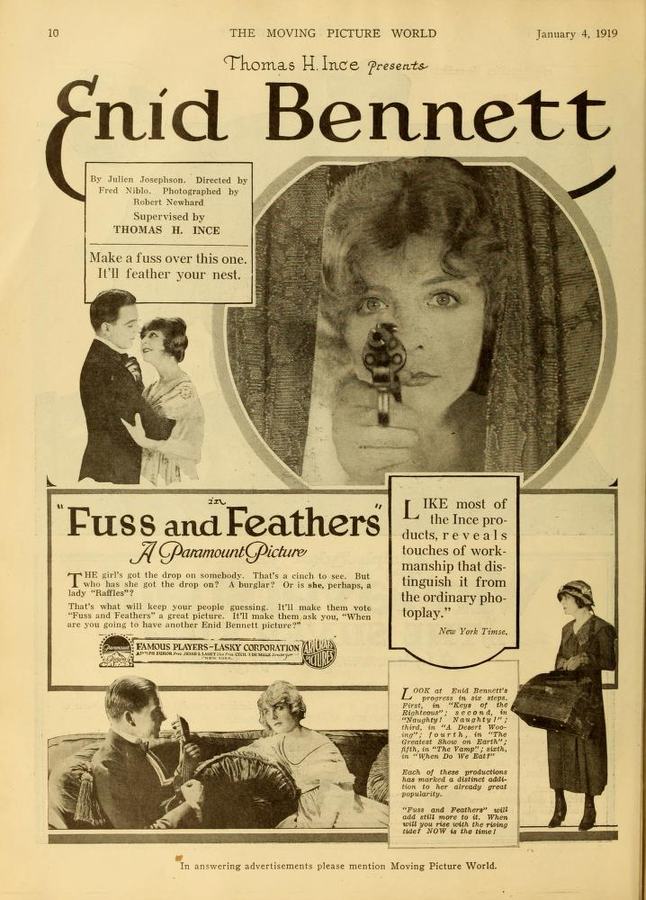
Stepping back into the cinematic landscape of 1918, one encounters a curious gem, a film that, despite its century-plus vintage, still manages to pluck at the enduring strings of class, ambition, and the eternal quest for belonging. Fuss and Feathers, a title that perfectly encapsulates the delicate balance between societal pretense and genuine human spirit, emerges as a delightful social satire, anchored by a premise that remains as relevant today as it was in the nascent years of Hollywood. It’s a narrative about transformation, not just of circumstance, but of self, observed through the keen lens of societal expectation and personal aspiration.
The film introduces us to a young woman, initially devoid of the polished veneer of high society, whose life takes an abrupt and unexpected turn toward opulence. Imagine, if you will, the sudden jolt of inheriting a fortune, a windfall that propels one from the familiar comfort of the common into the bewildering labyrinth of the elite. Our protagonist, portrayed with an endearing blend of naiveté and burgeoning confidence by Enid Bennett, finds herself in precisely this predicament. Her wealth is undeniable, yet her social education is, shall we say, a work in progress. This isn't merely about acquiring new clothes or a grander residence; it's about mastering an entirely new language, a silent lexicon of gestures, etiquette, and unspoken rules that govern the upper crust.
Enter the other crucial player in this social charade: the disinherited son of an upper-class family. This young man, through circumstances that are only hinted at but deeply felt, has been cast adrift from his inherited privilege. He possesses the very attributes our newly wealthy heroine lacks: an innate understanding of social graces, a natural command of aristocratic bearing, and a lineage that speaks volumes even when his pockets are empty. The irony is palpable and deliciously explored. He is a walking, breathing manual of high society, yet one who has been deemed unworthy of its full embrace. His role as a tutor, therefore, is not just a job; it’s a poignant commentary on the fluidity of social standing and the sometimes-arbitrary nature of its rewards.
Douglas MacLean, in the role of this fallen aristocrat, brings a nuanced performance to the screen. He isn't merely a caricature of the stuffy upper class; there's an underlying vulnerability, a quiet dignity to his predicament. His interactions with Bennett’s character are initially marked by a professional distance, but as the lessons progress, a more complex dynamic begins to emerge. It’s a dance of power, of knowledge, and eventually, of mutual respect and perhaps something more profound. This dynamic, reminiscent of Pygmalion-esque narratives, is handled with a light touch, never descending into didacticism, but rather allowing the characters' evolving understanding of each other to speak volumes.
Enid Bennett’s performance is, without hyperbole, the luminous core of Fuss and Feathers. She navigates the transformation of her character from an unrefined, perhaps even gauche, young woman to a more polished, yet still authentic, social figure with remarkable grace and comedic timing. Her initial struggles with etiquette are genuinely humorous, eliciting a sympathetic chuckle rather than outright ridicule. We root for her because Bennett imbues her with an inherent decency, a core of sincerity that no amount of acquired social polish can obscure. She is not merely mimicking the manners of the elite; she is integrating them, or perhaps, more accurately, finding a way to exist within them without losing herself entirely.
This ability to convey both vulnerability and strength, awkwardness and charm, is what elevates her portrayal beyond simple caricature. It speaks to a broader theme that runs through many silent-era films concerning female protagonists navigating new social landscapes, much like the spirited character in The Little Gypsy, who also finds herself in unfamiliar territory, learning to adapt while retaining her intrinsic spirit. Bennett’s character in Fuss and Feathers embodies the spirit of self-improvement, not for superficial gain, but for a deeper sense of belonging and self-actualization.
Beyond the charming performances, Fuss and Feathers offers a subtle yet incisive critique of societal hierarchies. It questions the very foundations of what constitutes 'class' and 'refinement.' Is it inherited wealth and lineage, or is it something more profound – kindness, intelligence, resilience? The film suggests that while external markers of status can be acquired, true character often shines through, regardless of one's upbringing. The tutor, despite his noble birth, is financially broken, while the girl, despite her humble beginnings, possesses the resources to shape her destiny. This inversion of expectations provides much of the film’s thematic depth.
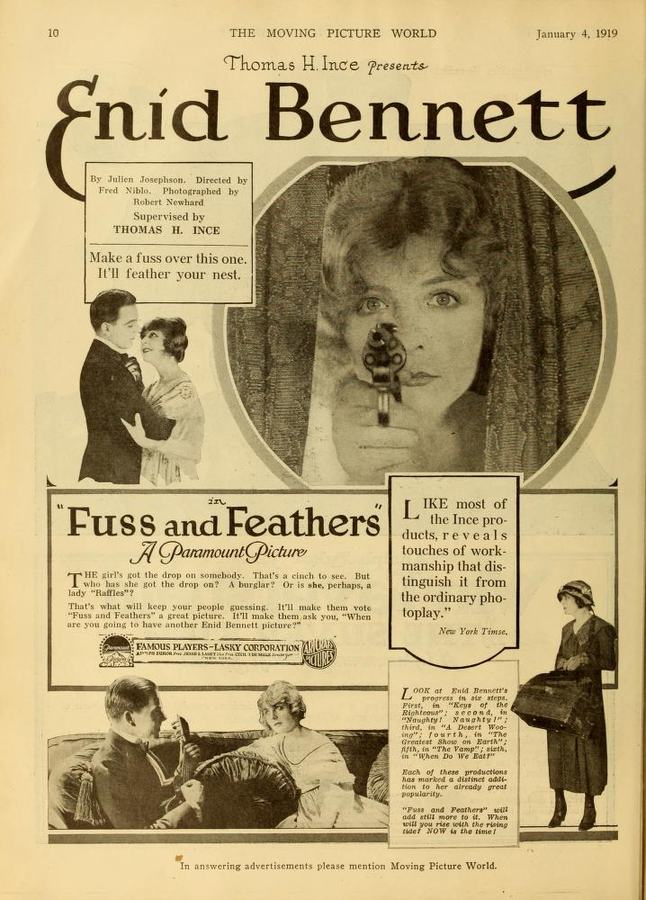
The film also touches upon the performative aspect of high society. Characters are often seen 'putting on airs,' adhering to rituals that feel more like elaborate theatrical productions than genuine social interactions. The protagonist’s journey is, in many ways, an education in this performance, learning to mimic the gestures and intonations of a world that is not inherently hers. Yet, the film subtly argues that true connection transcends these superficialities, hinting that authenticity, even if initially unpolished, ultimately holds more value than practiced pretense. This exploration of authenticity against societal pressure can be seen as a precursor to themes found in later films like What's His Name, where identity and perception are constantly at play.
Julien Josephson's script, brought to life by the directorial vision, manages to maintain a brisk pace, a commendable feat for a silent film that relies heavily on visual cues and intertitles. The cinematography, while perhaps not groundbreaking by today's standards, effectively conveys the stark contrast between the protagonist's former life and her new opulent surroundings. The sets and costumes are meticulously designed, contributing significantly to the film's ability to immerse the viewer in the world of early 20th-century American high society. The visual language is clear, concise, and serves the narrative without unnecessary embellishment.
The use of expressive acting, a hallmark of the silent era, is particularly effective here. Bennett’s facial expressions and body language communicate a wide range of emotions, from initial bewilderment to growing confidence. MacLean’s subtle gestures convey his character’s internal conflict and quiet resignation. The supporting cast, including the likes of Charles K. French and Sylvia Ashton, provide solid performances that flesh out the societal backdrop, often serving as foils or comedic relief, further enhancing the film’s engaging quality. Their collective efforts create a believable, if slightly exaggerated, world for our characters to inhabit and navigate.
The narrative arc of an individual climbing the social ladder, or attempting to, is a perennial favorite in cinema. Fuss and Feathers engages with this theme in a manner that feels both timeless and specific to its era. One might draw parallels to films like Just Out of College, where young men grapple with their place in the world and the expectations of their social standing, albeit often from a different starting point. While the contexts differ, the underlying tension between aspiration and reality, and the challenges of adapting to new environments, remain universal. The film subtly critiques the notion that inherited status guarantees happiness or success, instead advocating for a more meritocratic, or at least authentic, path.
Furthermore, the idea of a sudden change in fortune drastically altering one's social trajectory is a common trope, yet Fuss and Feathers handles it with a refreshing lack of cynicism. Instead of merely portraying the pitfalls of new money, it focuses on the personal growth and the genuine connections that can form despite, or perhaps because of, these societal divisions. The film's message, while delivered with a light touch, suggests that true value lies not in the superficial trappings of wealth or inherited status, but in the character and integrity of the individual.
In an era often remembered for its dramatic, sweeping epics or slapstick comedies, Fuss and Feathers stands out as a charming, character-driven piece that offers both entertainment and thoughtful social commentary. It's a reminder that even a century ago, filmmakers were exploring complex human dynamics and societal structures with nuance and wit. The film doesn't preach; it observes. It doesn't condemn; it questions. And in doing so, it invites the audience to reflect on their own perceptions of class, wealth, and what it truly means to be 'well-bred.'
For those with an appreciation for silent cinema, or indeed, anyone interested in the enduring themes of social mobility and personal authenticity, Fuss and Feathers is a delightful discovery. It’s a testament to the power of strong performances and a well-crafted narrative to transcend the limitations of time and technology. It’s a film that proves that a little bit of 'fuss and feathers' can, in the right hands, reveal a great deal about the human heart and the intricate tapestry of society.
The film leaves us with a pleasant sense of resolution, but more importantly, with a lingering appreciation for its gentle wisdom. It’s not just a story of a girl learning manners; it’s a story of two individuals from disparate worlds finding common ground, and perhaps, finding themselves in the process. A truly understated classic that deserves more recognition for its astute observations and its timeless charm.
IMDb 6.9
1923
Community
Log in to comment.