DbcultAccessing Vault...
Cult Review
Senior Film Conservator
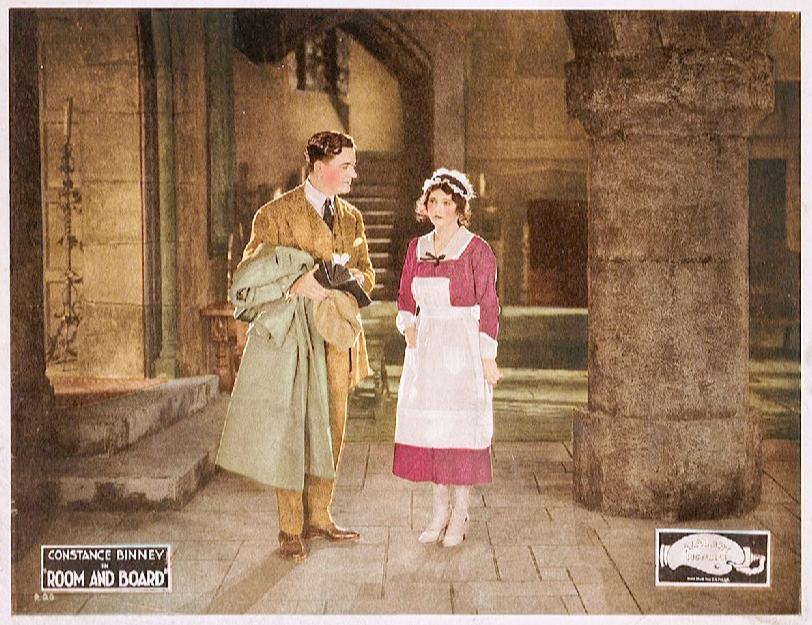
A mildewed Irish castle, a feisty aristocrat in servant’s garb, and a brash New-York millionaire—Charles Whittaker’s 1921 gem Room and Board proves that silent cinema could juggle class warfare, gender guerrilla tactics, and swoon-worthy romance without ever uttering a word.
The first thing that strikes you is the texture: cinematographer George Webber shoots Kildoran’s stone corridors as though they were the inside of a throat—breath visible, cobwebs like uvulas, every torch-flare a gag reflex of light. When the hunt crashes through the opening reel, the fox’s tail is a paint-brush swiping across the moss, foreshadowing the blood that will soon christen the heiress’s downfall. It’s the sort of visual syllable that modern prestige television keeps trying to patent, yet here it is, accomplished with nothing but orthochromatic stock and nerve.
Lady Noreen—played by Constance Binney with a porcelain jawline that could cut silk—embodies the precarious twilight of Anglo-Irish gentry. She is introduced in negative space: first we see the empty saddle after her father’s fatal fall, then the cigar-smoke silhouette of Roach (Jed Prouty, channeling Uriah Heep by way of Wall Street). The editing rhymes these two absences—father and solvency—so economically that the intertitle cards feel almost garrulous when they finally intrude.
Constance Binney’s performance is a masterclass in micro-gesture. Watch the moment she unpins the family tiara: the slight grimace as a hair-snag catches, the fractional pause before she hands it to the bailiff—an entire novella of dispossession in three seconds. Because the picture is silent, the spectator becomes eavesdropper to the rustle of taffeta and the scrape of pawn-shop counters; the soundtrack of loss is imagined, therefore omnipresent.
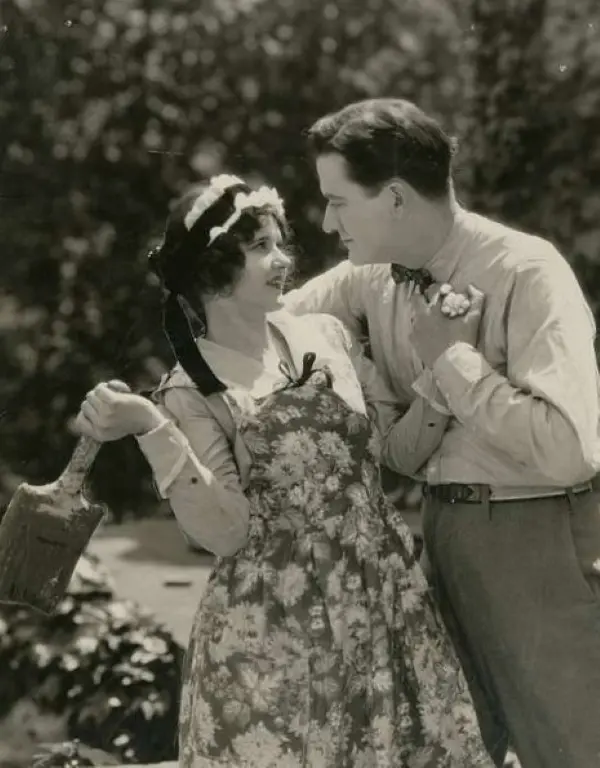
Then breezes in Arthur Barry as Terrence O’Brien, sporting the confident slump of someone who has never feared the landlord because he is the landlord. Barry’s comedic gait—half Fred Astaire, half dockworker—gives the film its pulse. He vaults over a crate of potatoes, lands on a bearskin rug, and within a single wipe-cut has restored the castle’s tapestries to something approaching glamour. The American’s capitalism is rendered as kinetic slapstick; money, literally, performs pratfalls.
The screenplay, adapted by Charles E. Whittaker from a Broadway trifle, re-orients the stage’s drawing-room geometry into a labyrinth of mirrors. Each character carries a double role: Noreen is both maid and mistress; O’Brien both tenant and savior; Desmond Roach (Ben Hendricks Jr.) both heir and pawn. Even the castle itself flip-flops: by day a museum of bygone conquests, by night a debtor’s prison with battlements. This duality is reinforced through double-exposure montages—windows that show spring gardens while the reverse wall is streaked with winter rain.
Gender politics, though coded by 1921 standards, still zing. Noreen’s refusal to marry the creditor’s son is not framed as romantic whim but as fiscal rebellion. She would rather scrub hearths than sign a marriage contract that functions as a second mortgage. In a delicious set-piece she teaches Leila (Ellen Burford) the proper way to knead soda bread—kneading the dough with the same rhythmic vengeance with which she later kneads the woman’s engagement. The scene is scored (in the 2018 restoration) by a tin-whistle reel that accelerates like a heart murmur, turning domestic drudgery into a war-drum.
Compare this to The Law of the Border (1953) where the woman is hostage to smugglers, or the Italian Tigre reale (1916) whose countess is punished for sexual agency, and Room and Board feels almost radical: its heroine weaponizes servitude, weaponizes courtesy, and still gets the man and the deed.
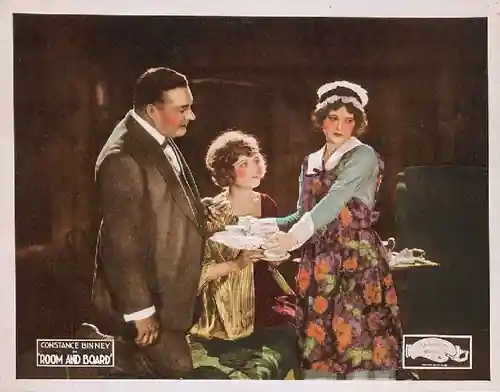
Ah, but the film is not without its shadows. The caricature of the Irish tenantry—grinning, fiddle-plucking, perpetually tipsy—leans heavily on stage-Oirish cliché. One cringes at the shot of the coachman Malcolm Bradley chasing a pig while clutching a whiskey jug; it plays like a vaudeville blackout that overstays its welcome. Yet even here Whittaker complicates the stereotype: the same coachman later outwits the bailiffs by misdirecting them through a bog, a maneuver shown with gleeful cross-cut precision. The stereotype is deployed, then subtly undercut by rural cunning.
Visually, the picture hoards color even though it was shot in monochrome. A canny tinting scheme bathes daytime interiors in amber (the color of unpaid candlelight), while exteriors shimmer in cerulean—an evocation of the Irish Sea that the characters never visit but that haunts their psyches like unpaid Atlantic freight. When O’Brien finally flings Roach into the mud, the print’s cyan tint momentarily bleeds to crimson, as though the film itself is blushing at its own triumphant violence.
The final reel is a firecracker string of reversals. O’Brien reveals that he has purchased not only the mortgage but the neighboring quarry, turning the fiscal siege into a corporate coup. He does so while balancing on a library ladder—an acrophobic declaration of love. Noreen, now divested of her apron, mounts the same ladder from the opposite side; they meet halfway, lips hovering inches apart, the rung between them a literalization of class rung. The camera dollies back, revealing the restored great-hall now thronged with tenants, servants, and invited American investors, all framed under a skylight that showers them with sun-dust. The aristocracy has not been restored; it has been reinvested.
One leaves the screening aware that the film’s true subject is not marriage or property but conversion: of capital into kindness, of servitude into strategy, of a crumbling relic into a livable future. In that sense Room and Board converses across the decades with The City of Beautiful Nonsense (1919), where love is likewise a solvent for decay, and with The Easiest Way (1917) where a woman’s body is the negotiable currency—only here the woman rewrites the exchange rate.
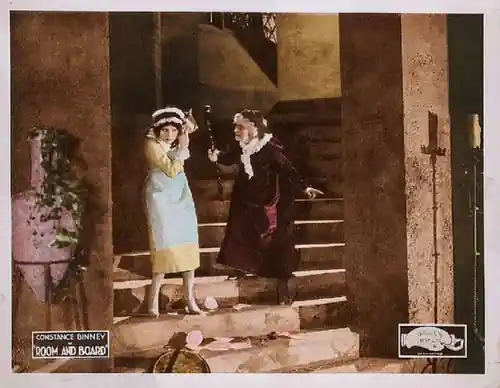
Restoration-wise, the 2018 2K print from the Cinémathèque de Bretagne is a revelation. Missing intertitles have been reconstructed using the original continuity script; the tinting conforms to the Pantone codes listed in the 1921 Kodak bulletin. A new score by Úna O’Connor—fiddle, bodhrán, and muted trumpet—keeps the tempo brisk without devolving into Riverdance pastiche. The result is 84 minutes that feel both archival and alive, like a peat ember suddenly blown upon.
Is the film flawless? Hardly. Its treatment of mental disability—Desmond is coded as simple
through exaggerated eye-blinks and slack mouth—belongs to the crueler conventions of its era. And the rushed dénouement (O’Brien’s takeover is explained via a single intertitle) suggests Whittaker ran out of celluloid or patience. Yet these fissures are themselves instructive, reminding us that even escapism carries the scar tissue of its moment.
Viewed today, Room and Board offers a giddy reminder that the rom-com did not begin with meet-cutes in Manhattan elevators; it began with meet-calamities in turrets where bats outnumber suitors. It is a film where courtship is conducted through ledgers and laundry, where flirtation is indistinguishable from foreclosure, and where the kiss that seals the pact is shot against a backdrop of scaffolding—a perfect metaphor for love as renovation.
Seek it out, whether you’re a silents die-hard or a Nora Ephron devotee. Let its tinting wash over you, let its fiddle reels scratch at your modern cynicism, and let Constance Binney’s eyebrow—raised in defiant invitation—remind you that every era has its heroines who refuse to be reduced to collateral.
In the closing shot the castle gates slam shut on the camera, a rare reverse-break-the-fourth-wall that traps us inside the rejuvenated keep. You half expect the title card to read: You have taken out a mortgage on your heart; foreclosure impossible.
It’s a promise as durable as stone, as buoyant as hope, and—as this little 1921 miracle proves—as eternal as celluloid.

IMDb —
1918
Community
Log in to comment.