DbcultAccessing Vault...
5.1/10
Senior Film Conservator
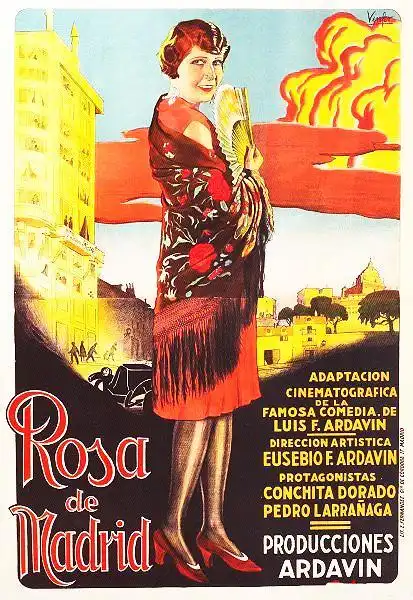
A definitive 5.1/10 rating for a film that redefined the boundaries of cult cinema. Rosa de Madrid remains a cornerstone of transgressive art.
Alright, let’s be upfront about Rosa de Madrid. Is it essential viewing today? Probably not for everyone. If you’re looking for slick storytelling or perfectly polished performances, you’re going to bounce off this one pretty hard. But if you have a soft spot for early cinema, for films that feel like a window into a slightly unkempt past, and you don’t mind a few rough edges—or even enjoy them—then yeah, give it a shot. It’s a specific taste, though. Casual viewers, probably skip it.
Conchita Montenegro, as our titular Rosa, has this undeniable spark. It’s not always consistent, mind you. There are moments where her energy just radiates off the screen, particularly in the market scene where she’s haggling for flowers. You can almost feel the dust and the noise. But then there are other stretches where she defaults to a kind of wide-eyed earnestness that gets a little repetitive. It's less acting, more a series of poses she knows the camera likes.
The pacing here is… interesting. There’s a scene, early on, where a character—I think it was Pedro Larrañaga’s character, though it’s hard to be sure without a proper plot synopsis handy—walks from one end of a plaza to the other. And the camera just holds. For a solid thirty seconds. You start noticing the details in the background: the way the light hits a particular building, a dog sniffing around a cart. It’s not necessarily bad, but it definitely feels like the film is asking you to slow down, maybe a little too much.
And the editing, oh boy. There are jump cuts that feel less like artistic choices and more like someone just snipped a bit out because the reel was getting long. One moment, Rosa is looking wistful by a fountain, the next, she’s in a completely different dress, laughing with a group of friends. The transition is so abrupt it almost gives you whiplash. It’s charming in its clunkiness, though. You can almost feel the film trying to convince you this moment matters, even if it hasn't quite earned it.
The costumes are a mixed bag. Rosa’s outfits are generally lovely, fitting for the era. But there’s a recurring extra, a man with a truly enormous, almost comically oversized bowler hat, who pops up in several crowd scenes. Every time he appears, he draws your eye. You start wondering if it was a prop department joke, or if that was just his everyday hat. It's a small thing, but it takes you out of the story, just a little.
Dialogue, when it’s there, can be a bit stilted. Not always, but enough that you notice. There’s a particular exchange between Rosa and a suitor where the lines just don't quite land. It’s like they’re reading from cue cards that are slightly out of sync with their emotions. You get the gist, but the natural rhythm is missing. It feels… rehearsed, not lived.
But then, every so often, Rosa de Madrid hits on something genuinely lovely. There’s a sequence where Rosa is simply dancing in a sun-dappled courtyard, completely alone. No dialogue, just the music and her movements. It’s surprisingly affecting. It feels like a moment of pure, unadulterated joy, and it’s a stark contrast to some of the more forced romantic entanglements. It’s these quiet, almost accidental moments that stick with you.
The tonal shifts can be quite jarring too. One minute, it’s a light romantic comedy with playful chases through the streets, the next, it’s trying to be a serious drama about unrequited love. The film struggles to blend these two modes, often switching gears so abruptly that you’re left wondering if you missed a scene. It doesn’t quite settle into a consistent mood, which can be frustrating if you’re trying to invest in the emotional arc.
Overall, Rosa de Madrid is a peculiar little film. It’s not a masterpiece, and it won’t rewrite your understanding of cinema. But for those who appreciate the quirks and charms of older films, who enjoy watching actors figure out their craft in real time, and who don't mind a meandering pace, there’s something here. It’s a film that demands patience, but occasionally rewards it with a flash of genuine human spirit, or just a really big hat.
IMDb —
1920
Community
Log in to comment.