DbcultAccessing Vault...
Cult Review
Senior Film Conservator
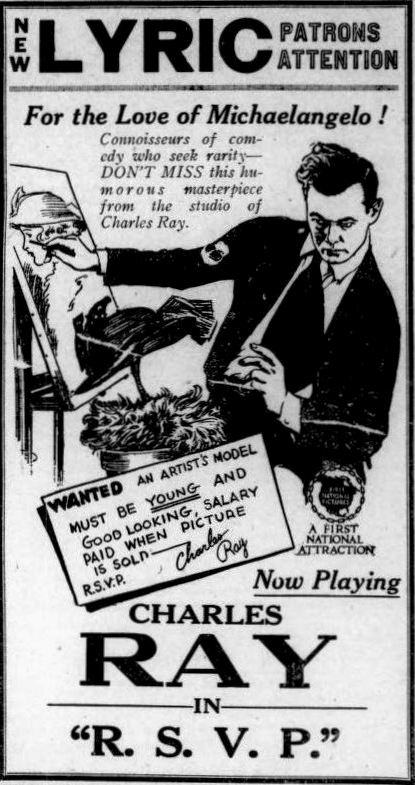
In the dimly lit garret where Richard Morgan’s brushes dance, *R.S.V.P.* (1920) unfolds as a silent film that resonates with the same fervor as a Monet painting. Edward Withers and Rob Wagner’s script—a delicate balance of romantic yearning and socioeconomic critique—positions Richard as a quintessential starving artist, his poverty not merely financial but existential. The film’s opening shots of his cluttered studio, with canvases half-finished and charcoal dust clinging to his overcoat, evoke the same raw vulnerability as a Toulouse-Lautrec sketch. Yet, unlike the hedonistic depictions of bohemian life in *The Yellow Passport* (1922), *R.S.V.P.* grounds Richard’s struggles in authenticity, his artistry a lifeline against the tide of obscurity.
Enter the artist’s model—a character who transcends the traditional muse trope to embody the paradox of privilege. Her wealth, symbolized by the gilded frames of her boudoir and the crisp folds of her designer gowns, becomes a prison of expectations. Jean Calhoun’s performance is a masterclass in subtlety; her gaze lingers on Richard not with pity, but with a yearning that mirrors his own. This dynamic evokes the tragic duality seen in *The Heart of a Rose* (1919), where beauty and freedom are mutually exclusive. The film’s visual language—shadowed close-ups of her conflicted expressions, wide shots of Richard’s cramped quarters—amplifies the chasm between their worlds.
Richard’s salvation lies not in a grand gesture, but in the quiet triumph of his craft. His paintings, initially dismissed as the scribblings of a penniless eccentric, gain traction when exhibited at a gallery that caters to the same elite who mock his poverty. This turn of events, while narratively convenient, serves as a sharp critique of the art world’s fickle embrace of the avant-garde. The final scene, where Richard’s work hangs alongside the model’s portrait, is a visual metaphor for the reconciliation of art and life—a theme echoed in *Scarlet Days* (1923), though with far less nuance.
Charles Ray’s Richard is a study in duality: the gaunt figure hunched over his easel radiates both fragility and tenacity. His interactions with Harry Myers’ boisterous friend—a character reminiscent of those in *Ever Since Eve* (1920)—add levity without undermining the narrative’s gravity. Florence Oberle, as Richard’s landlady, delivers a nuanced performance that humanizes the often-overlooked figures in silent cinema. Her scenes with Richard, particularly their exchanges over unpaid rent, are imbued with a pathos that transcends dialogue, relying instead on the expressive power of her eyes.
Director Jean Calhoun’s visual style—marked by stark chiaroscuro and meticulous set design—elevates *R.S.V.P.* from a melodrama into a visual poem. The contrast between Richard’s dingy garret and the model’s opulent residence is not merely symbolic; it’s a narrative device that underscores the film’s central tension. The use of mirrors to reflect Richard’s artistic process is particularly striking, their glass surfaces doubling as portals into his psyche. This technique parallels the introspective framing in *Between the Acts* (1921), though *R.S.V.P.* employs it with greater emotional resonance.
Though nearly a century old, *R.S.V.P.* resonates with contemporary audiences grappling with the intersection of art, commerce, and identity. Its critique of elitism and the commodification of creativity feels eerily prescient in an era where social media fame often supersedes artistic merit. The film’s resolution—where Richard’s talent, not his wealth, secures his place in society—offers a bittersweet optimism that aligns with the themes of *The Glory of Yolanda* (1926), albeit with a more grounded perspective. For historians and cinephiles, *R.S.V.P.* is a vital artifact of early 20th-century cinema, its legacy preserved in the hushed reverence of film archives.
While *R.S.V.P.* shares thematic DNA with *Das rosa Pantöffelchen* (1919)—both explore the artist’s struggle for recognition—their tonal differences are stark. Where *Das rosa Pantöffelchen* leans into farce, *R.S.V.P.* maintains a tragic core, its humor subtle and situational. Similarly, the model’s agency in *R.S.V.P.* diverges from the passive archetypes in *The Prussian Cur* (1920), her character’s arc reflecting a growing 1920s fascination with female autonomy. These comparisons highlight *R.S.V.P.*’s unique position in the silent film canon, a bridge between the romantic idealism of earlier works and the social realism of the coming decade.
Ultimately, *R.S.V.P.* endures not merely as a relic of its era, but as a testament to the timeless struggle of artists to reconcile their creative visions with the constraints of the world. Its exploration of class, love, and the redemptive power of art remains as poignant today as it was in 1920. For those seeking a film that marries intellectual depth with emotional resonance, *R.S.V.P.* is an essential viewing. As Charles Ray’s Richard steps into the light of the gallery, we are reminded that the greatest masterpieces are born not from ease, but from the crucible of adversity.

IMDb 6.9
1928
Community
Log in to comment.