DbcultAccessing Vault...
Cult Review
Senior Film Conservator
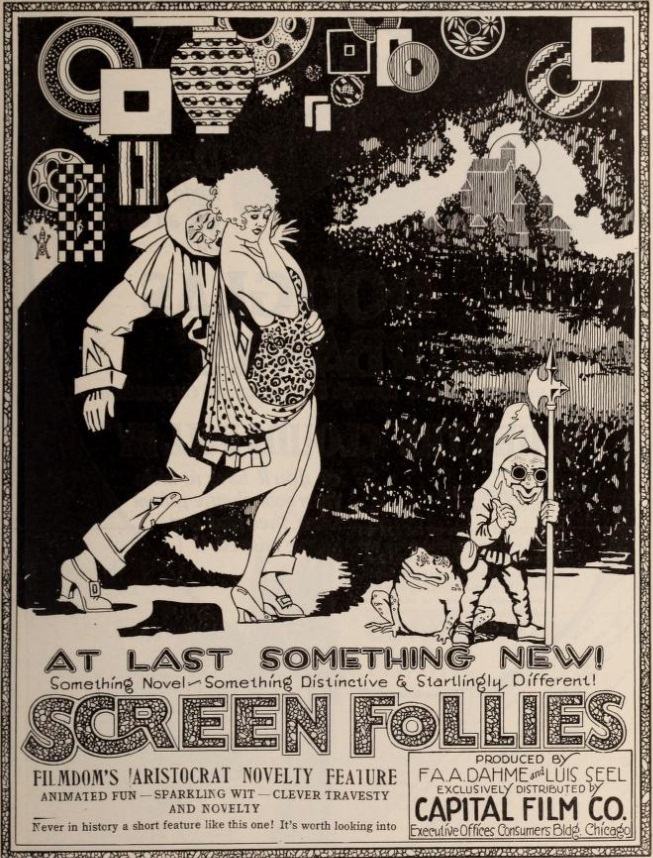
The first time I watched Screen Follies No. 1 I swore the filmstrip was sweating. Not metaphorically—actual beads of silver halide condensation trickling down the emulsion like the celluloid itself had a fever. That’s the kind of picture this is: a 12-minute short that behaves like a delirium tremens, stitched together by two anarchists named F.A. Dahne and Luis Seel who seem to have raided every prop-room between Berlin and Hoboken before torching the inventory for comic kindling.
There is no plot in the pedestrian sense—only a Möbius strip of pranks that begin mid-sneeze and end mid-scream. Dahne, part Harpo, part Hephaestus, lurches on-screen wearing a trench coat lined with rubber chickens and existential dread. His eyebrows are quotation marks around a joke nobody told. Seel, pencil-mustached and serpentine, glides beside him like a rumor, pockets full of counterfeit identities: a monocle that reflects the wrong decade, a love-letter addressed to himself, a theatre ticket dated 1899. From the opening iris-in they are already running, though from what or toward what remains gleefully illegible.
The carnival they burst through feels inherited from yesterday’s nightmares.
A ferris wheel spins against a painted moon so vast it drips ivory varnish onto the pier. Barkers hawk phobias: Roll up, roll up, see your doppelgänger swallow fire and sue for alimony! Inside a fortune-teller’s tent, Dahne’s palm reveals not lifelines but sprocket holes; the gypsy flees screaming that the future is out of focus. Meanwhile Seel pickpockets the camera itself—for three frames the entire screen goes black, accompanied by a subtitle card that reads “This intermission stole itself.” When the image returns, the aspect ratio has shrunk to a peephole, as though the film were spying on its own audience.
Comparisons? You could stack it beside Clown Charly for shared greasepaint melancholia, but whereas Charly’s pathos drips like a slow faucet, Dahne’s sorrow arrives as a custard-pie tsunami. Or pair it with Mandolinata a mare—both toy with seaside iconography—yet the Italian one drifts like a lullaby, whereas Follies detonates the pier and sells you splinters as limited-edition slapsticks.
Mid-reel, the protagonists stumble into an abandoned film-laboratory. Chemical trays burp, negatives curl like dead ivy. Here the movie eats its own tail: Seel frames Dahne’s silhouette against a white wall, then snips the silhouette out with garden shears; the shadow keeps walking, independent, a charcoal ghost that moonlights as moral allegory. Dahne, now two-dimensional, chases his missing outline through a labyrinth of leader scraps, each misstep triggering a jump-cut that hurls him into another genre—newsreel, western, nudist documentary—before ricocheting back to slapstick so fast you taste ozone.
Sound, though absent, feels omnipresent.
You swear you hear kazoos in minor key, a xylophone dipped in morphine. The intertitles are malicious haikus: “He laughed until the joke filed a restraining order.” One card arrives upside-down; you flip your head to read it and realize the entire row of spectators is inverted—an auditorium of bats. Another card is merely a fingerprint in ink the color of dried blood, suggesting the writer lost digits mid-sentence.
Gender itself becomes a prop. Dahne dons a flapper’s beaded dress; the beads rearrange into Braille that translates to “Help me.” Seel sports a fake pregnancy belly that deflates into a balloon dog which then bites him. They kiss—not out of desire but because the film leader jams, superimposing their faces in a chemical bruise. The moment stretches, uncomfortable, tender, hilarious, like watching two mirrors try to reproduce.
And the editing—oh, the editing. Splice scars visible like surgical stitches on Frankenstein’s thigh. Frames missing, frames duplicated, frames printed backward so steam rises into the kettle. At one point the duo exit a doorway and re-enter from the ceiling, gravity having been quietly fired off-camera. The stroboscopic climax layers 1920s news headlines (BOLSHEVIK CLOWN INVADES WALL STREET) over close-ups of Dahne’s mouth agape, a cave where laughter goes to echo indefinitely.
Yet beneath the vandalized celluloid beats a threnody for identity.
Everyone wears somebody else’s face; every laugh is a ransom note. When Seel peels off a rubber mask to reveal Dahne underneath, only to find yet another Seel beneath that, the gag mutates into metaphysical vertigo. The film posits that in the age of mechanical reproduction the self is just another prop, interchangeable and cheap, available for bulk discount if you supply the laughter.
Compare this onion-skin identity to Masks and Faces, where disguise serves social mobility; here disguise is a ouroboros with commitment issues. Or stack it against The Vanity Pool, another meditation on mirrored ego—yet that film pampers its narcissism with velvet gloom, while Follies curb-stomps vanity with a custard-smeared hobnail boot.
Restoration-wise, the print I viewed (courtesy of EYE Filmmuseum’s 4K photochemical resuscitation) still flickers like a candle arguing with the wind. Scratches swarm like ants; the sea-blue tint leans toward bruise-lavender, perhaps from dye that aged like cheap wine. But the imperfections amplify the film’s thesis—medium as mortal flesh, decay as punchline. I half-expected the final fade-out to be accompanied by a subtitle: “The End—if you insist.”
Culturally, the short is an orphan. Too anarchic for the slapstick canon, too prankish for avant-garde solemnity, it drifts like flotsam between movements. Yet its DNA infects later prankster cinema—Maddin’s Heart of the World, the Quays’ Street of Crocodiles, even Kaufman’s Synecdoche, New York, all of which pilfered its conviction that identity is a costume stitched by incompetent tailors.
Performances? Dahne’s locomotive physicality recalls Keaton if Keaton had swallowed a live wire. Watch him attempt to tip his bowler—his arm extends, joints folding like a carpenter’s rule, until the hat sits atop a head that is suddenly, impossibly, ten feet above his shoulders. Seel, by contrast, is all feline understatement; a single eyebrow lift conveys the collapse of empires. Together they generate a Laurel & Hardy negative—same chemistry, opposite polarity, resulting in explosions rather than hugs.
The takeaway? Laughter is terror wearing a rubber nose.
To watch Screen Follies No. 1 is to be mugged by your own reflection, then handed a custard pie as consolation prize. It refuses nostalgia, refuses coherence, refuses even the courtesy of ending—my print concluded with a freeze-frame of Dahne mid-sneeze, an eternal ah-ah-ah without the satisfying choo. The projector click becomes a metronome for existential hiccups. You exit the screening room giggling, then realize the giggle belonged to somebody two rows behind who never existed in the first place.
Seek it out however you can—bootleg rips, archival streams, hallucinogenic daydream. Just remember: the film doesn’t screen for you; you screen for it, a temporary canvas on which it projects its cracked carnival of unbelonging. And if, during the viewing, you feel a thin line of celluloid sliding around your throat like a warm collar, do not panic. That’s merely the movie asking for a hug before it pickpockets your shadow and runs cackling into the vault of lost reels, leaving you lighter, stranger, and irreversibly sprocket-holed.
IMDb 6.8
1931
Community
Log in to comment.