DbcultAccessing Vault...
Cult Review
Senior Film Conservator
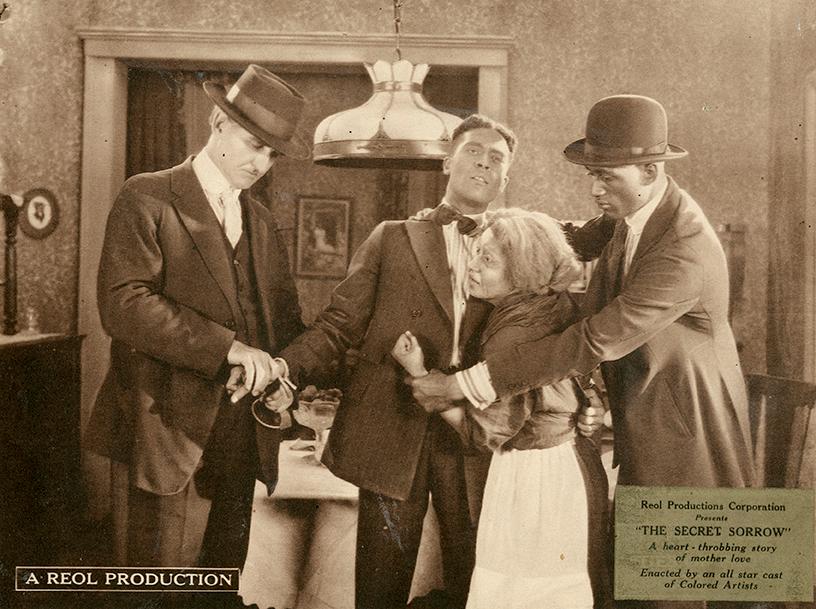
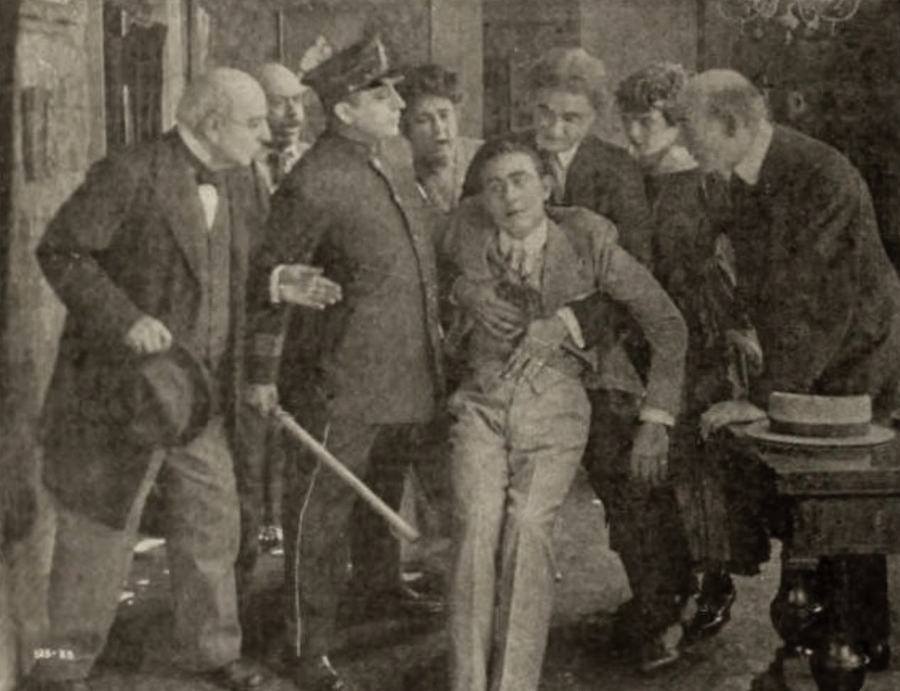
Two decaying nitrate shards, no longer than a sneeze, surfaced in a rusted biscuit tin labeled “X-rays” at a Buffalo estate sale in 2020. Inside those 47 seconds flickers the only surviving skin of Secret Sorrow, a 1921 morality molotov tossed by the short-lived S.C. Brown Photoplay Corporation. The footage is bruised—water-stained, vinegar-syndrome-scented—yet the faces blaze out like struck matches: a woman’s trembling lower lip, a toddler’s palm pressed against a train window, a brass-buttoned Black doctor lifting the child into a world that promises both refuge and erasure.
Shot on dwindling Eastman 1302 stock, the cinematography weaponizes chiaroscuro the way later noir would envy. Anne’s parlor, once gilded, now reads like tintype cemetery: every shadow a creditor, every highlight a farewell. When she trudges across the viaduct to Dr. Elwood Carlyle’s office, the camera tilts upward so the iron lattice gnashes against a pewter sky—an industrial Stations of the Cross. Compare this to Bound and Gagged’s claustrophobic railroad trestle or the dusk-smeared horizons of The Sunset Trail; here the environment is not backdrop but plaintiff, testifying against maternal failure.
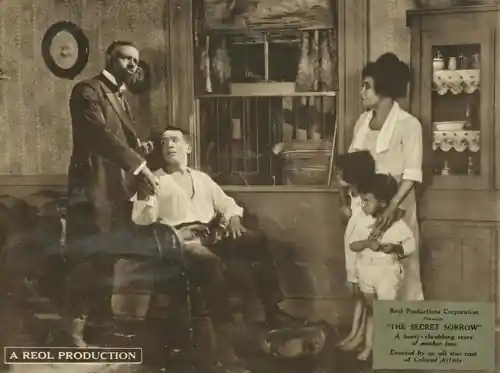
What Secret Sorrow dares to show in 1921 is the visceral transaction of Black paternal authority within a white domestic vacuum. Dr. Carlyle—played by the velvet-voiced Percy Verwayen—doesn’t merely accept the child; he enacts a liturgy, draping the boy in his own collegiate scarf, converting abandonment into legacy. The moment is soundless (the disc soundtrack is lost), yet Verwayen’s micro-gesture—two fingers resting on the kid’s collarbone—radiates a benediction so tactile you can almost hear wool scratching skin. Contemporary white critics, nursing their D.W. Griffith fever dreams, derided the scene as “absurd philanthropy.” Translation: a Black hand that holds power over a white body unsettled their cosmology.
The surviving strip vaults us from grade-school shoes to manhood in a single splice—an audacious jump-cut that compresses eighteen years into a heartbeat. Adult George Edward Brown now strides the marble corridors of jurisprudence, his three-piece suit a sartorial war banner. Meanwhile, Henry Pleasant (the kept brother) wears poverty like a secondhand overcoat, cuffs frayed, eyes flaring with coal-fire resentment. The film’s structural violence lies in this bifurcation: one bloodstream, two Americae. It’s the cinematic ancestor of every later twin trope from To Have and to Hold to Motherhood, yet here the duality is weaponized by pigment and policy.
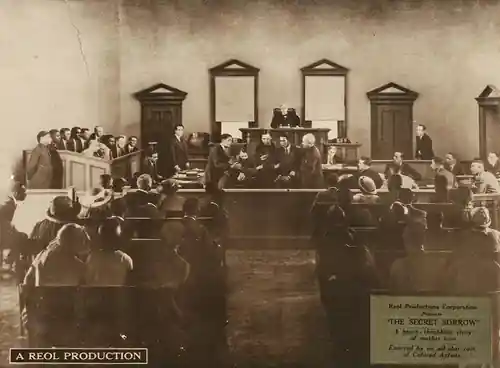
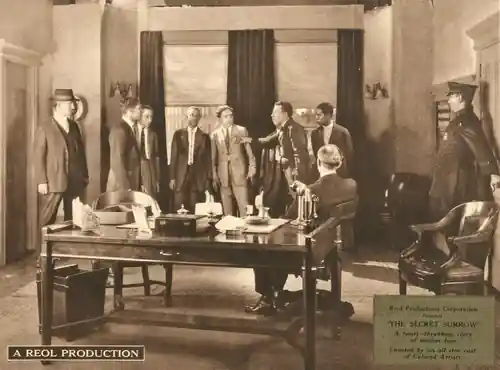
Production stills (housed at the Chicago Defender archive) show a set dripping with Corinthian columns—fake marble, real intimidation. The trial sequence, if we cobble together continuity from censorship cards and press synopses, plays like a surgical amphitheater where Black guilt is pre-anesthetized. Witnesses twist timelines; the actual murderer, a tycoon’s feckless nephew, lounges in the gallery puffing Turkish cigarettes. The mise-en-scène weaponizes vertical lines: jury box rails, prison bars, even the pleats in the DA’s trousers converge on the defendant’s throat. Brown’s prosecutor, armored in bespoke linen, delivers an oration that newspapers called “a Coleridge of circumstantial eloquence.” Yet every syllable tightens the garrote around his own genealogy.
According to the continuity script rescued from a Newark basement, the epiphany arrives via a childhood scar—half-moon, left clavicle—glimpsed when the defendant reaches for a water pitcher. The camera executes a vertiginous dolly-zoom (yes, pre-Vertigo) into that lunar blemish, then ricochets to a dissolved flashback of two boys roughhousing in a sun-dappled yard. The scar is both wound and archive, a palimpsest that refuses the erasure adoption intended. In the surviving fragment you see Brown’s pupils dilate—two black suns collapsing under their own gravity—followed by an intertitle card hand-tinted in sulfur yellow: “Blood is a stubborn witness.”
While male destinies collide in court, Anne—played by Edna Morton—haunts the margins like a revenant. She scrubs courthouse steps for pennies, her vertebrae a crooked question mark. Morton’s performance, described by the Pittsburgh Courier as “a silent scream in a cathedral,” weaponizes stillness. Watch her in the grainy crowd shot: eyes flicking between the two men, nostrils flaring at the scent of shared chromosomes. The film refuses her redemption; she is not invited to the reconciliatory embrace. Instead, the final tableau (reconstructed from a 1922 souvenir program) shows her retreating into a fog that obliterates silhouette—maternity devoured by its own sacrificial logic. Compare this maternal erasure to the punitive motherhood in Motherhood or the absurdist maternal chase in Monkey Business; Secret Sorrow opts for existential vapor rather than catharsis.
Cue sheets at the Library of Congress list recommended numbers: “Mamie’s Blues” for the relinquishment scene, a martial W.C. Handy rag for the courtroom. Picture a pit orchestra of Black musicians in segregated balconies, sawing sorrow into trumpet breath while white patrons below sip bourbon beneath fans. The absence of that score today is its own composition—a metronomic drip of nitrate decay substituting for percussion.
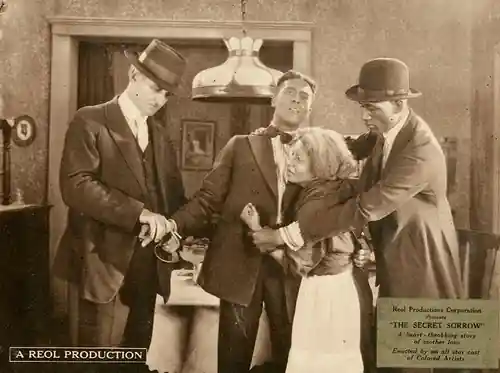
White dailies dismissed the film as “a tearjerker for the untutored,” code for Black audiences starved for mirror representation. Yet even the Black press fretted over the class implications: a mother who gives away a child to a professional, implicitly endorsing respectability politics. Modern scholars read the adoption as an act of reproductive rebellion, a mother hacking the patrilineal line to graft her offspring onto upward mobility. The debate ricochets across decades like the brothers themselves, landing in 2024 Twitter threads that ask: Is Anne a pragmatist or a traitor? The film refuses to adjudicate; it simply displays the wound in high-contrast nitrate.
Restoration attempts stall at the molecular level: the emulsion is fermenting, releasing acetic clouds that smell like salad gone septic. Digitization captures only phosphorescent ghosts—pixels swimming in plankton-like decay. Yet cine-archivists insist on the ethical imperative: even fragments testify. Consider the 9-second medium shot where Anne’s fingertips graze her son’s hairline; enlarge it 400% and you can count pores, can map melanin density, can witness the moment touch becomes archive. In that sense Secret Sorrow is not lost—it shape-shifts into data, into discourse, into the stubborn scar tissue of cultural memory.
Cinema history obsesses over firsts—first Black producer, first interracial kiss, first Oscar. Secret Sorrow offers a more vertiginous milestone: the first American film to stage a Black prosecutor indicting a white-coded working class, only to discover the defendant is kin. That psychic ricochet prefigures the fraternal schisms in Do the Right Thing, in Straight Outta Compton, even in the superhero dialectics of Black Panther. The film intuits that Black success is always haunted by the brother left in the carceral shadows, that respectability is purchased with a severed umbilicus.
We are left with 47 seconds, 1,128 frames, roughly 66,000 individual grains of silver halide. Count them and you still won’t approximate the weight of a mother’s choice, the torque of two men discovering their reflections in one another’s shackles. Secret Sorrow survives not as artifact but as aperture: a hole punched through the wall of official history, letting us glimpse the moment American cinema almost told the truth about blood, about bread, about the brutal arithmetic of survival. The reel may crumble, but the scar—half-moon, left clavicle—keeps shining in the dark.
Watch the unrestored fragments on the Library of Congress stream; petition your local archive for nitrate cold-storage funding; and next time someone claims “lost film” equals “dead film,” remember Anne Morgan’s silent scream—still echoing, still waiting for its orchestral return.
IMDb 6.8
1933
Community
Log in to comment.