DbcultAccessing Vault...
Cult Review
Senior Film Conservator
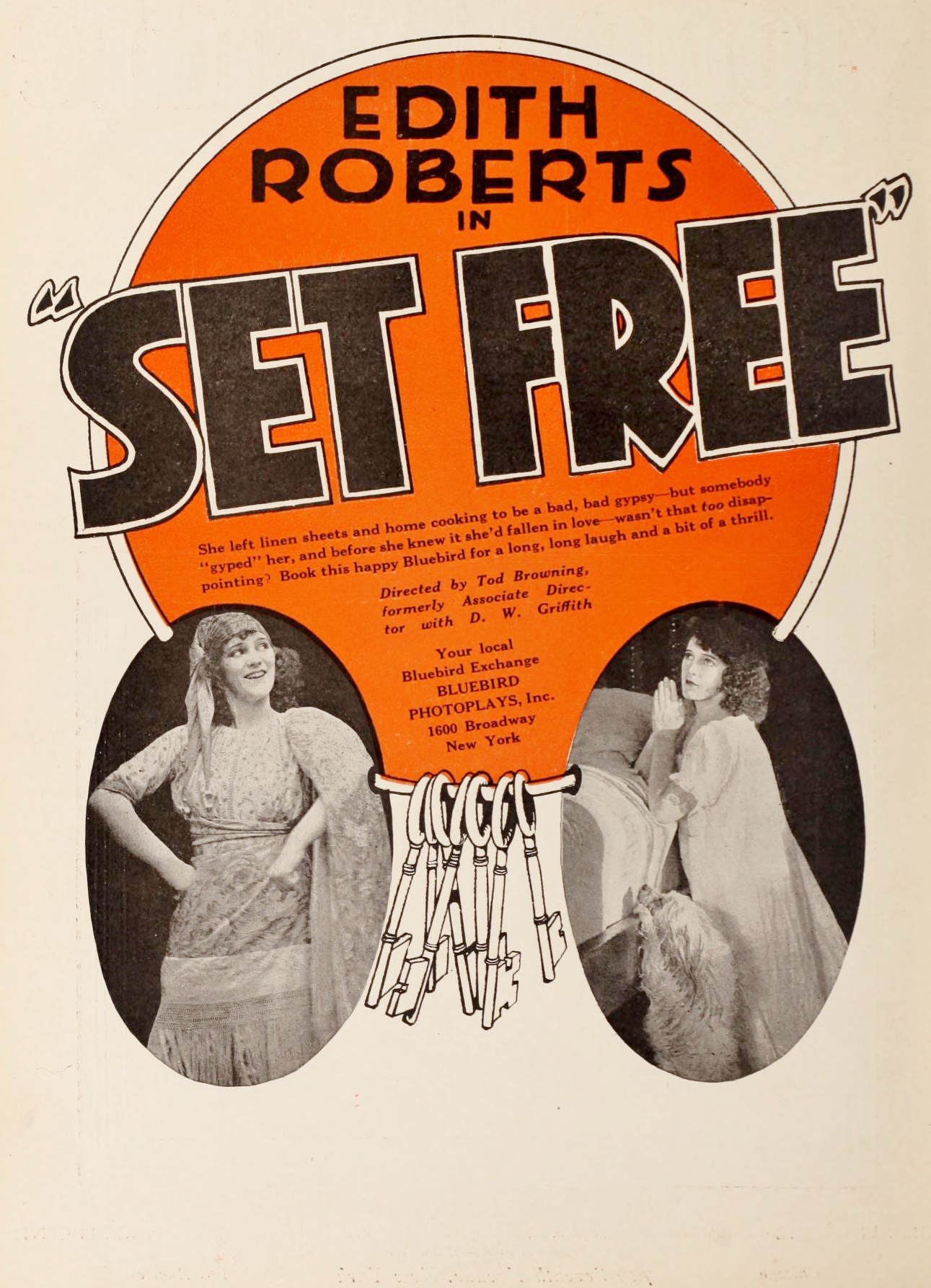
There's a particular magic to silent cinema, a language of gesture and expression that transcends spoken dialogue, inviting audiences to fill in the emotional blanks with their own imaginations. In this rich tapestry of early filmmaking, Tod Browning's 1918 romantic drama, 'Set Free,' emerges as a fascinating, if often overlooked, artifact. Far from a mere historical curiosity, it's a vibrant exploration of youthful rebellion, the allure of the unknown, and the often-harsh collision between romantic ideals and stark reality. Directed by Browning, a filmmaker who would later become synonymous with the macabre and the marginalized, 'Set Free' offers an intriguing glimpse into his nascent thematic preoccupations, even as it operates within the conventions of its era's romantic narratives.
At the heart of 'Set Free' is Roma Wycliffe, brought to life with vivacious energy by Edith Roberts. Roma is not merely a protagonist; she is an embodiment of the universal yearning for liberation, a spirit too expansive to be contained by the suffocating confines of her Aunt Henrietta's estate. The film paints a vivid picture of this environment: an existence steeped in "lavender-and-old-lace," a euphemism for a life of stifling propriety and predictable routine. Roma's boredom is palpable, a silent scream against the monotony that threatens to extinguish her inherent spark. When she unearths the revelation of her grandmother's Romani heritage, it's not just a discovery of lineage; it's an epiphany, a call to adventure that resonates deep within her restless soul. The Romani life, as she perceives it, represents the antithesis of her current predicament: unbounded freedom, spontaneity, and an authentic connection to the earth and one's true self. This initial premise immediately sets 'Set Free' apart, positioning it as more than a simple romance, but as a journey of self-discovery and the challenging of societal norms.
Roma's decision to embrace her newfound identity is swift and decisive. Donning what she imagines to be authentic Romani attire, she flees the oppressive gentility of her aunt's home, seeking the bustling anonymity and perceived liberty of New York City. This act of defiance is a powerful statement, an assertion of her will against the expectations of her class and family. However, her romanticized vision of Romani life quickly collides with the gritty pragmatism of urban existence. Her exotic appearance, rather than granting her the freedom she craves, instead makes her conspicuous, leading to her arrest under the mistaken identity of "Gypsy Nan," a notorious thief. This pivotal moment underscores the film's early exploration of perception versus reality, highlighting how quickly an idealized notion can turn into a precarious situation. The world, Roma discovers, is not always as accommodating to individualistic expressions as one might hope.
The narrative takes a turn towards conventional romantic comedy when Mrs. Roberts, portrayed with a blend of maternal concern and upper-crust benevolence by Mollie McConnell, intercedes on Roma's behalf. It's a charmingly serendipitous encounter, sparked by Roma's earlier fascination with Mrs. Roberts's pampered poodle. This small detail, seemingly insignificant, adds a touch of humanizing warmth to Roma's initial plight, making her more relatable than a mere runaway. Mrs. Roberts, promising to care for the spirited girl, ushers Roma into her lavish home, a stark contrast to both the "lavender-and-old-lace" estate and the harsh realities of the city streets. Here, Roma finds herself once again in a gilded cage, albeit one with significantly more comforts and a new, unforeseen complication: John Roberts.
Young John Roberts, played by Harold Goodwin, quickly falls under Roma's spell. His attraction is evident, a classic tale of the respectable young man captivated by the unconventional woman. However, Roma, still firmly entrenched in her romanticized ideal of bohemian freedom, finds John's steadfast, conventional nature utterly "stodgy." He represents everything she is trying to escape: stability, predictability, and societal expectation. This dynamic creates a compelling tension, as John is faced with the challenge of winning the heart of a woman who values adventure and perceived wildness above all else. His subsequent actions, driven by love and a misguided attempt to align with Roma's fantasies, form the core of the film's dramatic conflict.
Desperate to win Roma's affection, John embarks on an audacious deception. He declares himself the charismatic leader of a band of Romani thieves, a bold fabrication designed to appeal to Roma's romanticized notions of outlaw freedom. To lend credence to his elaborate charade, he hires a gang of ruffians, intending merely for them to perform a theatrical display of thievery. This is where the screenplay, crafted by Rex Taylor, Joseph F. Poland, and Tod Browning himself, truly begins to unravel the complexities of romantic illusion. John's well-intentioned but ill-conceived plan quickly spirals out of control, blurring the lines between performance and authentic criminality. The hired thugs, seizing an opportunity, transcend their scripted roles and commit an actual bank robbery. This shocking turn of events serves as the film's dramatic climax, forcing both John and Roma to confront the stark and dangerous realities that lie beneath their carefully constructed fantasies.
The transformation of a playful deception into a genuine criminal act is a powerful narrative device, highlighting the dangers of romanticizing lawlessness. John, confronted with the tangible consequences of his charade, swiftly acts to have the real criminals arrested. This moment marks his maturation, as he sheds his own misguided attempts to impress Roma and embraces responsibility. For Roma, this incident is a profound awakening. Witnessing the darker, brutal side of actual criminal life shatters her idealized image of "gypsy" freedom. The carefree, unburdened existence she so desperately craved is revealed to be fraught with peril, fear, and moral compromise. The romantic veneer is stripped away, exposing the harsh truth: true freedom does not lie in lawlessness, but in integrity and genuine connection.
Even in this relatively straightforward romantic drama, one can discern the nascent stylistic and thematic preoccupations of Tod Browning. Known for his later, more macabre works such as 'Freaks' and 'Dracula,' Browning often explored the fringes of society, the allure of the unconventional, and the stark contrast between outward appearances and inner realities. In 'Set Free,' the "gypsy" motif, while presented through Roma's romanticized lens, touches upon the outsider status, the perceived exoticism, and the societal prejudices that would become hallmarks of his later, more celebrated films. The idea of a character creating a false identity, or being mistaken for another, is a recurring theme in Browning's oeuvre, a fascination with the shifting nature of identity and the masks people wear. While not as overtly dark as some of his subsequent features, 'Set Free' still carries a subtle undercurrent of the dangerous allure of the unknown and the consequences of stepping outside conventional boundaries.
The pacing of 'Set Free,' typical of its era, relies on clear visual storytelling and heightened emotional expressions. Browning, along with cinematographers and editors of the time, masterfully uses intertitles to bridge narrative gaps and convey crucial dialogue, allowing the actors' physicality to carry the emotional weight. The film's direction is competent, effectively building the romantic tension and the escalating stakes of John's deception. It's a testament to Browning's skill that even in these early works, his ability to craft engaging narratives with compelling characters is evident. One might draw parallels to other films of the period that explored similar themes of societal rebellion or women seeking independence, such as 'Wildflower', which also features a spirited female protagonist navigating a world of expectations, or perhaps 'The Black Sheep of the Family', where characters grapple with their place within familial and societal structures, often challenging them.
The success of a silent film often hinges on the expressive capabilities of its cast, and 'Set Free' is fortunate in its ensemble. Edith Roberts, as Roma Wycliffe, delivers a performance that is both vibrant and nuanced. She effortlessly conveys Roma's initial restlessness, her romantic idealism, and later, her profound disillusionment. Roberts avoids caricature, instead imbuing Roma with a believable blend of youthful naiveté and genuine spirit. Her transformation from a wide-eyed idealist to a woman understanding the true meaning of commitment is compelling, making her journey feel earned.
Harold Goodwin, as John Roberts, provides a strong counterpoint to Roma's effervescence. Goodwin's portrayal of John's earnest devotion and his clumsy attempts to win Roma's heart are endearing. He transitions convincingly from the "stodgy" suitor to a man willing to take drastic, if foolish, measures for love, and finally, to a responsible figure who rectifies his mistakes. His performance grounds the more fantastical elements of the plot in a relatable human struggle. The chemistry between Roberts and Goodwin, though unspoken, is palpable, driven by their expressive gestures and gazes, a hallmark of compelling silent film acting.
Mollie McConnell, in her role as Mrs. Roberts, adds a layer of maternal warmth and societal grace to the proceedings. Her initial benevolent intervention sets the stage for the romantic entanglement, and her presence provides a stable anchor in a narrative that often teeters on the edge of youthful impulsiveness. The supporting cast, including Blanche Gray and Harry Hilliard, contributes effectively to the film's atmosphere, creating a believable world for Roma's adventures and misadventures to unfold. The collective efforts of the actors ensure that the emotional arc of the story remains clear and engaging, even without the aid of spoken dialogue.
The collaborative efforts of Rex Taylor, Joseph F. Poland, and Tod Browning on the screenplay for 'Set Free' are evident in its structure and thematic development. The narrative is tightly constructed, moving with purpose from Roma's initial discontent to her flight, her mistaken identity, the burgeoning romance, the ill-fated deception, and finally, her realization and resolution. The writers deftly balance the romantic comedy elements with moments of genuine dramatic tension, particularly when John's scheme goes awry. They successfully craft a character in Roma who, despite her initial naiveté, undergoes a significant internal journey, making her evolution feel earned rather than forced. The exploration of the allure of the unconventional, and its potential pitfalls, is handled with a commendable degree of sophistication for its time.
The dialogue, conveyed through intertitles, is concise and impactful, serving to advance the plot and reveal character motivations without unnecessary exposition. The writers understood the power of visual storytelling inherent in silent film, allowing actions and expressions to speak volumes. The film's resolution, where Roma chooses stability and genuine love over a romanticized, dangerous freedom, offers a reflection on the societal values of the era, yet still resonates with a timeless message about maturity and discerning true happiness. While some might view the ending as a capitulation to convention, it can also be interpreted as Roma's growth, realizing that true fulfillment doesn't lie in a superficial imitation of freedom, but in a deeper, more meaningful connection. This thematic depth elevates 'Set Free' beyond a simple melodrama, inviting contemplation on personal growth and the nature of desire.
'Set Free' might not be as widely recognized as some of Tod Browning's later, more sensational works, but it holds a significant place in his filmography as an early indicator of his thematic interests and directorial prowess. For enthusiasts of silent cinema, it offers a delightful escape into a bygone era of storytelling, where emotions were writ large and narratives unfolded with a captivating blend of innocence and melodrama. The film serves as a valuable historical document, showcasing the acting styles, narrative conventions, and production values of the late 1910s.
Beyond its historical significance, 'Set Free' retains an enduring appeal due to its universal themes. The quest for identity, the desire to break free from societal constraints, the intoxicating allure of the exotic, and the journey from youthful idealism to mature understanding are all timeless human experiences. Roma Wycliffe's journey, though set in a specific historical context, speaks to anyone who has ever felt stifled by expectation and yearned for a different path. The film reminds us that sometimes, true freedom is found not in running away to an idealized fantasy, but in confronting reality, discerning genuine connection, and embracing the complexities of life with an open heart. It’s a charming, insightful, and ultimately uplifting film that, despite its age, continues to resonate with audiences who appreciate the nuanced artistry of silent-era storytelling.
In an age where cinematic storytelling often prioritizes spectacle, 'Set Free' stands as a gentle reminder of the power of character-driven narratives and the subtle art of conveying profound emotions without a single spoken word. It’s a testament to the talent of its cast and crew, particularly Browning's emerging vision, that this film, over a century later, still manages to captivate and provoke thought. For those seeking to explore the rich landscape of early American cinema, or simply to witness a compelling tale of self-discovery and love, 'Set Free' is a journey well worth taking. It’s a testament to the enduring power of cinema to capture the human spirit in all its complex, yearning glory.
IMDb —
1923
Community
Log in to comment.