DbcultAccessing Vault...
Cult Review
Senior Film Conservator
Honestly? Only if you are the kind of person who enjoys squinting at grainy black-and-white footage for two hours. If you want a smooth story or clear audio, you are going to absolutely hate this. It’s a movie for people who treat film history like an archaeological dig. 🏺
You probably shouldn't watch this if you’re looking for a fun Friday night. It's more of a 'I want to see how movies were born' kind of vibe. It’s slow. Like, really slow.
I found myself staring at the background more than the actors. The sets look like they were painted by someone who had a very limited budget and maybe three hours of sleep. It reminds me of the rough edges in The Winning of Beatrice, though this feels even more fragile.
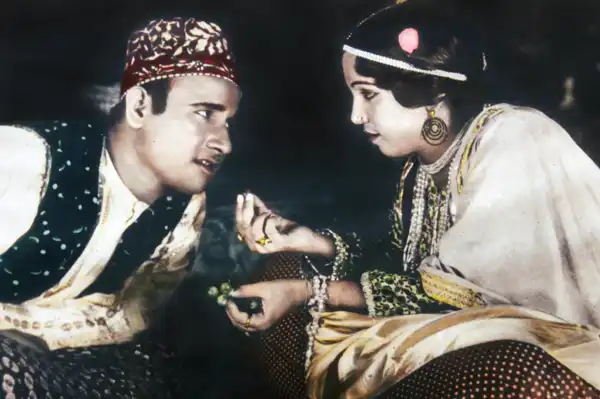
Agha Jani Kashmiri has this very specific way of standing. He doesn't just walk into a room; he announces himself with his entire torso. It’s very theatrical. I guess that’s just how they did things back then.
His eyes always seem to be looking just a few inches above the lens. It makes him look like he’s constantly distracted by a very interesting fly on the ceiling. 🪰
Then there is Sultana. She’s got that silent-film-star face where every emotion is dialed up to eleven. When she’s sad, she looks like the entire world just ended in front of her. It’s a bit much, but I kind of love it.
The sound quality is... well, it’s bad. There is a constant hiss that sounds like a radiator leaking in the next room. Sometimes the dialogue just gets swallowed by it. It’s not as polished as something like Men of the North, which at least has some rhythm to its noise.
I noticed a scene where a character is drinking tea, and the cup is clearly empty. You can hear the ceramic clinking against the saucer in a way that sounds way too light. It’s a small thing, but once you notice it, it’s all you can think about. ☕
The lighting is super inconsistent too. One shot is bright enough to melt your retinas, and the next is so dark I thought my monitor had died. It’s like the cameraman was just guessing where the sun was.
I kept thinking about The Dancer of Paris while watching this. Both movies have this weird obsession with long, lingering shots of people just... thinking. But in this one, the thinking looks more like they forgot their next line.
There is a moment with a child actor—I’m pretty sure it’s a young Nurjahan—and she’s the only one who feels natural. She has this tiny hat on that keeps slipping. She just keeps shoving it back up without breaking character. It’s the most 'real' thing in the whole movie.
The costumes are incredibly heavy. You can see the actors literally sweating under the weight of all that embroidery. It looks uncomfortable. I felt itchy just watching them. 🧵
I’ll be honest, I zoned out during the middle part. The plot sort of meanders into this long sequence of people talking in a garden that looks like it was made of cardboard. It’s not exactly The Border Legion in terms of pacing.
One reaction shot of an old man in the background lasted for about ten seconds too long. He wasn't even the focus of the scene. He was just... there, looking slightly confused. It made me laugh, which I don't think was the intention.
The music comes in at the weirdest times. It’ll be dead silent for ten minutes, and then suddenly a harmonium starts blaring for no reason. It’s like the ghost of the theater organist woke up and decided to scare everyone. 👻
It’s a weird experience watching something this old. It feels like you’re looking at a dream someone had a hundred years ago. It’s messy and the grammar of the film is all over the place.
If you liked Shûnen no dokuja, you might appreciate the atmosphere here. But be warned, this is much more of a struggle to get through. It’s not 'good' by modern standards, but it’s interesting.
I don't think I’ll ever watch it again. Once is enough to get the point. It’s like eating a very old piece of candy you found in a drawer—interesting to see it still exists, but not exactly a meal. 🍬
The ending felt very abrupt. Like they just ran out of film and said, 'Yeah, that’s probably enough.' No real closure, just a quick fade to black and then silence.
Anyway, if you’re a completionist for early Indian talkies, go for it. Everyone else should probably just look at some still photos and call it a day. It’s a fascinating relic, but a relic nonetheless.
One last thing—the way they transition between scenes is just... weird. It’s not a cut, it’s like the image just gives up and disappears. It’s kind of haunting, actually.
I give it credit for existing. That’s about it. 🎥

IMDb —
1932
Community
Log in to comment.