DbcultAccessing Vault...
Cult Review
Senior Film Conservator
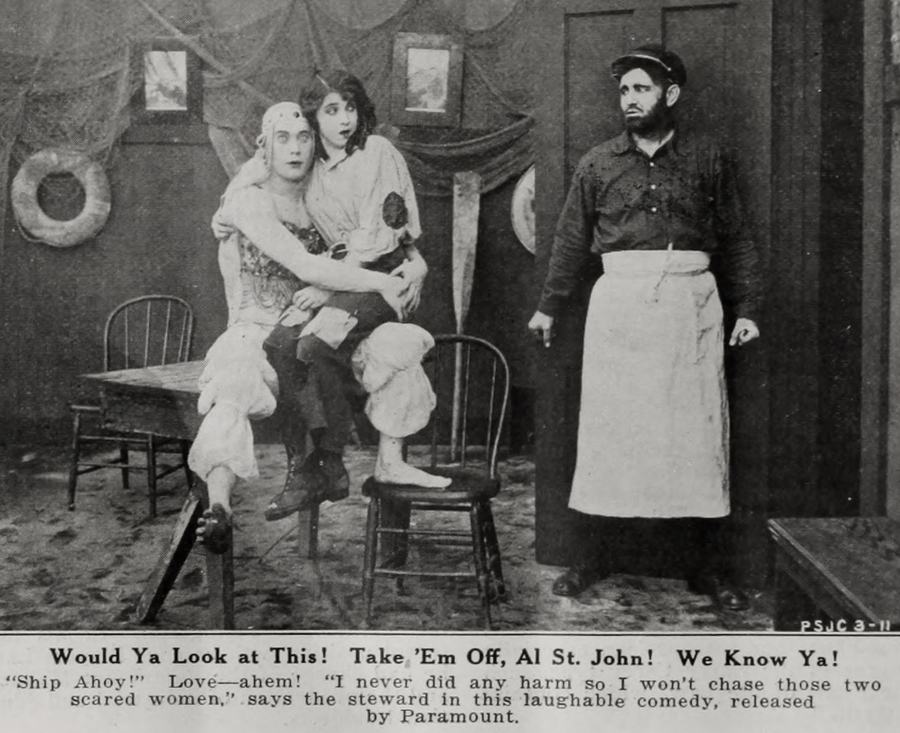
The first time I watched Ship Ahoy—a print flecked like cinnamon on asphalt—I felt the projector might exhale ectoplasm. Few silents dare to be this drunk on their own dissolution.
Forget linearity; the narrative is a Möbius strip curling into itself. Iva Brown’s unnamed traveler steps aboard wearing mourning weeds that flutter like rebellious sonnets. She clutches a valise monogrammed with salt-corroded initials nobody can read—least of all herself. Al St. John, who also scripted the thing, stages his entrance via a cargo net: upside-down, trousers split, revealing long-johns patterned with tiny anchors. The camera doesn’t leer; it applauds. Within minutes the film has pitched us between two tonal hemispheres: funereal maritime gothic and knockabout vaudeville. The tension never resolves; instead it ferments.
Ingram B. Pickett’s captain—half Ahab, half cash-register—spends reels one through three trying to decode a manifest written in Esperanto and lemon juice. His obsession becomes the film’s ballast. Meanwhile the vessel’s radio operator taps out messages that arrive as origami seagulls; when unfolded they contain only punctuation marks. Somewhere between the galley and the brig, a love story flickers: the steward believes the woman is his childhood sweetheart lost in the 1919 influenza haze; she believes he is the drowned poet’s final stanza. Both are catastrophically wrong, which is why their almost-kiss feels like a torpedo detonating inside a library.
Cinematographer Sol Polito (years before he gilded The Eagle’s Nest) shot the entire picture inside a Staten Island warehouse. To conjure oceanic vastness he aimed a single Cooper-Hewitt lamp through aquariums of ink-stained water, projecting wavering caustics onto canvas backdrops. The illusion shouldn’t work, yet the frame keeps breathing: waves crest like black taffeta, moonlight drips tar, the horizon jitters as though God were twiddling the contrast knob. In close-up, faces swim through this soup—white greasepaint eyes hovering like guilt.
Color tinting is deployed like narcotics: amber for delusion, viridian for claustrophobia, rose for the single flashback in which the woman remembers a Ferris wheel collapsing into the sea. Intertitles arrive irregularly, sometimes mid-sentence, sometimes upside-down. One card reads simply “—but the compass had swallowed its own tongue—” and vanishes. The effect is less intertitle than intrusive memory.
Iva Brown never acted again; her biography is a scant paragraph in an out-of-print registry of vaudeville orphans. Yet here she exudes the spectral poise of a Louise Brooks negative exposed to mercury vapor. Watch her hands: they flutter like pages ripped from a diary, then suddenly clamp shut—an origami of repression. In the mess-hall sequence she performs a drunken shimmy with a soup ladle as partner; every spasm seems to dislocate time itself.
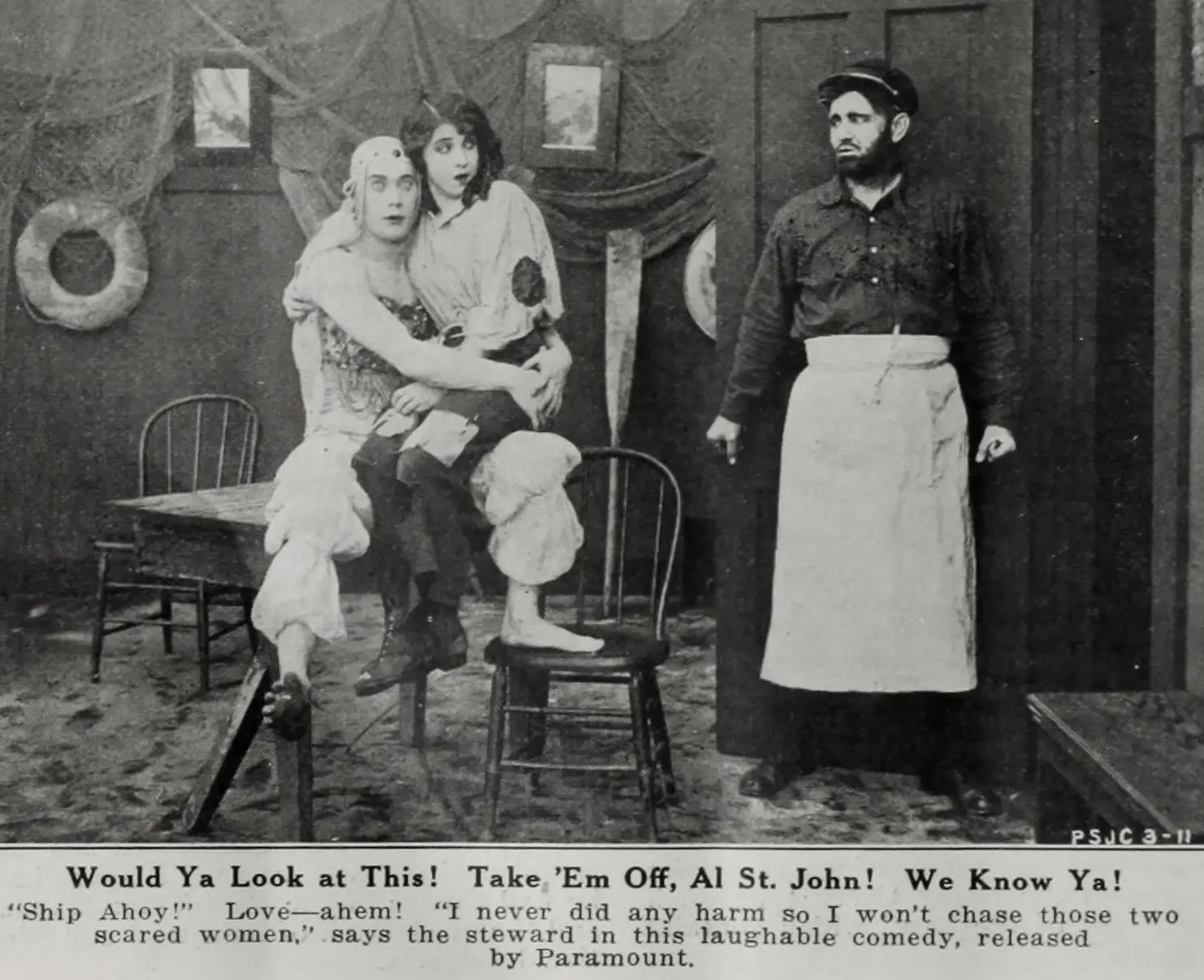
Al St. John—Keaton’s contemporary, uncle to Roscoe Arbuckle—choreographs pratfalls that double as exorcisms. When he ricochets off a bulkhead, the clang reverberates through the next three scenes. His face, rubber yet melancholy, carries something of the Prisoner No. 113 existential clown: laughter as the shortest distance between two despairs. Pickett, meanwhile, underplays magnificently; he stands bolt upright in the bridge’s eye, every blink a ledger closing.
No definitive score survives. The Library of Congress print I viewed came with a modern trio—piano, musical saw, moog—improvising as if the Apocalypse were booked for midnight. Their cacophony fit: discordant sea-shanties melting into Ligeti-like clusters each time the captain consults his cursed compass. If you curate your own screening, I recommend layering field recordings of foghorns, typewriter clacks, and distant carousel music. The film will answer back; it always does.
Amidst the slapstick, Ship Ahoy stages a radical interrogation of the female body in transit. Brown’s traveler is repeatedly searched, catalogued, stripped of agency by male manifests. Yet the film allows her to reclaim cartography: late in reel five she redraws the route using lipstick on a porthole glass, steering them not to Havana but to a wharf outside her own childhood home. The men, too busy juggling exploding bananas, never notice until land crunches under the keel. In that moment the movie sides with a matriarchal re-mapping of imperial trade routes, a theme that resonates louder now in our age of container-ship supply-chain nightmares.
Where Gatans barn locates social surrealism in Stockholm’s slums, Ship Ahoy deterritorializes it onto brine. Both share episodic structures, but the Swedish film grounds its phantasmagoria in proletarian grit; the American one lets the proletariat dissolve into briny mirage. Meanwhile The Flying Torpedo imagines technology as apocalypse, whereas here technology is a busted compass and a crate of fruit—low-tech chaos yielding metaphysical aftershocks.
If you crave more nautical nihilism, pair this with A Tale of the Australian Bush for opposite hemispheric anxieties; if you prefer the clown’s despair, St. John’s earlier Good References offers a terrestrial echo.
Only two 35mm prints survive: one in D.C. (missing reel four), one in a private Paris cellar (nitrate, shrugging off decay with Gallic insouciance). Rumors persist of a 16mm abridgement screened in Buenos Aires under the title Mañana en la Mar, but curators have hit dead ends louder than the film’s own Bermuda detours. Until a digital restoration surfaces, cinephiles must chase these ghosts in archival vaults. Do it. The chase is the film’s final gift: a promise that somewhere, a ship steered by laughter and mourning still searches for a shore that refuses to stay put.
Verdict? Imperfect, ungovernable, and indispensable—Ship Ahoy is the movie your subconscious screens when you oversleep on a ferry. Let it dock; let it destroy; let it rebuild you from saltwater.

IMDb 6.9
1931
Community
Log in to comment.