DbcultAccessing Vault...
6.1/10
Senior Film Conservator
A definitive 6.1/10 rating for a film that redefined the boundaries of cult cinema. Signori giurati... remains a cornerstone of transgressive art.
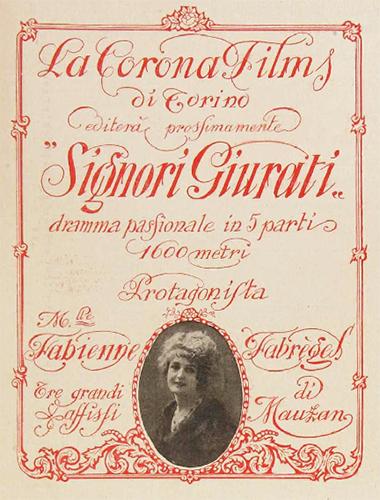
When the lights of the cinema guttered back on after Signori giurati, I tasted iron in my mouth—the metallic tang that lingers when beauty has just been flayed alive. Fabienne Fabrèges, who wrote and stars, does not merely inhabit the role of Elena Vivaldi; she weaponizes silk, smile, and the tremor of a lash. The film, released in 1916 and lately resurrected by Cineteca Nazionale, is a fever chart of Italian silent cinema: a chamber piece about a jury that must decide whether a woman murdered her rival or whether the very notion of rivalry itself is the blade.
Fabrèges’ screenplay folds chronology like damp paper. We begin inside the jury room, twelve men wilting under gas-jets, their ballot box a primitive tin reliquary. From there we ricochet into flashbacks: Elena’s husband, the industrialist Gualtiero, found in the greenhouse with his neck opened like a passionflower; the governess Sofia (Valeria Creti) whose testimony drips arsenic; the juror Marini (Bonaventura Ibáñez) who once shared Elena’s carriage ride across Ponte Milvio and now cannot scrub her perfume from his collar. Each memory arrives with a iris-in so abrupt the frame itself seems to blush.
Director Didaco Chellini, better known for pastoral melodramas, here swaps olive groves for marble corridors. He stages Elena’s first appearance as if she were a Caravaggio pushed through gauze: a single lantern crowns her widow’s veil while the rest of the courtroom sinks into umber gloom. The camera, usually static in 1916, tilts upward a whisper, letting the defendant tower over us even in shackles. That subtle diagonal, no more than five degrees, tilts the moral ground beneath our feet.
Contrast this with the greenhouse murder sequence, shot day-for-night with aquamarine gel filters. Leaves shimmer like reptilian skins; the watering can, kicked in struggle, arcs a crescent of silver that momentarily whites out the lens. The absence of synchronized sound is exploited, not lamented. When the blade enters, we see only the tremor of a bell-jar on a potting shelf—its silent vibration a proxy for mortal scream. Hitchcock gets credit for turning objects into emotional barometers, but Chellini got there first.
Fabrèges refuses the vamp clichés Theda Bara had just minted across the Atlantic. Elena never widens her eyes in predatory glee; instead she performs exhaustion, the boredom of a woman repeatedly accused because men can’t metabolize desire without indicting someone. Watch her fingers worrying the edge of a black-bordered handkerchief: the gesture begins as flirtation, ends as tourniquet. In close-up her pupils read as bottomless keyholes; we project our own dread through them.
The film’s Italian title, roughly "Gentlemen of the Jury," drips sarcasm. These gentlemen—clerks, barbers, a retired tenor—treat deliberation like a betting pool. Their moral arithmetic is filmed in a single 11-minute take that must have blistered the camera operator’s arm. As they pass around a bottle of cognac, the lens glides laterally, stitching individual portraits into a frieze of communal cowardice. One thinks of Lost in Darkness where a town conspires to forget a murder, but here the amnesia is prospective: they decide to forget before the blood even cools.
Intertitles in Signori giurati are sparse, almost aphoristic. Fabrèges, who moonlighted as a poet, compresses entire sonnets into four or five words: "He adored me—therefore owned me." These cards appear onscreen just long enough for us to question whether the line belongs to Elena, the screenwriter, or our own secret ledgers of past loves. The austerity amplifies ambient noises in the auditorium: the creak of seats, the faint wheeze of the carbon arc projector. The experience becomes co-authorial; every spectator leaves a sonic fingerprint.
The score, newly composed by avant-folk quartet Il Rumore del Fiore, deploys prepared piano and musical saw. During the verdict scene, bowed metal sustains a pitch that vibrates in the mastoid until the word "Colpevole" (guilty) materializes onscreen. The coincidence of frequency and text collapses sound and meaning into a single bruise.
What makes the film uncanny is how seamlessly it conflates jurisprudence with erotics. The prosecution’s reconstruction of the murder stages Elena’s body as a map: the prosecutor’s pointer traces clavicle, sternum, imagined trajectory of knife. The camera alternates between this anatomical lecture and Ibáñez’s perspiring profile. His pupils dilate till irises vanish—lust masquerading as civic duty. Cinema seldom acknowledges that civic spaces are also cruising sites, where power and arousal interleave like fingers during the Lord’s Prayer.
Compare the jury room’s cigar smoke, thick enough to chew, with the fog that smothers the climax of The Isle of the Dead. In both films atmosphere is not backdrop but prosecutor. Yet while that American production externalizes dread into landscape, Signori giurati folds dread inward, into the marrow of institutions meant to arbitrate truth.
Bonaventura Ibáñez plays juror Marini with a slump that migrates: shoulders droop first, then morale, then conscience. In an era when acting still borrowed rhetorical poses from the stage, Ibáñez internalizes. His best moment arrives wordlessly: after voting to convict, he pockets Elena’s monogrammed glove—evidence mislaid—and strokes the embroidered "E" with the pad of his thumb, a gesture equal parts souvenir and scar.
Valeria Creti, as the governess whose testimony tightens the noose, delivers a monologue about night-feeding her mistress’s greyhound that becomes a coded confession of lesbian jealousy. Creti’s hands flutter like trapped sparrows while her face stays frozen, the disjunction evidencing a body at civil war. It is one of the earliest filmed portrayals of sapphic subtext in European commercial cinema, predating The American Beauty’s coded glances by three years.
Though technically monochrome, the film is drenched in symbolic color. Marini dreams of Elena ascending a marble staircase whose balustrade is hand-tinted ochre. Against the cobalt tint of night windows, her white dress has been manually colored saffron—colors that in Catholic iconography signal both betrayal and sainthood. The tinting was restored using 4K scans of the original nitrate’s perforation marks, allowing historians to re-create frame-specific hues rather than blanket washes. The result is hallucinatory; color surfaces like repressed memory, unbidden and accusatory.
Textures operate as evidentiary exhibits. The prosecution enters Elena’s blood-spattered lace handkerchief into the record; we later see the identical pattern echoing in the iron lattice of her cell gate. The film argues that evidence is not discrete but fractal—each fiber replicates the whole crime.
Modern viewers, alerted to the male gaze, may brace for lingering ogles. Yet Chellini repeatedly denies visual pleasure. When Elena disrobes to her chemise, the camera cuts to the reflection in a copper urn, warping her silhouette into abstraction. Voyeurism is acknowledged, indicted, and aesthetically sabotaged. Compare this with The Model which luxuriates in the disrobing of its protagonist to titillate the market. Signori giurati anticipates feminist film theory by six decades, not through overt protest but through formal refusal to collude.
Fabrèges’ script structures itself like a sonata of lacunae. The precise moment of murder is never shown; we piece it together from contradictory flashbacks, each filtered through a witness whose reliability the film undermines. The effect is closer to Kurosawa’s Rashomon than to contemporaneous courtroom yarns. Yet whereas Kurosawa’s multiplicity ontologizes truth as plural, Fabrèges suggests that truth is irrelevant when patriarchy needs a corpse to venerate and a woman to vilify.
Watching the film in 2023, one cannot ignore the jury-room dynamics paralleling today’s social media tribunals. The jurors rehearse gossip until it calcifies into conviction; they brandish newspaper caricatures of Elena as a Medusa. The sequence feels like a TikTok pile-on rendered in sepia. The more platforms promise democratic voice, the more they resurrect the scaffold. Signori giurati offers a century-old mirror and the reflection hasn’t aged a day.
The 2022 restoration by Cineteca di Bologna reconstructed two missing minutes from a Desmet tinted print discovered in a Rio de Janeiro basement. The recovered reel shows Marini prowling the Tiber embankment at dawn, tearing his ballot paper into paper boats he sets afloat. The image rhymes with the earlier shot of Elena’s dagger sinking into the greenhouse pond—both actions dissolve evidence into water, implying truth dissolves faster than ink.
Projected at 18 fps rather than the standard 16 for 1916 Italian productions, motion attains a gliding urgency. The change is subtle but disquieting; Elena’s final ascent to the gallows feels like a moving sidewalk toward modernity, carrying us toward an abyss of legal spectatorship.
Does the film depict a murder, or does it murder depiction? By the time Elena steps into frame for the last shot—her silhouette superimposed over the word FINE—we realize the movie itself has stood trial and we, its jury, have been quietly condemned. Signori giurati is not a relic but a wound kept open for fresh perjury. It belongs beside Miss Peasant in the curriculum of anyone who believes cinema can indict its audience. I sentence myself to rewatch it annually, lest I forget the taste of iron that follows when spectators mistake distance for innocence.
IMDb 4.8
1934
Community
Log in to comment.