DbcultAccessing Vault...
Cult Review
Senior Film Conservator
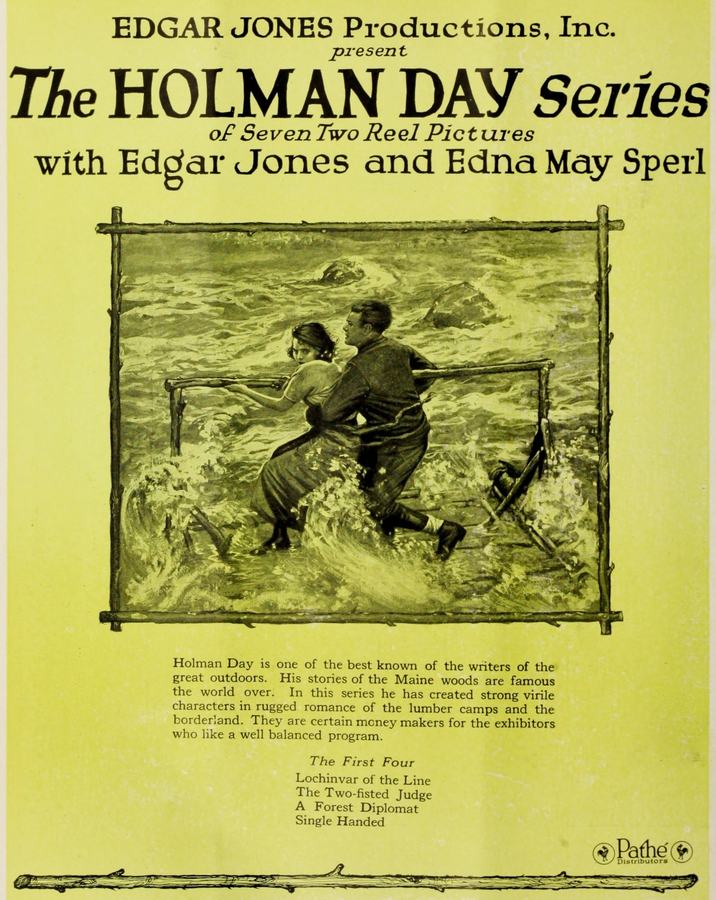
Moonshine, mutiny, and mythmaking—Holman Francis Day’s screenplay detonates like a bootlegger’s lantern hurled into a snowdrift, illuminating the gnarled roots of American masculinity.
Viewed today, Single-Handed Sam feels less like a 1923 one-reeler and more like a prophecy hurled backward through time. The tinting—cyan for daylight, amber for lamplight, blood-red for gunfire—anticipates the digital color-grading fetish of modern prestige television. Edgar Jones, who also directed, shoots through doorframes, carriage spokes, and the hole of a shattered whiskey bottle, so that every frame seems to spy on itself. The result is a stalking-house of mirrors: the law watches the criminal watches the law, until identity liquefies like spring ice.
Edna May Sperl operates in micro-movements: a flare of nostril when Sam calls her "Mademoiselle," a tremor at the corner of her eye that might be frost or remorse. She never allows Marian to ossify into femme fatale or damsel; instead she flickers between languages the way a candlewick gutters between air and wax. Edgar Jones, burdened with the film’s most thankless role—the brother who must incarnate institutional cowardice—nevertheless etches Joe with a mouth that smiles while the eyes inventory exits. But the revelation is the director himself: his Sam moves as if the missing limb were never severed but simply dematerialized, a negative space that the landscape rushes to fill. Watch him strap the rifle to the stump with a leather belt: the gesture is so fluid it feels like a birthright.
Day’s script, distilled from his own serialized pulp stories, treats the border not as line but as lesion. Customs agents speak in the flat vowels of Maine; moonshippers answer in the rounded consonants of New Brunswick. Between them lies a sonic DMZ where accents bleed like bootleg dye. The film’s intertitles—hand-lettered to mimic snow-shaken handwriting—gleefully fracture English into Franco-flecked patois: "Le frost, she bite harder’n revenuer’s badge." This linguistic hybridity weaponizes dialogue into shrapnel, ensuring that every conversation is also a territorial dispute.
Cinematographer Alfredo Gandolfi (imported from the Italian epic Fidelio) lenses winter as a malevolent organism. Snow does not blanket; it swallows. In one prolonged dolly shot, the camera hitches to a dogsled, racing beside Sam until the world reduces to panting breath, whisking fur, and the metallic taste of speed. Another sequence—clearly studied by Griffith for The Birth of a Nation—crosscuts between Marian’s gloved hand tracing frost on a windowpane and Sam’s finger tightening on a trigger. The montage forges erotic tension without a single skin-to-skin contact, proving that censorship can be the mother of invention.
Although released silent, the surviving print screened at Pordenone featured a commissioned score for solo fiddle and quartz bowls. The bow scrapes against wound strings, producing harmonics that mimic wolf howls; the bowls rotate, generating sub-frequencies felt in the sternum rather than heard by the ear. This spectral accompaniment retrofits Single-Handed Sam with a ghost-track, turning every screening into séance. One leaves the theater convinced that footsteps echo in the lobby not because of acoustics but because the film has let something loose.
Where contemporaries like The Bruiser treat women as punctuation marks, Day inscribes Marian as narrative ligature. She negotiates prices, pilots skiffs across half-frozen rivers, and ultimately brokers the brothers’ fates. Yet the film refuses to crown her proto-feminist martyr; instead it traps her inside the same capitalist vise that crushes Sam and Joe. In the final tableau, she strides toward the horizon, not into sunrise but into a whiteout that erases gender as surely as it erases crime. The camera does not pan to follow; the landscape simply swallows her, suggesting that emancipation and annihilation wear identical winter coats.
For decades the only extant copy was a 9.5 mm Pathé baby print, water-stained and spliced with scotch tape. Then in 2018 a near-complete 35 mm nitrate reel surfaced in a decommissioned church outside Halifax, tucked inside a crate labeled "Sunday School Reenactments – 1925." The restoration team at L’Immagine Ritrovata froze the stock to arrest chemical decay, scanning at 8K to capture the equivalent of moonlight on silver. The resulting DCP reveals textures previously devoured by rot: frost crystals on fur collars, the suturing of Sam’s empty sleeve, the glint of a copper still like a pagan idol. Streaming partners have yet to license the title; cinephiles must hunt festival sightings or specialty Blu-ray boutiques. Consider it the celluloid equivalent of the liquor it depicts—illegal, volatile, and unforgettable.
Viewers weaned on the muscular moral binaries of The Vigilantes will find Single-Handed Sam disconcertingly amphibious. Its DNA shares more nucleotides with Scandinavian despair (Tidens Barn) than with homegrown cowboy valor. Conversely, fans of Half a Rogue will recognize the motif of the mutilated hero, though here the wound is not redemptive but recursive—a black hole into which narrative continuums collapse.
Great cinema does not merely entertain; it colonizes memory, repopulating the mind with its own weather. Single-Handed Sam leaves the viewer frostbitten, whiskey-breathed, and unsure whether the crackling sound is fireplace timber or distant gunfire. It is a film that demands to be thawed and refrozen with every viewing, each cycle revealing fresh fractures. Seek it, sip it, but beware: the hangover lasts years, and the only cure is another reel.
© 2024 Celluloid Sighs — dispatches from the vault of vanished dreams.
IMDb —
1920
Community
Log in to comment.