DbcultAccessing Vault...
Cult Review
Senior Film Conservator
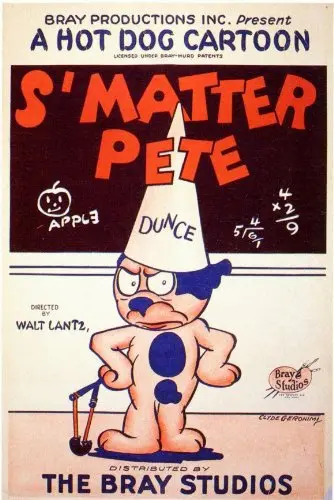
"S'matter Pete?" is an acquired taste, a relic of early animation that will either charm you with its frenetic, unrefined energy or leave you utterly cold. If you're a student of animation history, particularly interested in Walter Lantz's formative years before Woody Woodpecker, then yes, it offers a specific, if limited, kind of insight. For the casual viewer seeking polished storytelling or nuanced humor, it’s probably best skipped.
This film works because it is a pure, unadulterated burst of kinetic silliness, relying entirely on visual gags and physical comedy without a shred of narrative pretense. It fails because its humor is often repetitive, its character flimsy even by early cartoon standards, and its technical execution rudimentary. You should watch it if you appreciate the raw, unpolished beginnings of a major animation studio, or if you simply enjoy the sheer, unbridled chaos of rubber-hose characters flailing against an indifferent world. Otherwise, you'll likely find it a baffling, perhaps even boring, experience.
Walter Lantz's "S'matter Pete?" is less a fully formed narrative and more a proof-of-concept for sustained visual mayhem. It’s a short that feels like a child's excited scribbles brought to life, all movement and exaggerated reaction, with little concern for logic or pacing beyond the next punchline. The entire premise hinges on Pete, a character whose primary trait is his remarkable ability to attract misfortune, constantly stumbling from one minor catastrophe to another. His rubbery limbs stretch and contort with every pratfall, every near miss, embodying the very essence of early 20th-century cartoon physics.
The film’s opening sets the tone immediately: Pete, a fishing rod barely in hand, loses his lure. This isn't a setup for a grand adventure; it's a springboard for a series of escalating, interconnected gags. He tries to retrieve it, falls in, gets chased by a goose, then a dog, then a swarm of bees. The logic is thin. The gags themselves are often variations on a theme: Pete gets wet, Pete gets dirty, Pete gets chased. It’s a relentless assault of physical comedy that rarely pauses for breath.
The primitive animation here, while technically limited, possesses a raw, uninhibited spirit that many later, more refined cartoons often lose.
One might argue that the film’s charm lies precisely in its lack of polish. The hand-drawn imperfections, the slightly off-kilter perspectives, and the abrupt cuts contribute to a sense of spontaneous creation. It feels like Lantz and his team were inventing the rules as they went, throwing everything at the screen to see what stuck. There's an undeniable energy to Pete's frantic, wide-eyed expressions as he realizes he's about to face another indignity. The simple lines and bold movements are direct, almost aggressive in their pursuit of a laugh.
While the energy is palpable, the film's reliance on pure, unadulterated slapstick without much variation eventually wears thin. After a few minutes, Pete's repeated misfortunes cease to be genuinely funny and begin to feel more like a rote exercise. There's no character arc, no real stakes beyond momentary discomfort. Unlike more sophisticated shorts like Lantz’s later The Crackerjack, which still offered simple narratives, "S'matter Pete?" prioritizes quantity of gags over quality or development.
The animation, while lively, rarely showcases inventive techniques beyond the basic rubber-hose flexibility. Backgrounds are sparse, almost an afterthought, serving merely as a stage for Pete's suffering. This isn't a criticism of its era; many shorts from the period, such as Looking for Trouble or Dolly's Vacation, shared similar visual limitations. However, it does mean that the film offers little visual texture or depth to hold attention beyond the immediate gag.
My main contention is that its historical value often overshadows its entertainment value. It's an important stepping stone for Lantz, yes, but that doesn't automatically make it a pleasurable viewing experience for anyone not actively studying the medium's evolution. One could even argue that its relentless, almost brutal, comedic rhythm becomes more irritating than amusing after a short while.
Without a synchronized soundtrack, as was common for many early shorts, the film relies entirely on its visuals to convey meaning and humor. One can imagine a live orchestra or pianist providing a frenetic score to match Pete's antics, which would undoubtedly enhance the experience. Watched silently today, the visual gags feel somewhat muted, lacking the percussive impact that sound would provide. The pacing, while fast, sometimes feels disconnected without the guiding hand of a musical tempo.
The film's ending, like many shorts of its kind, is abrupt and unceremonious. Pete, having endured every conceivable indignity, is left in a final, ridiculous predicament, and then the film simply cuts. There's no grand resolution, no moral, just the cessation of chaos. It's a blunt end to a blunt film. This lack of a graceful exit, while typical, underscores the film's primary goal: to deliver a string of laughs, then get out.
"S'matter Pete?" is a curio. It exists as a testament to the sheer, unbridled energy that characterized early animated shorts, a raw, almost frantic exercise in visual comedy. For a brief few minutes, Walter Lantz unleashes a torrent of slapstick that, while undeniably primitive, holds a certain historical fascination. It’s a foundational piece, important for understanding the roots of American animation, but it rarely transcends its historical context to become something truly captivating on its own merits.
Don't approach it expecting the wit of later Looney Tunes or the artistry of Disney. This is rough, tumble, and often repetitive. It's a short for the dedicated animation student or the completist, not for a casual evening's entertainment. Its value is more academic than aesthetic. If you’re willing to meet it on its own terms, acknowledging its limitations as much as its strengths, you might find something to appreciate in its untamed spirit. Otherwise, there are countless other, more engaging, early animations to explore.

IMDb 6.7
1936
Community
Log in to comment.