DbcultAccessing Vault...
Cult Review
Senior Film Conservator
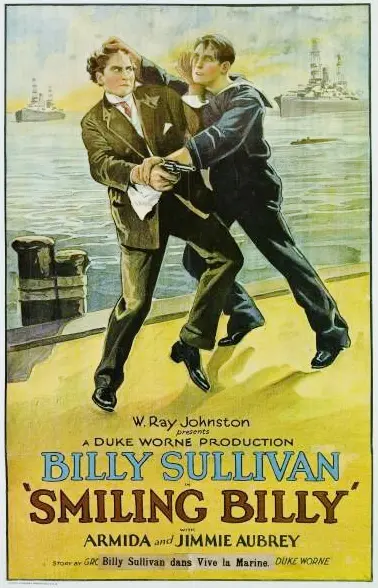
Is Smiling Billy worth watching today? Short answer: yes, but with significant caveats. This early cinematic outing offers a fascinating glimpse into a bygone era of straightforward storytelling and nascent action, making it a compelling watch for film historians and enthusiasts of vintage cinema, but it will likely test the patience of modern audiences accustomed to complex narratives and sophisticated production values.
For those who appreciate the foundational building blocks of popular entertainment, particularly the adventurous spirit of early American filmmaking, Smiling Billy presents a delightful, if somewhat simplistic, journey. It’s a film that doesn't aim for profundity, preferring instead to deliver a clear-cut tale of heroism and villainy, wrapped in the cheerful disposition of its titular character.
This film works because it captures an undeniable, almost innocent, charm inherent to early cinema's ambition. It presents a clear-cut conflict with earnest performances, delivering a sense of adventure that, while rudimentary, holds a certain nostalgic appeal for those who appreciate the foundational elements of genre filmmaking.
This film fails because its narrative simplicity and often broad characterizations struggle to maintain engagement over its runtime, especially for viewers without a deep appreciation for the historical context. The villain, while menacing in concept, lacks the nuanced development that would elevate the stakes beyond a cartoonish threat, and the resolution feels preordained rather than earned.
You should watch it if you are a scholar of early American cinema, a fan of pre-code era light adventure, or someone curious about the evolution of film narrative and character archetypes. Conversely, if you demand intricate plots, psychological depth, or contemporary pacing, this might be a challenging voyage.
The plot of Smiling Billy is, by modern standards, refreshingly uncomplicated. We are introduced to Billy, a sailor defined by his perpetual good cheer, alongside his trusty best friend and a good-natured rival, all serving in the U.S. Pacific fleet. Their world, seemingly one of naval duty and shore leave camaraderie, is upended by the discovery of a mad inventor’s plot to annihilate the entire fleet with a dangerous contraption.
This revelation ignites a classic race against time. The trio, spurred by duty and the added personal stake of Billy’s imperiled sweetheart, springs into action. Their mission is clear: thwart the scientist, rescue the damsel, and save the fleet. It’s a narrative structure that leaves little room for ambiguity or complex character arcs, instead focusing on the immediate thrill of the chase and the triumph of good over a very unambiguous evil.
The film leans heavily into the escapist fantasy of its era, where heroes are unequivocally heroic and villains are cartoonishly malevolent. There’s a certain charm in this directness, a purity of intent that modern blockbusters often overcomplicate with convoluted backstories and morally grey areas. Smiling Billy knows what it is, and it delivers precisely that.
The cast, led by Billy Sullivan in the titular role, delivers performances that are undeniably products of their time. Sullivan embodies the 'happy-go-lucky' moniker with broad smiles and energetic physicality. His portrayal is less about internal struggle and more about outward expression, a common trait in early cinema where emotions were often projected rather than subtly conveyed.
Jimmy Aubrey, as Billy's best friend, provides reliable comedic support and a grounding presence. Their chemistry, while not deeply explored, is palpable enough to sell the camaraderie central to the plot. Thomas A. Curran, as the friendly rival, completes the heroic trio, adding a competitive edge that never devolves into genuine antagonism, maintaining the film's lighthearted tone.
Armida, playing Billy's sweetheart, fulfills the role of the damsel in distress with grace, though her character is largely reactive rather than proactive. Edward Cecil, as the mad inventor, is suitably menacing, if a bit one-dimensional. His villainy is conveyed through exaggerated gestures and a palpable sense of derangement, fitting the archetypal antagonist of the period.
These aren't performances designed for critical introspection but rather for immediate audience engagement. They are earnest, direct, and serve the simple narrative effectively. For instance, the sequence where Billy first learns of the plot relies heavily on his expressive face, transitioning from carefree joy to determined resolve in a matter of seconds, a testament to Sullivan's ability to communicate without extensive dialogue.
The direction in Smiling Billy, while not groundbreaking, is effective in maintaining a consistent pace that suits its adventurous premise. The film moves with a briskness that prevents its simpler plot from dragging, a crucial aspect for early cinema where attention spans were tested by nascent storytelling techniques.
Scenes transition smoothly, and the action sequences, while rudimentary by today's standards, are choreographed with a clear sense of purpose. The director understands the need for momentum, particularly during the sailors' mission to thwart the inventor. There's a palpable build-up of urgency, even if the stakes feel more like a Saturday matinee serial than a grand epic.
One particular sequence involving the pursuit of the inventor showcases a decent understanding of visual storytelling, utilizing quick cuts and dynamic camera angles to convey speed and danger. It’s not revolutionary, but it demonstrates a nascent understanding of how to build tension visually. The film doesn't linger; it propels its characters from one plot point to the next with commendable efficiency.
Given the era, the cinematography of Smiling Billy is functional and clear. It prioritizes visibility and direct communication of action over artistic flourishes. The shots are well-composed, allowing the audience to follow the narrative without confusion, which was a significant achievement in early filmmaking.
The production design, particularly the ship sets and the mad inventor's lair, serves its purpose. The fleet scenes convey a sense of scale, however modest, and the villain's hideout is appropriately cluttered with contraptions that immediately signal his nefarious intentions. It’s not about hyperrealism, but about creating an immediate, recognizable world for the audience.
There's a quaint charm to the visual style, a directness that makes it accessible. The film doesn't attempt to dazzle with special effects but relies on the strength of its straightforward narrative and character actions to engage. For instance, the 'dangerous contraption' itself, while simple in design, is presented with enough visual menace to be a believable threat within the film's context.
The overarching theme of Smiling Billy is uncomplicated heroism and the enduring power of friendship. Billy and his companions exemplify the virtues of duty, courage, and loyalty, without a hint of cynicism or moral ambiguity. It’s a refreshing, almost nostalgic, take on heroism, where good triumphs simply because it is good.
The tone is consistently lighthearted, even when dealing with the threat of fleet destruction. The 'happy-go-lucky' nature of Billy permeates the entire film, suggesting that even in the face of grave danger, a positive outlook and camaraderie can prevail. This unwavering optimism is perhaps its most distinguishing characteristic.
It’s a film that believes in its heroes and in the clear distinction between right and wrong. There’s no existential dread or complex philosophical underpinnings; just a straightforward adventure designed to entertain and uplift. This simplicity might be its biggest strength, allowing it to stand as a pure example of early genre storytelling.
Yes, Smiling Billy is worth watching, but with a specific audience in mind. It's an important piece of early cinema history. It offers a clear window into how adventure stories were told nearly a century ago. The film is best viewed as a historical artifact. Its charm lies in its earnestness and simplicity. Modern audiences seeking complex narratives might find it challenging. It works. But it’s flawed.
Smiling Billy is more than just a relic; it’s a vibrant, if unsophisticated, piece of cinematic history that deserves a look for its sheer earnestness. It stands as a testament to the power of simple storytelling and the universal appeal of heroism, even when executed with the nascent tools of early filmmaking. While it certainly won't challenge the narrative complexities of modern blockbusters, it offers a refreshing antidote to them, a direct and unpretentious adventure.
It’s easy to dismiss films of this vintage as merely academic curiosities, but to do so would be to miss the genuine, if modest, pleasures Smiling Billy offers. It's a film that doesn't demand much from its audience beyond an open mind and an appreciation for where cinema began. Is it a lost classic? No. Is it an important stepping stone in the evolution of popular film? Absolutely. It’s a charming, if slight, diversion that reminds us that sometimes, a good-natured sailor, his friends, and a mad scientist are all you need for an enjoyable, if fleeting, cinematic experience. Don't expect The Illustrious Prince, but rather a different, lighter flavor of early adventure.

IMDb 6.8
1915
Community
Log in to comment.