DbcultAccessing Vault...
Cult Review
Senior Film Conservator
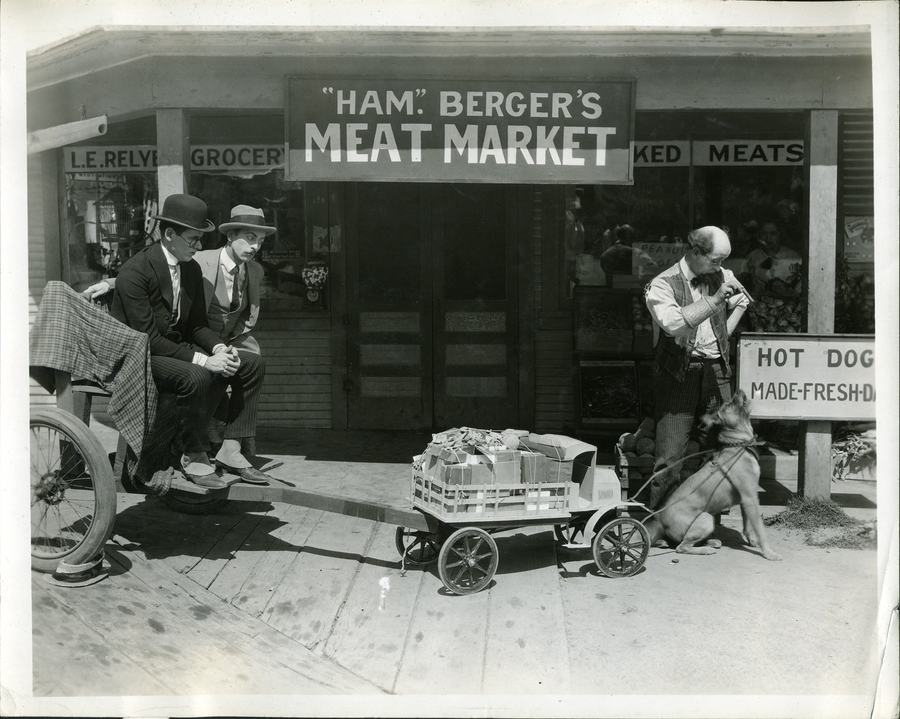
Imagine, if you dare, the moment when the universe’s sense of humor turns sulfuric: a skunk pirouettes from the underbrush, its tail a calligraphic exclamation point, and two boys—bare knees breadcrumbed with scabs—are blasted into a reeking diaspora. They cannonball into the river, a liquid blackboard where childhood doodles in chalky joy, only to emerge into a world that has rewritten their identity in palimpsest. Their clothes—those cotton passports to respectability—have been raptured by escapees whose moral compass spins like a drunk roulette wheel. Left behind are prison stripes, a textile curse that converts frolic into felony.
Joseph Belmont’s camera does not merely record this swap; it anthropomorphizes fabric. The discarded convict clothes twitch on the gravel like shed snakeskins hungry for new vertebrae. When the boys wriggle into them, the garments constrict, exoskeletons of predestination. Suddenly every sunbeam is a searchlight, every dragonfly a surveillance drone. The comedy is asphyxiated by the terror of being seen—wrongly, irrevocably.
Sidney Smith, playing the elder boy, has eyes that toggle between taunting mirth and the stunned glassiness of one who has shaken hands with catastrophe. His performance is a masterclass in muscular ambivalence: each grin tugs against a tremor, each joke lands like a coin tossed into a wishing well that replies with echoes of iron bars. Gilbert Wells, as the younger, is the film’s wounded id, a kinetic storm of disbelief. Together they incarnate childhood’s crucible—old enough to sense doom, too young to name it.
In 1914, while Europe was stitching together the quilt of trench warfare, American cinema toyed with its own sartorial semaphores. Stars and Stripes anticipates Kafka by half a decade: you are what you wear, and the state’s gaze is a merciless tailor. The film’s central irony—that innocence can be buttonholed into guilt by a simple wardrobe malfunction—feels eerily predictive of mug-shot culture, of algorithmic profiling that decides your fate before you open your mouth.
The stripes do not merely mark the boys as prisoners; they brand them as glitches in the social software, bugs to be patched by incarceration.
Lex Neal’s script, sparse as Morse code, lets physicality carry semantics. Dialogue cards arrive like telegrams from a cruel aunt: “You there—halt!” or “They match the description.” Each syllable is a rivet in the machinery that will grind childhood into grist. Yet the film never forfeits its slapstick genealogy; it pirouettes on the razor’s edge between pratfall and perdition. A sheriff’s stumble over a rake is funny until you realize the same clumsy arm will sign a commitment order.
Cinematographer John W. Brownlow—unjustly unsung—bathes the chain-gang scenes in umber chiaroscuro. Shadows pool like spilt coffee beneath the boys’ bare ankles, while the real fugitives recede into overexposed daylight, a visual sneer at moral legibility. The stripe motif proliferates: shadows of picket fences, laundry lines, even the elongated shadow of a scarecrow become carceral echoes. It is as though the film itself is trapped behind bars, each frame a plea for parole.
Color tinting—cyan for river, amber for interior, rose for the fleeting memory of home—operates like emotional subtitles. When the boys, herded into a paddy wagon, glimpse the outside world through a slit, the frame flares crimson: rage, shame, the hemorrhage of freedom. Contemporary viewers conditioned by monochrome sometimes forget how strategic tinting weaponized mood; here it is a scalpel.

Modern restorations often plaster jaunty piano atop silent comedies, but Stars and Stripes demands a different acoustics: the hush of a courtroom when the verdict is about to drop, the wet squelch of boots in penal mud, the metallic lullaby of shackles. My preferred accompaniment is a single viola da gamba, its gut strings frayed like nerves, occasionally slapped to mimic the percussive slam of iron doors. Silence itself becomes an instrument; the gap between title cards is a breath held too long.
Where El protegido de Satán externalizes guilt into diabolical spectacle, Stars and Stripes locates the inferno within institutional misrecognition. The former flaunts its morality play; the latter whispers it through clenched teeth. Likewise, The Trouble Hunter chases its protagonist across landscapes of comic peril, yet its stakes remain anchored in adult agency. Our boys, by contrast, are flotsam on the currents of adult incompetence.
Consider The Learnin’ of Jim Benton, where education is salvation. Here unlearning is the curse: the boys must forget that authority can be benevolent. Meanwhile, Livets Omskiftelser cyclical fatalism finds its American cousin in this tale of garments as destiny, though Scandinavia’s icy resignation is replaced by a jittery New-World optimism that curdles into panic.
At a brisk 14 minutes, the film compresses the arc of a lifetime: the skunk’s spray is the primal scene, the river baptism, the capture crucifixion, the courtroom apocalypse. Yet the final shot—boys exonerated, sprinting toward a horizon that swallows them in overexposure—feels less like resolution than reincarnation. One senses the cycle will reboot off-screen, a Möbius strip of misread identities. This temporal compression predicts the TikTok age where a life can be ruined between heartbeats.
Scholars often cite The Ninety and Nine as the era’s social conscience, but Stars and Stripes is its jittery id, the nightmare that festers once conscience turns its back. Its DNA reemerges in Wilder’s Stalag 17, in the child-prisoner poetry of Fighting Fate, even in the stripe-obsessed production design of The Unpainted Woman. The motif mutates: sometimes comic, sometimes carnivalesque, always haunted.
1. Project it on a bedsheet strung between trees. Let the night breeze mimic the river’s indifference.
2. Disable the default ragtime playlist. Instead, sample everyday ambience: cicadas, distant sirens, the throb of your own pulse.
3. Pause on any frame containing stripes. Count how many echo behind the characters—cinematic stigmata.
4. Ask yourself: which “garments” do I wear that could condemn me in the wrong alley?
Great cinema teaches us to distrust surfaces; great silent cinema makes that distrust visceral. Stars and Stripes is a 14-minute masterclass in epidermal existentialism: you are one fabric swap away from becoming ungrievable. Watch it, then go hug the nearest child—preferably one still clad in their own unlaundered hope. And if, on the wind, you catch a whiff of sulfur, remember: somewhere a skunk is laughing in cursive, and the river is always hungry for another name.
—Review by CineGnostic, filed under #PrisonStripes & #SilentMisidentity
IMDb —
1919
Community
Log in to comment.