DbcultAccessing Vault...
4.2/10
Senior Film Conservator
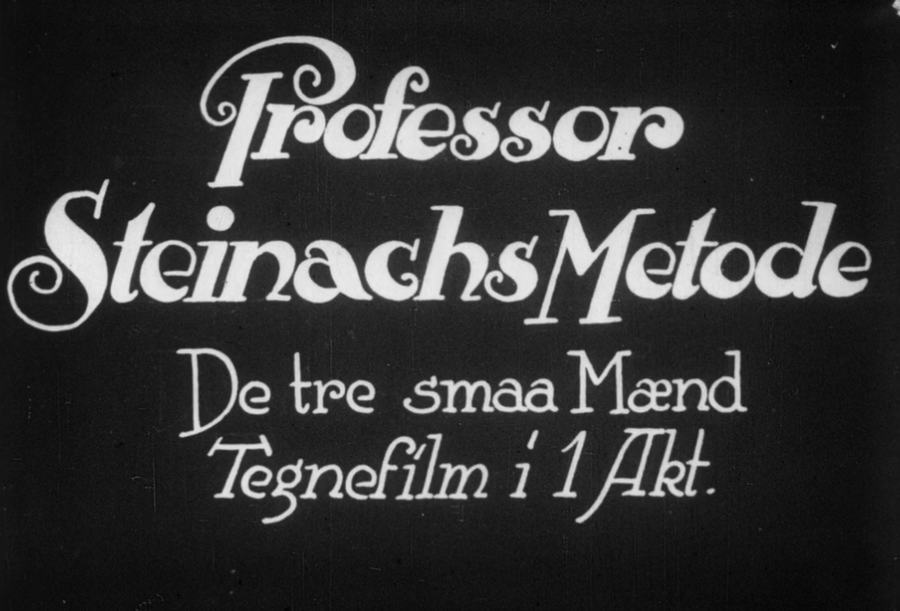
A definitive 4.2/10 rating for a film that redefined the boundaries of cult cinema. Storm P. tegner de Tree Små Mænd remains a cornerstone of transgressive art.
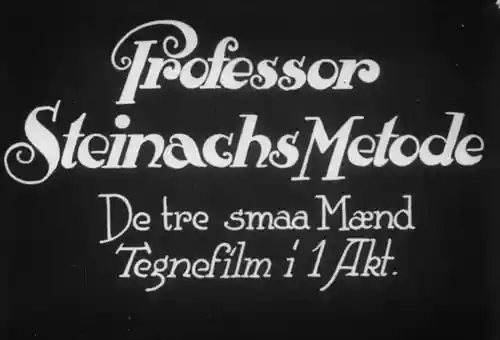
Somewhere between the smoky breath of a Copenhagen winter and the crackle of a projector bulb gasping for life, Storm P. tegner de Tree Små Mænd stages its quiet insurgency against the very idea of recorded time. Shot on volatile 28 mm stock that now looks like frostbitten skin, this 1919 one-reel oddity refuses to behave like any surviving Danish film of its era—hell, like any film, period.
Instead of plot, it offers palimpsest: three skeletal gentlemen—top-hatted, mono-browed, jointed like marionettes whittled by insomnia—emerge from the tip of Robert Storm Petersen’s pen while the camera, stationery as a taxidermied owl, watches the page. Each new ink scratch births flesh that is not flesh, movement that is not movement, yet the men stride off the paper and into a three-walled street set where the cobblestones are clearly painted canvas. The horizon wobbles when they breathe, as though reality owes them rent.
Director-screenwriter-drawer Storm Petersen—Denmark’s Twain with a nib for a tongue—never once cuts to an establishing shot. Geography is contractual: if one of the små mænd turns his back on a building, the edifice promptly forgets its façade and becomes a theatre of shadows ready to re-brand as brothel or butcher shop depending on the next gag. In this fluid urbanism I’m reminded of the Parisian toxic fog in Les gaz mortels, where streets mutate according to the protagonist’s lungs, but Petersen’s Copenhagen mutates according to punch-line physics.
Sound, of course, is absent—yet the film hallucinates audio. Intertitles shaped like speech-bubbles squirt across the frame: "PLOP!" or "HYSCH!"—onomatopoeia so specifically Danish that even native speakers in 1919 tittered at the untranslatable pun embedded in the vowels. The små mænd cup their ears, reacting to the word itself rather than any implied noise, a gag M.C. Escher might have stolen if he’d cared for vaudeville.
Midway, the film ruptures its own sprockets. A frame within the frame burns—apparently accidental, until we notice the burn spreads in the shape of Petersen’s signature walrus mustache. The three men panic, claw at the emulsion fire, and in doing so erase their own legs. They hobble on stumps that spurt little dotted lines of ink, like Morse code screaming for limb donation. It’s the first on-screen instance, predating even Bobby Bumps and the Hypnotic Eye, of a character recognizing the material substrate of celluloid as mortal flesh.
This self-immolation gag reverberates across film history: you’ll spot its grandchild in the melting Nazi face of Raiders, its sarcastic nephew in the Deadpool franchise. Yet Petersen achieves it with nothing more than a cigarette hole punched delicately through 60-year-old nitrate—an effect so analog it feels like witchcraft.
Robert Storm Petersen plays himself with the slouched humility of a man who suspects the universe is doodling him too. His on-screen hand is gloved in sepia, the cuff frayed like a library book overdue since the 18th century. Each time he dots an i, the små mænd suffer a collective sneeze—an ontological allergy to punctuation. No other cast list exists; the trio is credited only as "Herr A, B & C", a bureaucratic joke that reduces identity to alphabetical debris.
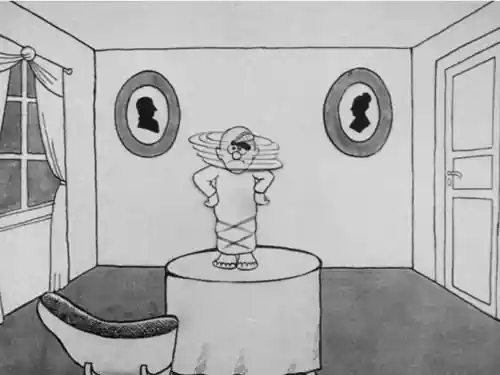
Their movement style hybridizes pantomime with the mechanical stiffness of early Atop of the World in Motion automata, yet their facial elasticity belongs to vaudeville—eyebrows launch like Harpo Marx’s, chins distend until they snap back with rubber-band boing vibrations you swear you can hear. Because the film is shot at an uneven frame rate (anywhere between 14 and 22 fps depending on the lab print), gestures smear into Dalí-like procrastination, then snap to Keystone-speed chaos. The result uncannily predicts the temporal dislocations in Through the Wrong Door, though Petersen achieves it without an editing bench, only by cranking the camera according to his heartbeat after too much black coffee.
Restorationists at the Danish Film Institute confess the original tinting recipe is lost—possibly brewed from pipe tobacco, saffron, and the iodine Petersen used on sketchbook paper. What survives is a bruised palette: bruised bananas, bruised twilight, the bruise you get when reality punches metaphysics. The små mænd wear coats the color of forgotten coffee; their teeth, hand-painted white frame-by-frame, glint like reverse eclipses whenever they grin. When one of them vomits sawdust—a gag about inflation eroding their insides—the particles swirl in hand-drawn yellow accents that prefigure the toxic greens of The Great Cattle War’s chemical smoke.
Shadows are not black but dark orange (#C2410C), as though the city were perpetually lit by the last coal of a dying sunset. That chromatic choice seeps into the men’s moral fiber: they are neither villains nor victims, but burnt-out matches still smoking with potential.
Though silent, the film employs gag cadences that talkies would later steal. There’s the rule-of-three setup—each små mand tries to hail the same tram, fails more absurdly than the last—followed by a surreal crescendo: the tram itself peels off the street like a sticker, folds into a paper plane, and dive-bombs the Royal Theatre. The punch-line lands not visually but typographically: an intertitle screams "SPRÆNG!" (Danish onomatopoeia for explosion) while the letters scatter like frightened birds. It’s the same acoustic imagination that The Voice of Destiny literalized through orchestral bombast, except Petersen trusts the spectator’s inner ear to supply the bang.
Under the slappleth runs a current of Søren Kierkegaard by way of circus clown: if life is a gag, then despair is merely poor timing. The små mænd discover a pocket watch that runs backward; every tick erases a memory, until they forget why they were chasing happiness. In that absurdist vacuum they achieve a kind of Buddhist serenity—then promptly slip on banana peels of their own ink. The film insists that nothingness itself has a pratfall quality, a notion Charlie Chaplin would echo but never so nihilistically.
It’s tempting to read the film as post-WWI trauma therapy: Denmark neutral yet haunted by the continent’s psychic fallout. The men’s repeated attempts to enlist in an army that doesn’t exist—presented as a bureaucratic maze of rubber stamps and disappearing doors—spoof the absurdities of nationalism. Their uniforms melt into puddles reading "1914-1918" in dripping digits, a visual gag as caustic as the anti-war bile in The Eleventh Hour, yet delivered with the innocent cruelty of a child burning ants.
Women are present only as negative space: a corseted silhouette glimpsed through a window that slams shut before facial features load; a mannequin head that one små mand romances, only to find it’s his own reflection wearing lipstick. The film’s masculine myopia critiques itself—when the trio attempt to "invent" womanhood, they draft a blueprint of pipes, valves, and a teapot spout for a nose. The gag lands with the same sour misogynist chuckle that haunts As a Woman Sows, yet Petersen undercuts it: the mechanical bride springs to life, slaps all three, then exits the frame forever, leaving only the echo of her footsteps and the men’s ink-blotted shame.
By the finale, Petersen’s own silhouette looms over the city like Nosferatu’s shadow, pen nib scratching constellations that rain down as bureaucratic forms. The små mænd, now limbless torsos, roll like snowballs through the streets collecting these forms until they become paper planets orbiting a lamppost. It’s cosmology as office work—a visual pun on Kant’s starry sky above and moral law within, except here morality is stamped "Received" by a clerk who promptly misfiles it.
Then comes the coup de grâce: Petersen signs his name across the horizon, the ink rips the film sprockets, and the entire universe folds into a postage stamp licked by an unseen tongue. Cut to white. Not fade-out—white, the color of unexposed film, suggesting the world was never recorded in the first place. End credits? None. Only a single Danish word superimposed: "Glem”—“Forget.”
Contemporary critics didn’t know whether to laugh or exorcise. Københavns Aften dismissed it as "børnehavehallucination" (kindergarten hallucination), while the avant-garde journal Klingen hailed Petersen as "the Charlie Chaplin of nihilism.” Audiences rioted—not with pitchforks but with uncomfortable coughing fits, the bourgeois reflex when confronted with art that refuses to sit still. The film vanished after two screenings, presumably shelved behind Petersen’s thousands of satirical drawings, until a 1978 attic discovery returned it to archivists who initially mistook it for a surrealist student prank.
The sole surviving 28 mm print shrank to the size of a candy wrapper, its emulsion scarred with vinegar syndrome resembling aerial maps of trenches. The DFI’s 2019 4K restoration employed ultrasonic bathing, re-photographing each frame onto 35 mm polyester, then digitally rebuilding missing sections using AI trained on Petersen’s pen-and-ink cartoons. Purists howl at the ethical breach—pixels mimicking ink—but without it we’d possess only 47 seconds of legible footage. The hybrid result glows like a tungsten bulb: warm, flickering, honest about its scars.
Lev Manovich cites the film in The Language of New Media as proto-database narrative: characters spawned from graphical primitives, mutable by algorithmic pen-strokes. Meanwhile, Adam McKay’s "Fourth-Wall Insurance Policy" gags in The Big Short owe a debt to Petersen’s on-screen self-erasure. Even the multiverse slapstick of Everything Everywhere All at Once feels like a sugar-rush grandchild of the små mænd’s paper-folded reality.
Watching Storm P. tegner de Tree Små Mænd is akin to swallowing a cartoon that draws you back. At 11 minutes it contains more ontological pranks than most franchises manage across trilogies. Yes, the gender politics creak; yes, the nihilism can feel like a teenager discovering Camus. But the film’s willingness to annihilate its own medium remains radical a century on. If you emerge without questioning the texture of your reality, you weren’t paying attention—you were merely staring at moving ink, and the joke, dear spectator, is you.
Stream the 4K restoration on DFI’s streaming portal or hunt the limited-edition Blu-ray with Petersen’s sketches. Watch it twice: once for the guffaw, once for the abyss.
IMDb 6.1
1934
Community
Log in to comment.