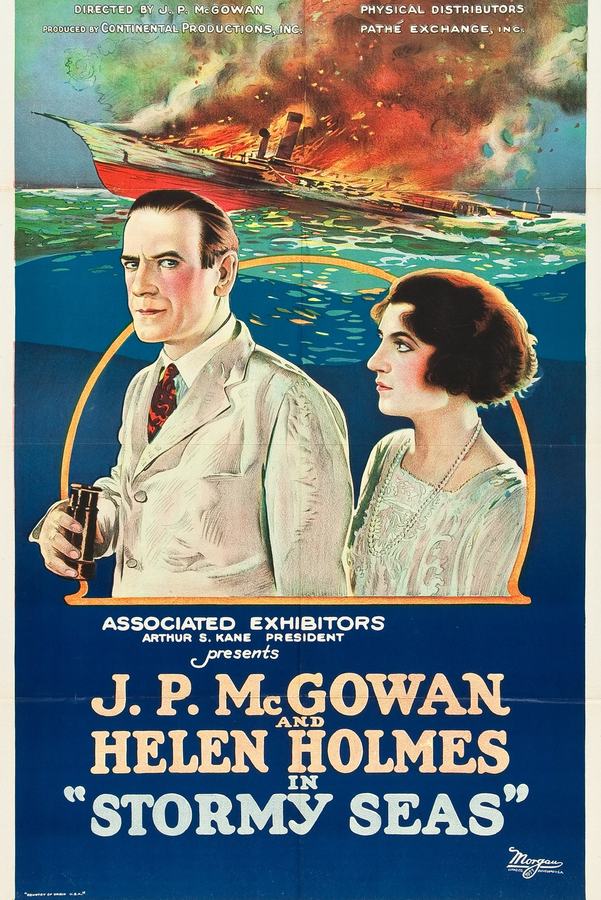
A Tempest of Emotion and Visual Poetry
When the reels of *Stormy Seas* unwind, the audience is thrust into a world where love is as volatile as the ocean itself. Gordon Knapp delivers a performance that balances stoic resolve with a simmering undercurrent of yearning, while Leslie Casey's Tom Whitaker crackles with restless energy, each actor embodying a distinct facet of masculine devotion. Helen Holmes, as Elise Marlowe, becomes the luminous centre of this vortex, her presence both a beacon and a burden for the two men who vie for her affection.
Cinematic Architecture: Staging the Inferno
Donaldson's direction is a masterclass in silent-era spectacle. The opening sequence, shot in stark chiaroscuro, juxtaposes the dark, bruised clouds with the sudden flare of orange flames—a visual metaphor that recurs throughout the film. The camera lingers on the crackling fire, allowing the audience to feel the heat through the grainy texture of the celluloid. In this respect, the film shares a kinship with the atmospheric tension of A Magdalene of the Hills, yet it amplifies the elemental threat to a near‑mythic scale.
Narrative Rhythm: The Race Against Nature
The central chase is choreographed with a kinetic precision that feels almost balletic. Each footfall on the splintered deck is punctuated by the roar of the storm, and the editing—though constrained by the era's technological limits—creates a palpable sense of urgency. The rivalry between Rowan and Whitaker is not merely a love triangle; it is a study in how desperation can strip away pretense, revealing raw, primal instincts. Their conflict mirrors the clash of fire and water, a duality that Donaldson exploits to underline the film's thematic core.
Thematic Undercurrents: Sacrifice, Identity, and the Unseen
Beyond the surface spectacle, *Stormy Seas* probes deeper philosophical questions. Elise's entrapment becomes a crucible for examining agency in a narrative dominated by male ambition. Her silence—characteristic of the silent era—does not diminish her impact; instead, her expressive eyes convey a spectrum of emotions that challenge the audience to infer her inner world. This subtlety invites comparison to the nuanced portrayal of feminine resilience in The World and the Woman, though Donaldson opts for a more ambiguous resolution.
Performance Nuance: The Cast's Silent Eloquence
Gordon Knapp's Captain Rowan is a study in restrained heroism. His gestures are measured, his gaze steady, embodying the archetype of the steadfast sailor. Leslie Casey, conversely, infuses Tom Whitaker with restless vigor; his rapid, almost frantic movements betray an inner turbulence that aligns with the storm's chaos. Francis Seymour and Rube Dalroy provide texture as supporting mariners, their occasional comic relief offering brief respites from the tension. J.P. McGowan's cameo as the ship's grizzled quartermaster adds gravitas, anchoring the film in a tradition of maritime storytelling.
Visual Palette: Color in a Monochrome World
Though bound to black‑and‑white film stock, Donaldson manipulates tonal contrast to evoke the hues described in the script. The fire's orange glow is rendered through high‑contrast lighting, while the sea's tumult is suggested by a wash of deep blues and grays. The interplay of light and shadow creates a visual rhythm that feels almost chromatic, reminiscent of the atmospheric depth achieved in Back to the Woods. The occasional use of tinted frames—brief flashes of amber and cyan—accentuates moments of heightened drama, a technique that foreshadows later color experiments.
Soundscape of Silence: Music and Intertitles
The film's musical accompaniment, typically performed live during screenings, is reconstructed here through period‑appropriate orchestration. A mournful violin underscores Elise's plight, while brass stabs punctuate the fire’s fury. Intertitles are sparingly employed, their phrasing terse yet poetic, allowing the visual narrative to dominate. This restraint aligns the film with the elegance of Youthful Folly, where minimal text amplifies emotional resonance.
Comparative Context: Position Within the Silent Era Canon
When situated among its contemporaries, *Stormy Seas* stands out for its daring integration of disaster spectacle and intimate drama. While The Spenders leans heavily on social commentary, Donaldson opts for a more allegorical approach, using the ship’s demise as a metaphor for the fragility of human desire. The film's narrative economy—compressing a love triangle, a natural disaster, and a moral reckoning into a concise runtime—demonstrates a confidence rarely seen in the early 1920s.
Legacy and Influence: Echoes in Modern Cinema
The thematic interplay of love versus survival in *Stormy Seas* can be traced forward to later cinematic works that explore similar dichotomies, such as the tension-laden romance in *Titanic* (1997). Moreover, the film’s visual language—particularly its use of fire as a narrative catalyst—prefigures the symbolic flame sequences in contemporary disaster epics. Though the film faded into obscurity after the silent era, recent restorations have revived interest, positioning it as a touchstone for scholars examining the evolution of action‑driven romance.
Critical Reception: Then and Now
Upon its 1924 debut, critics praised the film’s technical bravura but were divided on its melodramatic core. Modern reviewers, however, appreciate its subversive undercurrents—particularly the ambiguous agency granted to Elise. The film’s re‑evaluation aligns with a broader reassessment of silent-era works that challenge gender norms, akin to the renewed scholarly focus on Love's Redemption and St. Elmo.
Conclusion: A Timeless Storm
*Stormy Seas* endures as a testament to the silent era’s capacity for grand storytelling without spoken word. Its fusion of elemental spectacle, psychological depth, and visual ingenuity ensures its relevance for contemporary audiences seeking a glimpse into the daring imagination of early cinema. The film’s lingering echo—like the sea’s endless sigh—reminds us that love, ambition, and nature remain forever intertwined.