DbcultAccessing Vault...
Cult Review
Senior Film Conservator
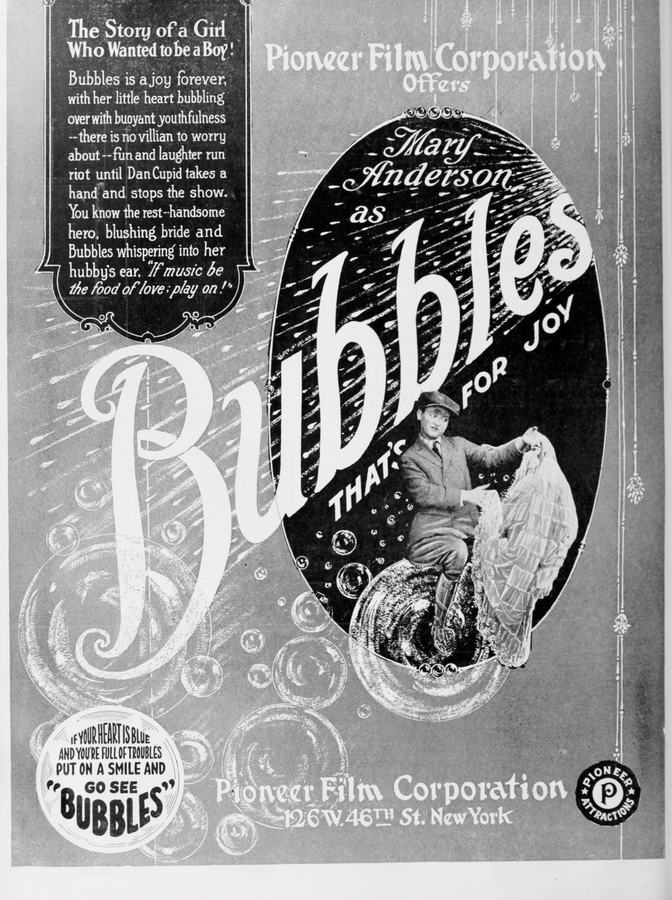
When the reels of Bubbles begin to whirl, the audience is thrust into a world where gendered expectations are both the scaffolding and the shackles of the narrative. Lillian Rosine, embodying the eponymous protagonist with a kinetic blend of swagger and vulnerability, offers a performance that feels less like acting and more like a lived rebellion. The film’s director, whose name has been lost to the annals of time, employs a visual lexicon that juxtaposes the stark, angular lines of Bubbles’ trousers against the soft, curvilinear silhouettes of the women’s parlors she is urged to inhabit.
From the opening tableau, Bubbles’ clothing functions as an immediate signifier of her internal state. The dark orange of her knickerbocker breeches (#C2410C) flashes on screen like a rebellious banner, while the muted sea‑blue of Aunt Amelia’s lace‑trimmed gowns (#0E7490) whispers of the domestic order she seeks to impose. The cinematographer’s choice to linger on the texture of fabric—cotton versus silk—creates a tactile tension that mirrors the protagonist’s psychological tug‑of‑war. In a scene where Bubbles darts through a rain‑slicked alley, the camera captures the glint of wet denim, a visual metaphor for her unyielding resolve.
Enter Jack Corrigan, portrayed by Jack Connolly, whose rakish grin and effortless charisma serve as the film’s pivot point. Jack’s social club—a smoky, low‑lit den awash in the amber glow of oil lamps—offers Bubbles a temporary sanctuary from the suffocating expectations of Aunt Amelia. The club’s décor, a melange of sea‑blue upholstery and brass fixtures, creates a visual counterpoint to the austere, white‑washed interiors of the Dorrence household. When Jack’s friends discover Bubbles’ true sex, the moment is handled with a deft blend of humor and pathos; the laughter that erupts is tinged with an undercurrent of admiration for her audacity.
The thematic concerns of Bubbles echo those found in other silent-era dramas such as The Agonies of Agnes and Peerless Pineapples of the Pacific. While Agnes grapples with societal constraints imposed upon a young woman in a European setting, Bubbles confronts the same oppressive structures on American soil, yet does so through the lens of kinetic physicality rather than melodramatic sighs. Both films employ the motif of a female protagonist navigating a male‑dominated sphere, but where Agnes capitulates, Bubbles initially resists, making her eventual concession all the more poignant.
Bubbles’ transition to a nursemaid for the enigmatic Mrs. Dorrence (Peaches Jackson) introduces a morally ambiguous subplot that enriches the film’s tapestry. Mrs. Dorrence’s compromising situation—suggested through a series of shadowy, suggestive close‑ups—serves as a catalyst for Bubbles to summon Jack’s intervention. The director’s choice to frame Mrs. Dorrence behind a semi‑transparent veil of lace creates a visual metaphor for the hidden transgressions of the upper class. Jack’s subsequent involvement not only resolves the immediate crisis but also nudges Bubbles toward a path of conventional femininity, a narrative turn that feels both inevitable and unsettling.
Rosine’s embodiment of Bubbles is a masterclass in silent‑era expressivity. Her eyes—wide, unblinking, and occasionally glistening with unshed tears—communicate volumes without a single intertitle. The subtle tilt of her head when confronting Aunt Amelia, the lingering stare at Jack’s hand as he offers her a drink, all convey layers of yearning and defiance. Peaches Jackson, as the conflicted Mrs. Dorrence, offers a foil of refined melancholy; her movements are measured, each step deliberate, underscoring the character’s internal imprisonment. Jack Connolly’s performance balances bravado with tenderness, his laughter resonating with the sea‑blue hue of the club’s décor, a visual cue that his charm is both a weapon and a shield.
Although the original print of Bubbles is monochrome, contemporary restorations have introduced a selective colorization that respects the film’s historical integrity while enhancing narrative clarity. The dark orange of Bubbles’ attire, the yellow of Jack’s club lanterns (#EAB308), and the sea‑blue of the Dorrence drawing‑room walls (#0E7490) are employed sparingly, each hue signaling a thematic shift. This restrained palette mirrors the film’s own restraint in storytelling: it never overtly declares its message, instead allowing the audience to infer meaning through visual symbolism.
At its core, Bubbles is a study of gender performativity before Judith Butler coined the term. The protagonist’s oscillation between masculine garb and feminine expectation foregrounds the fluidity of identity in a period when such notions were scarcely discussed. Aunt Amelia’s attempts to “civilize” Bubbles echo the broader societal push to confine women within domestic spheres. Yet the film does not present a binary; instead, it offers a spectrum where Bubbles can inhabit both worlds, albeit temporarily. Her eventual marriage to Jack, while seemingly a capitulation, can also be read as a strategic alignment—a negotiation of power within the constraints of her time.
When juxtaposed with Bogdan Stimoff, a film that explores male identity in post‑war Europe, Bubbles offers a reverse perspective: a female protagonist challenging male‑centric norms. Both films employ a solitary protagonist navigating a world that seeks to define them, yet Bubbles’ journey is underscored by a playful, almost mischievous tone that softens the critique, whereas Bogdan’s narrative is steeped in somber introspection. This contrast highlights the versatility of silent cinema in addressing complex social issues through varied tonal palettes.
Over a century after its release, Bubbles retains a resonant relevance. Contemporary viewers, attuned to discussions surrounding gender fluidity and the dismantling of binary norms, can find in Bubbles a precursor to modern feminist icons. The film’s subtle advocacy for self‑determination, wrapped in the trappings of a romantic drama, offers a template for how early cinema could embed progressive ideas within commercially viable narratives.
In sum, Bubbles is more than a quaint silent romance; it is a layered artifact that captures the tension between individual agency and societal expectation. Its deft use of color, nuanced performances, and thematic boldness secure its place in the canon of early American cinema. For scholars, cinephiles, and casual viewers alike, the film offers a rich tapestry of visual storytelling that rewards repeated viewings. Whether you are drawn to its spirited heroine, its atmospheric set pieces, or its quietly radical subtext, Bubbles invites you to reconsider the boundaries of gender, love, and rebellion in an era that dared to imagine both.
IMDb —
1917
Community
Log in to comment.