DbcultAccessing Vault...
Cult Review
Senior Film Conservator
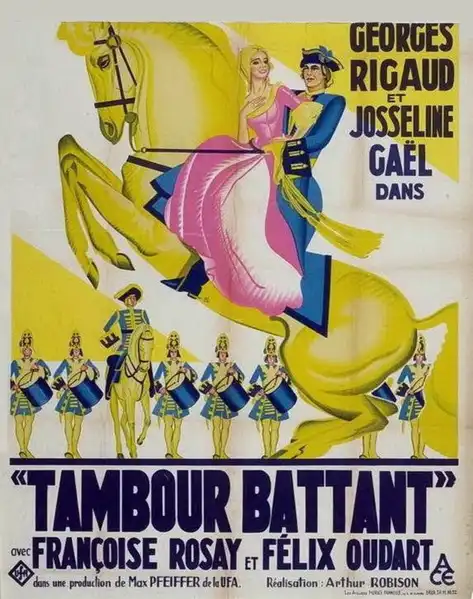
Tambour battant is one of those old-school romances that feels like it stepped right out of a dusty old novel. If you're into sweeping period dramas, the kind where class differences are everything and forbidden love is the main dish, you might find something to chew on here. But if you want a fast-paced, action-packed flick or something super 'woke' for today's eyes, you're going to be bored stiff. Maybe even a little annoyed by how slow things move along. 🕰️
The premise is simple enough. We’re in Bismarck’s Germany, back when titles meant everything. A nobleman, Baron Karl (Jorge Rigaud), he’s got his eye on Marie-Anne (Josseline Gaël), a pharmacist’s daughter. Right away, you know this is a big problem for pretty much everyone involved.
Marie-Anne, bless her heart, she’s got this quiet strength. You see it in her eyes during those early scenes. Not a lot of words needed. She just *looks* at Karl, and you get it.
Karl, though. He’s a bit of a dreamier type than I expected for a baron. Not super commanding, more like a puppy dog. He’s clearly smitten, almost painfully so.
The film takes its sweet time setting up this whole class divide. We get some long shots of grand estates, then we cut to the bustling, smaller world of the pharmacist's shop. The contrast is *really* laid on thick.
There’s this one scene, early on, where Karl's mother, played by Françoise Rosay, she just stares at Marie-Anne at some public gathering. It's a look that could curdle milk. No dialogue, just this icy glare. It tells you everything you need to know about the obstacles.
And speaking of obstacles, Marie-Anne’s father, the pharmacist (Paul Ollivier), he’s surprisingly pragmatic. Not thrilled about the whole thing, but also not totally against it if it means his daughter is happy. Or maybe he just sees the practical side of a baron for a son-in-law? Hard to tell sometimes. He’s a character full of small contradictions.
The pacing, for sure, is a *journey*. There are moments where the camera just sits, watching people walk across a room. Or a horse-drawn carriage going down a lane. It's not trying to rush you anywhere. You just gotta settle in. Like reading a very long letter.
Some of the dialogue, when it finally gets going, feels a bit… formal. Even for the era. It’s like everyone is reciting poetry, even when they’re just talking about the weather. But then again, maybe that’s how fancy people talked back then? 🤔
I found myself wondering about the costumes. Marie-Anne’s dresses, they're simple but elegant. You can tell they tried to make her look good without making her look "too rich." The details on the nobleman's uniforms, those little buttons and braids, are quite something.
There's a dinner scene that goes on a bit long. Everyone is just eating, very primly. No one really talks. The clinking of forks on plates becomes the main sound for what feels like an eternity. It makes you feel the *tension* in the room, sure, but also maybe a bit hungry.
The whole conflict hinges on this one idea: can love overcome social standing? The movie really wants you to believe it can. Even when everything around our two lovers is screaming 'no'.
I particularly liked Henri Chomette as Baron Karl’s stuffy uncle, or someone similar. He’s always lurking, looking displeased. Just a subtle sneer here and there. He doesn't need big speeches. His face just says it all. You know, the typical disapproving relative.
It's not a film that gives you huge emotional payoffs every ten minutes. It’s more about the slow build, the small gestures. A hand touch, a stolen glance. That’s where the real juice is, if you can wait for it.
There’s a small subplot about some family honor, or debt, that felt a little shoehorned in. Like they needed an extra hurdle for our lovers. It comes and goes without too much fanfare. Almost like they forgot about it for a bit, then remembered.
The musical score, it's pretty much what you'd expect. Swelling violins for the romantic bits, a bit more dramatic for the conflicts. Nothing too groundbreaking, but it does the job. It’s always there, nudging your feelings.
I noticed a few times the background extras. They’re just kinda… *there*. Standing around, looking vaguely interested. Not really doing much. It makes those grand ball scenes feel a little less lively than they probably wanted them to be. Like half the guests didn’t get the memo on how to socialize.
The interiors of the wealthy homes are all dark wood and heavy draperies. Very opulent, but also a bit stifling. You can almost feel the weight of tradition in those rooms. Then the pharmacist's home, it’s much brighter, simpler, almost cozy by comparison. A nice visual shorthand for the class difference.
There's a scene where Karl tries to talk to Marie-Anne in a garden, and it's just so *proper*. They stand so far apart! You want to just push them together. But no, it's all about polite distances and hushed tones. The rules of the time, I guess.
It’s interesting how even the smallest gestures, like a slight bow or a curtsy, carry so much meaning. Every movement is careful, deliberate. It paints a picture of a very different world.
The ending, without giving anything away, it’s… well, it’s a period romance ending. You either buy into it or you don't. It tries to tie everything up in a neat bow, perhaps a little *too* neatly for my taste. But then, it’s that kind of movie, isn't it? A bit idealistic.
Overall, Tambour battant is a slow burn. A film for a rainy afternoon when you don't mind taking your time. It’s not going to change your life, but it might give you a nice, gentle escape into a world long gone. Just remember to bring your patience. And maybe a cup of tea. ☕
IMDb —
1932
Community
Log in to comment.