DbcultAccessing Vault...
Cult Review
Senior Film Conservator
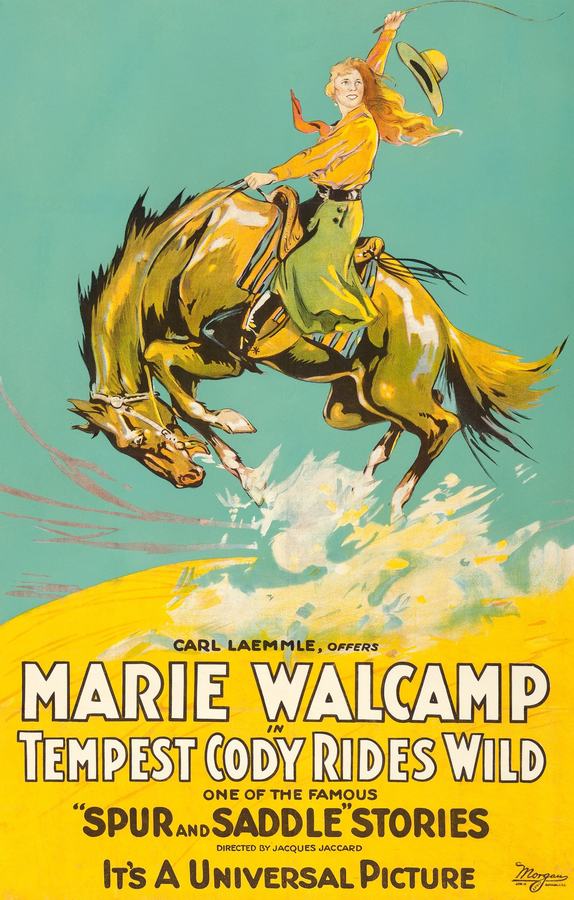
The opening tableau of Tempest Cody Rides Wild is a stark, sun‑bleached panorama that immediately immerses the viewer in the unforgiving atmosphere of a frontier outpost. Carl Miller, embodying the titular Tempest, exudes a gravitas that feels both mythic and palpably human. His measured gait across the dusty main street, the subtle tilt of his hat, and the quiet intensity in his eyes convey a character forged in the crucible of isolation and duty. This visual storytelling, orchestrated by directors Jacques Jaccard and George Hively, leans heavily on composition; the camera lingers on the interplay of light and shadow, casting the town’s structures in a chiaroscuro that mirrors the moral ambiguities at play.
The film’s narrative thrust hinges on a delicate balance between overt conflict and whispered intrigue. Marie Walcamp’s Lila McCarty, the saloon proprietor with a reputation for both hospitality and hard‑nosed negotiation, serves as a fulcrum for the town’s social dynamics. Her interactions with Tempest are layered with subtext—her flirtatious banter masks a deep-seated respect for his unwavering moral compass. Meanwhile, Gabe Prince’s portrayal of Billy Whitaker, the eager deputy, offers a counterpoint: his youthful optimism is continually tested against the town’s entrenched cynicism.
When the gang led by the menacing Jasper Flint (Charles Brinley) and the cunning Salina (Ben Corbett) arrives, the stakes shift dramatically. Their demand for a share of the newly discovered silver vein ignites a powder‑keg of greed, pitting the townsfolk against each other. The screenplay, penned by Jaccard and Hively, deftly weaves these threads, allowing each character to reveal hidden motives. Silas Griggs, the merchant portrayed by Robert Anderson, epitomizes the corrupt entrepreneur whose allegiance to profit eclipses any sense of communal responsibility. His clandestine meetings with the outlaws are shot in tight close‑ups, the dim lighting accentuating the treachery that lurks beneath his polished façade.
The cinematography employs a palette that, while constrained by the monochrome nature of silent film, evokes a visceral sense of place through texture and contrast. The use of long, sweeping shots across the canyon’s rim, interspersed with rapid cuts during the climactic gunfight, creates a rhythmic tension that mirrors Tempest’s internal struggle. The film’s pacing—deliberate in its exposition, frenetic in its action sequences—reflects the ebb and flow of frontier life, where moments of stillness are often shattered by sudden violence.
Comparatively, the tension in The Silent Voice is achieved through a similar reliance on visual storytelling, yet Tempest Cody Rides Wild distinguishes itself by embedding its conflict within a more pronounced moral framework. The showdown on Main Street is not merely a spectacle of gunfire; it is a tableau of ethical resolve, where Tempest’s choice to confront the outlaws alone underscores his commitment to an ideal of justice that transcends personal safety.
Miller’s performance is a masterclass in restrained intensity. He rarely raises his voice; instead, his power lies in the slightest twitch of a hand or the narrowing of his gaze. This understated approach aligns with the era’s acting conventions while offering a timeless quality that resonates with contemporary audiences. Walcamp’s Lila, on the other hand, oscillates between vulnerability and steel‑clad determination, embodying the duality of a woman who must navigate a patriarchal landscape while safeguarding her livelihood.
The supporting cast delivers equally compelling portrayals. Brinley’s Jasper Flint exudes a cold charisma, his villainy rendered through a combination of sharp gestures and a perpetual smirk that hints at a deeper, perhaps tragic, backstory. Ben Corbett’s Salina adds a layer of intrigue, her motives ambiguous until the film’s denouement reveals a personal vendetta rooted in a past betrayal—a revelation that recontextualizes her earlier actions and adds emotional depth to the narrative.
At its core, Tempest Cody Rides Wild grapples with the perennial theme of law versus lawlessness, a motif that has permeated the Western genre since its inception. However, the film distinguishes itself by interrogating the cost of upholding order in a world where moral absolutes are rare. Tempest’s internal monologue—communicated through intertitles rendered in a bold, sea‑blue typeface (#0E7490) that stands out against the stark white of the screen—offers a glimpse into his psyche, revealing a man haunted by past failures and driven by an unyielding sense of duty.
The film also subtly comments on the economic exploitation of the West, mirroring historical realities where mining interests often collided with indigenous lands and local communities. This subtext aligns it with later works such as The Craving, which similarly explore the intersection of greed and survival.
Although Tempest Cody Rides Wild has receded into relative obscurity, its influence can be traced through the evolution of the lone‑hero archetype in cinema. The stoic, morally ambiguous sheriff would later be echoed in the performances of John Wayne and Clint Eastwood, albeit with more dialogue‑driven narratives. The film’s reliance on visual storytelling and atmospheric tension prefigures the stylistic choices of directors like Sergio Leone, whose Spaghetti Westerns would amplify the stark, sun‑baked aesthetics first hinted at here.
For scholars of early American cinema, the film offers a valuable case study in how silent-era Westerns negotiated the balance between spectacle and substance. Its meticulous set design, authentic costuming, and deliberate pacing provide a window into the production values of the 1920s, while its narrative ambition showcases the genre’s capacity for sophisticated storytelling beyond the simplistic shoot‑‘em‑up formula.
In sum, Tempest Cody Rides Wild is a richly textured work that rewards repeated viewings. Its layered characters, thematic depth, and visual flair coalesce into a film that, while rooted in its historical moment, speaks to timeless concerns about justice, community, and the price of integrity. Whether you are a seasoned aficionado of silent Westerns or a newcomer seeking a compelling narrative, this film stands as a testament to the enduring power of cinema to capture the rugged beauty and moral complexity of the American frontier.
IMDb 6.8
1935
Community
Log in to comment.