DbcultAccessing Vault...
Cult Review
Senior Film Conservator
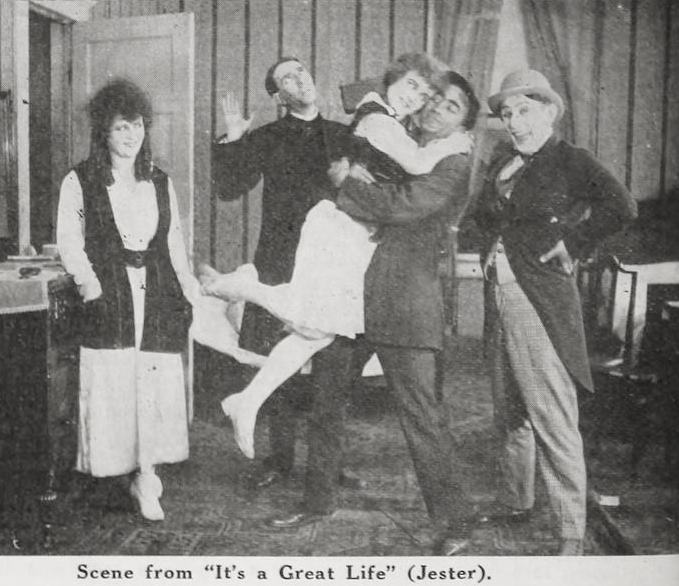
To understand the silent film era is to acknowledge a hierarchy of clowns, yet beneath the monolithic shadows of Chaplin and Keaton lies the vibrant, peripatetic legacy of Marcel Perez. In his 1918 masterclass, It's a Great Life, Perez—operating under his 'Tweedy' moniker—crafts a frantic tapestry of urban survival that feels surprisingly modern in its cynicism. While many of his contemporaries were exploring the heavy-handed moralism seen in His Vindication, Perez was busy dismantling the very concept of the 'American Dream' through the medium of the well-timed pratfall.
The film operates on a principle of escalating entropy. We are introduced to a world where objects possess more agency than the humans who inhabit it. Perez’s genius lies in his ability to treat a simple domestic task as a high-stakes military operation. Every gesture is imbued with a desperate sort of grace, a vaudevillian heritage that he brought over from his days as 'Robinet' in the Italian Cines studios. This transatlantic transition allowed him to blend European sophistication with the raw, unbridled energy of the burgeoning American slapstick scene.
The narrative structure of It's a Great Life is deceptively simple, yet its execution requires a precision that would make a watchmaker blush. Thomas C. Regan and Nilde Baracchi serve as the perfect foils to Perez’s kinetic outbursts. Baracchi, in particular, offers a performance that transcends the 'damsel' or 'shrew' archetypes common in the era. She is a participant in the chaos, her timing synchronized perfectly with the crashing of plates and the slamming of doors. This level of ensemble coordination is often overlooked in favor of the solo star, but here it is the heartbeat of the production.
Consider the spatial logic of the film. Unlike the expansive, almost operatic sets of The Lords of High Decision, It's a Great Life thrives in confinement. The kitchen, the parlor, and the street corner become arenas of existential combat. Perez uses the frame not just to capture action, but to trap his characters. There is an inherent claustrophobia to the comedy; the more Tweedy tries to expand his horizons, the more the world pushes back. This thematic resonance is what separates a mere 'funny movie' from a work of lasting artistic merit.
When we look at the broader cinematic output of 1918, we see a fascinating divergence. While How Uncle Sam Prepares was documenting the grim realities of a nation at war, Perez was providing a necessary safety valve. However, his comedy wasn't purely escapist. It reflected the anxieties of a society in flux. The 'Great Life' mentioned in the title is clearly ironic—a satirical jab at the propaganda of the time that promised prosperity while the average citizen struggled with the basic mechanics of living.
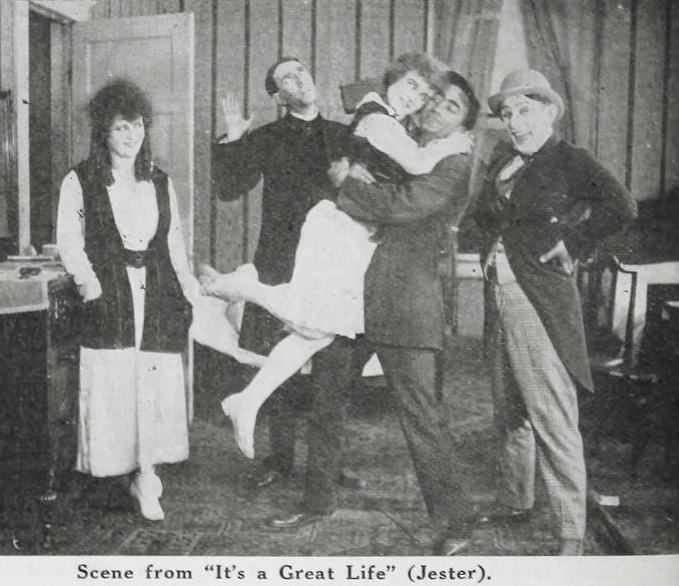
In terms of narrative complexity, one might compare the film to The Black Envelope. While the latter utilizes mystery and suspense to drive the plot, It's a Great Life uses the 'gag' as a plot device. Each mishap isn't just a detour; it's a brick in the wall of Tweedy's eventual psychological collapse. The film asks: how much can one man take before the absurdity of life becomes a joke he is no longer in on? It’s a question that echoes through the decades, finding a kinship with the social critiques found in Tidens Barn.
The cinematography in this short is remarkably fluid for the period. We see early experiments with camera height and movement that anticipate the more sophisticated visual languages of the 1920s. Perez, as both writer and lead, demonstrates a profound understanding of the 'sight gag.' He knows exactly when to hold a shot to let the tension build and when to cut for the maximum punchline impact. This rhythmic editing is as essential to the film's success as the acting itself.
Contrast this with the more static, stage-bound feel of The Commanding Officer. Perez’s work feels alive, breathing with the pulse of the city. There is a sequence involving a chase that utilizes the urban environment with a flair that rivals The Traffic Cop. It’s not just about speed; it’s about the interaction between the human body and the unyielding geometry of the sidewalk, the alleyway, and the storefront.
One cannot overstate the importance of Nilde Baracchi in this equation. In many silent comedies, the female lead is a mere trophy or a catalyst for the hero's journey. Baracchi, however, is a comedic powerhouse in her own right. Her reactions are the emotional glue of the film. When Tweedy fails, we see the ripple effect on her face—a mixture of resignation, affection, and mounting exasperation. This humanizes the slapstick. It moves the film from the realm of cartoonish violence into the sphere of domestic comedy, making it far more relatable than the high-society antics of Sylvia on a Spree.
The chemistry between the two suggests a long-standing creative partnership, one built on mutual trust. You can see it in the way they share the frame, never vying for the spotlight but rather enhancing each other's presence. This collaborative spirit is what makes the film's climax—a crescendo of domestic disorder—so satisfying. It feels like a shared experience of survival, a 'great life' lived in the trenches of the everyday.
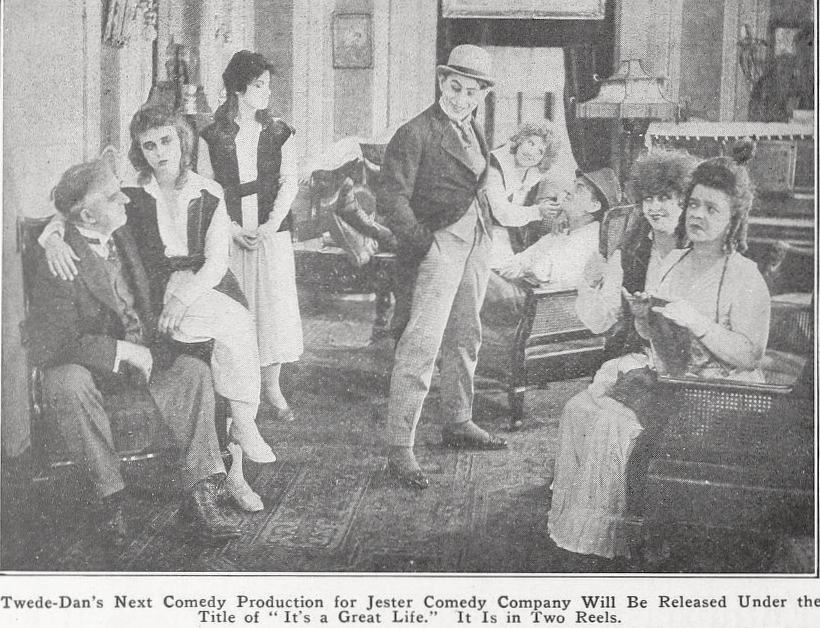
Why does It's a Great Life still resonate over a century later? Perhaps it’s because the frustrations it depicts are universal. We have all felt like Tweedy at some point—overwhelmed by technology (or in his case, simple machinery), stymied by bureaucracy, and desperately trying to maintain a facade of competence. While films like A Butterfly on the Wheel deal with the crushing weight of social injustice, Perez deals with the crushing weight of a falling shelf. Both are valid, but Perez's approach offers the catharsis of laughter.
In the pantheon of silent cinema, Marcel Perez remains an 'adventurer' of the form, much like the protagonist in The Beloved Adventurer. He explored the boundaries of what a camera could do and what a body could endure. He wasn't afraid to look foolish, to be small, or to fail spectacularly. This vulnerability is his greatest strength. It makes his comedy poignant, his timing impeccable, and his films essential viewing for anyone who claims to love the art of the moving image.
It's a Great Life is a masterclass in controlled chaos. It is a testament to the power of the short-form comedy to deliver profound insights into the human condition. Marcel Perez may not have the name recognition of the 'Big Three,' but in this film, he proves he was their equal in every sense. It is a vibrant, hilarious, and ultimately touching look at the beautiful mess of being alive. Whether compared to the artistic aspirations of När konstnärer älska or the gritty realism of Kick In, this film stands tall as a pillar of early twentieth-century creativity.
Rating: A Slapstick Essential
IMDb —
1916
Community
Log in to comment.