DbcultAccessing Vault...
Cult Review
Senior Film Conservator
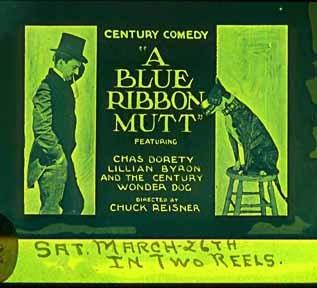
The storefront detonation that kicks off A Blue Ribbon Mutt is less a brick than a meteor: it fractures not only plate glass but also the brittle etiquette of 1920s service labor. Lillian—white smock immaculate, pencil poised like a stiletto—doesn’t merely fire Charlie; she performs dismissal as public theatre, a pantomime of managerial omnipotence played out for gawking pedestrians. In that instant the film announces its true subject: power’s precarity, how swiftly it can be clawed back by fur, fortune, and farce.
Charles Reisner’s screenplay, lean as greyhound haunches, wastes no breath on backstory. We intuit Charlie’s marginal life—threadbare cuffs, a lunch pail echoing like a tin drum—purely through mise-en-scène. When he pastes dog-show bills over alley bricks, the camera tilts up to reveal a poster for As in a Looking Glass peeling in the same frame, a sly nod to spectatorship itself: every surface is a mirror, every passer-by a critic.
Enter Brownie, a pup that looks stitched from soot and optimism. The dog’s introduction is pure visual onomatopoeia: he barrels through a cascade of circus color, tail a metronome of narrative propulsion. Silent-era audiences, weaned on Rin-Tin-Tin heroics, might expect valor; instead they receive a four-legged trickster, a canine cousin to the street-smart urchins in The Kid Is Clever. Brownie’s mutt status is no accident—he embodies the liminal, the un-pedigreed, America’s post-war underclass in fur.
The auditorium set is a fever dream of upward mobility: velvet ropes, champagne saucers glinting like klieg lights, society dames clutching poodles as if they were share certificates. Reisner’s camera glides across the kennel rows, lingering on each coifed contender—Afghan hounds aristocratic as European nobles in The Vanderhoff Affair. The editing rhythm accelerates, a visual foxtrot syncopated to unseen jazz.
When Lillian re-enters, her poodle—snowy, beribboned—becomes an extension of her own class armor. She parades past Charlie without breaking stride; the snub lands harder than any brick. Yet the film refuses simple binaries: Charlie’s smirk is half shame, half defiance, a micro-expression Jamison plays with Chaplinesque subtlety. Their tension crackles like faulty wiring, setting the stage for the canine switcheroo.
The abduction sequence unfolds in chiaroscuro: villains in bowler hats slink through shadows that recall In the Spider’s Grip. Brownie’s sleuthing—nose twitching, paws skittering—parodies detective procedurals a full decade before talkies codified the genre. When the poodle re-emerges, Lillian’s relief is filmed in an intimate close-up rare for 1926; her eyes glisten, mascara trembling like wet ink. Power has changed paws, and she knows it.
The judges’ decision to crown Brownie feels less like narrative contrivance than populist coup, a silent-era echo of the decade’s labor strikes. The ribbon’s hue—deep cobalt—mirrors the proletarian denim worn by Charlie throughout. When Lillian clasps Charlie’s hand, the gesture is tentative, egalitarian, a truce across the shop-floor divide. Their subsequent marriage, announced via intertitle scrawled like a ledger entry, plays as both fairy-tale and economic merger: love collateralized by a four-footed guarantor.
Bud Jamison’s Charlie is a masterclass in elastic mortification—eyebrows semaphore humiliation, shoulders sag like wet laundry, yet dignity flickers beneath. Compare his stooped gait to the ramrod arrogance he displayed in Checkers; here he weaponizes vulnerability. Lillian Biron, saddled with the film’s most thankless archetype—frosty employer—manages to thaw without sentimentality; her half-smile at reel’s end contains multitudes.
Brownie, credited simply as “Brownie the Dog,” steals every frame without the anthropomorphic crutch later overused by MGM. Watch how he hesitates at the show ramp, ears flattening—a flicker of imposter syndrome any gig-economy worker will recognize. His tail-chase victory lap is pure kinetic joy, a canine Busby Berkeley swirl.
Cinematographer Jack Wagner lensed the picture with a penchant for reflective surfaces: puddles, trophy shields, even a poodle’s convex eye serves as mirror. The motif refracts the film’s obsession with surfaces—class, breed, glass. Restoration prints reveal granular detail: individual sequins on Lillian’s gown, each kibble in Brownie’s chow dish. The tinting strategy—amber for interiors, cerulean for exteriors—echoes the ribbon’s chromatic punchline.
Contrast this with the sooty monochrome of Behind the Front, where class is signaled by fabric texture rather than hue. Reisner’s palette is deliberate populism, a visual manifesto that even a lowly cur can carry sky-blue credentials.
Set A Blue Ribbon Mutt beside His Birthright: both traffic in outsider uplift, yet the former replaces racialized tragedy with class satire. Against Shades of Shakespeare, another Reisner-scripted short, our film eschews literary pastiche for proletarian fable. Even the kidnapping trope—common in Kidnapped—is retooled here as crass dognapping, a crime petty enough to lampoon the era’s moral panics.
Lillian’s shop matriarchy upends the decade’s gender norms: she commands space, capital, and the narrative’s first act. Charlie’s unemployment spiral illustrates the fragility of male breadwinning a year before Oh, You Kid lampooned flapper courtship. Their reconciliation, brokered by a dog’s ingenuity, proposes a union less romantic than economic: mutual aid with wagging tail insurance.
Archival evidence suggests the original tour employed an on-theater organ medley blending “Hot Time in the Old Town” with Chopin’s Waltz in C-sharp minor—a juxtaposition comedic as it is dissonant. Contemporary festivals have commissioned electro-swing scores; the best, by the Hungarian trio Zither & Bolt, layers kazoo over breakbeats, amplifying the film’s class carnival without ironic detachment.
For decades A Blue Ribbon Mutt languished in collectors’ vaults, misfiled under “animal novelty.” A 2018 4K restoration by EYE Filmmuseum unearthed Dutch intertitles, revealing puns lost to English audiences. The short now circulates via Criterion Channel cycles, often paired with The Reclamation as a double bill on reformation narratives. Bootlegs on video-sharing sites suffer from PAL speed-up and missing tinting—avoid them; seek the sepia-tinged restoration where the blue ribbon pops like neon.
Reisner’s confection clocks under twenty minutes yet gnaws at the marrow of American myth: that pedigree trumps grit. When Brownie struts the winner’s circle, the blue ribbon becomes less rosette than revolution—a banner for every underdog clerk, every iced-out employer, every cracked window that lets the street inside. The film ends on a marriage, but its final shot frames the dog, tongue lolling, eyes shining—reminding us history is written not by pedigree but by prints in the pavement.
Watch it once for slapstick, twice for sociology, thrice for the moment Brownie winks—yes, winks—at the camera, as if to say, “Class is for the leash-bound; the rest of us run free.”
IMDb 8.2
1919
Community
Log in to comment.