DbcultAccessing Vault...
Cult Review
Senior Film Conservator
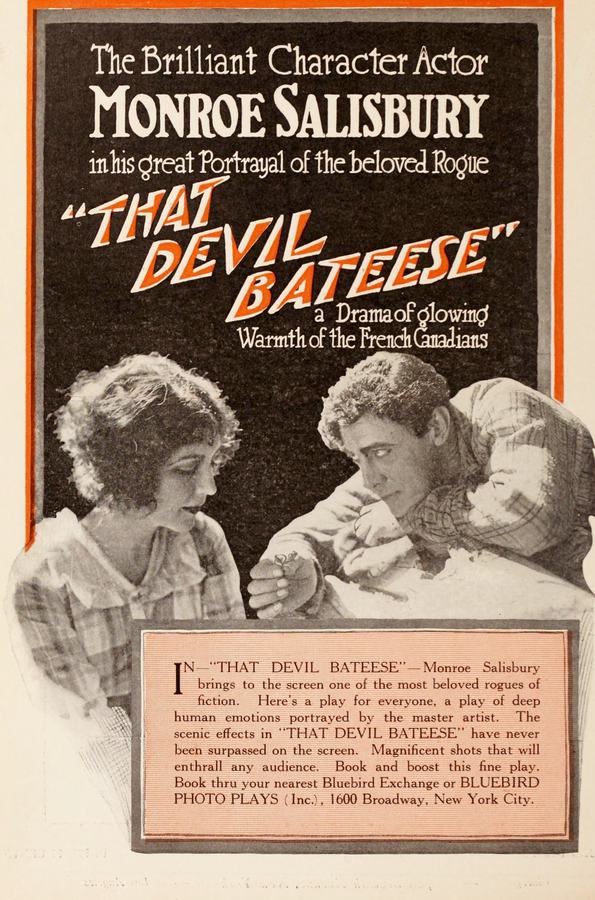
The first time I watched That Devil, Bateese I was alone in a repurposed grain-shed cinema, the projector’s carbon arc spitting stars onto a wrinkled sheet. By the time the canoe vanished over the lip of the falls, the shed smelled of cedar smoke and my own sweat—proof that a 1918 Canadian potboiler can still detonate under the ribs. The film survives only in a 35 mm paper print at Library and Archives Canada, 9½ minutes truncated, yet its emotional aftershock arrives with the blunt force of a cant hook.
Director Bernard McConville shoots Montrouge like a fairytale diorama carved inside a whiskey cask: cathedral trees, river mist that swirls like absinthe in crystal, and a village main street barely wide enough for two yoked oxen. Into this Eden lumbers Bateese Latour—Lon Chaney two years before The Penalty, his face still pliable, but the eyes already flickering with the same Promethean hurt. Chaney’s Bateese is half folklore, half hangover: a logger who can fell a white pine in the time it takes to recite a Hail Mary, yet whose soul leaks through the cracks of a tin flask.
Kathleen St. John—played by Adda Gleason with the brittle poise of a porcelain doll left too long in the kiln—enters wearing city tweeds the color of bruised lilac. She is the embodiment of post-war feminine displacement: educated, fiancé-jilted, seeking self-flagellation in the wilderness. McConville never gives her a classroom scene; we glimpse her authority only in the way village children scatter like grouse when she passes. Her vulnerability is the film’s fuse.
The attack sequence is pure chiaroscuro: sunlight razored through spruce, dust motes orbiting like micro-planets, Louis Courteau’s shadow mounting the screen like a wolf on hind legs. The intertitle card—”A beast wore the mask of a man”—may read quaint, but the staging is ferocious. Courteau pins Kathleen against a paper-birch, his hand clamping her mouth; the celluloid itself seems to bruise. Then the forest erupts. Bateese’s entrance is not heroic but seismic—he hurls Courteau as if discarding a broken axe-handle.
What follows is a courtship conducted in the key of pine resin and contraband rum. Bateese, ashamed of his own breath, chews spruce gum to mask the sour mash. Kathleen, still tasting city champagne, accepts his proposal with the resigned grace of a woman who has learned that survival often masquerades as romance. Their wedding is a candle-lit shack draped with cedar boughs; the ring is a copper rivet hammered from a drive-belt. When Chaney mutters “I’ll never touch another drop,” the lie hangs in the air like sawdust lit by a lantern.
Martin Stuart arrives via river steamer, celluloid collar gleaming like ice. Monroe Salisbury plays him with the languid cruelty of a man accustomed to being the most polished object in any room. His re-ignition of Kathleen’s doubt is done almost off-stage—a whispered name, a glove left deliberately on a stump. Bateese’s jealousy is not the petulant tantrum of a barroom brawler but the existential howl of a man who suspects he is merely the intermission between acts of a grander drama.
Cue the canoe of doom: a 40-foot pine dugout painted ox-blood, riding the current toward a 30-foot cataract. McConville intercuts three planes of action—Bateese paddling like a metronome of despair; Kathleen sprinting along the bank, petticoats snagging on devil’s club; Martin frozen on a rock outcrop, watching the narrative he has detonated. The intertitle reads: “The waterfall sang his requiem—yet the river refused the sacrifice.” We never see the plunge; instead, the director cuts to foam, then to Bateese’s broken body on a sandbar, arm twisted like a windblown cedar. He lives because the film needs him to bear witness to his own rebuke.
Offsetting the central triangle is Louis’s sister, credited only as “The Forsaken.” She wanders the village in a tattered bridal gown, veil trailing like a comet’s tail, clutching a dried bouquet of marsh-marigolds. When she recognizes Martin as the fiancé who abandoned her years earlier, the recognition is filmed in a single close-up: eyes widening, pupils dilating as if swallowing the entire landscape. She becomes the film’s Cassandra, warning Kathleen that men leave the way ice leaves the river—suddenly, loudly, and always too late.
The symmetry is brutal: two women, two wedding garments, two forms of abandonment. The dress, once white, is now the color of nicotine; its lace resembles fungal rot. When she presses the wilted bouquet into Martin’s hand, the petals fall like tiny suicides. It is one of the most unsettling sequences in silent cinema, precisely because it refuses melodrama—it simply lets grief exist.
Three years later Chaney would strap on leather stumps for The Penalty; here his body is still intact, but the contortions are internal. Watch his hands: they flutter around Kathleen like moths afraid of the flame, then clench into pulp-mill hammers when jealousy spikes. His drunk scenes avoid the rubber-limbed clichés of Keystone; instead he gives us a man whose spine seems to be slowly bending under the weight of unspoken apologies. The sobriety vow is delivered with the cracked voice of someone who already knows he will fail.
There is a moment—easy to miss—when Bateese, sober for three days, sees Kathleen teaching a child to write her name on a slate. Chaney’s face flickers: pride, terror, the realization that literacy is a door she can walk through anytime she chooses. He turns away, and in the shadow his profile looks like a cathedral gargoyle learning desire.
Because the print is silent, every noise must be imagined: the thunk of axes at dawn, the wet slap of fish in the river, the inhale before a slap. I recommend pairing the film with something percussive—maybe Colin Stetson’s saxophone or the low thrum of a diesel generator. The absence of synchronized sound turns the waterfall into a philosophical event; its roar exists only in the cavity behind your eyes. When the canoe tips, you supply the scream yourself.
Written by Bess Meredyth—later to pen Ben-Hur—the script sneaks in proto-feminist barbs. Kathleen’s teaching contract pays half the wage of the male teacher she replaces; village elders remind her that “a woman’s place is between the cradle and the washtub.” She responds by organizing a moonlit spelling bee where girls out-spell every boy. The film never again mentions pedagogy; instead it lets the river punish patriarchy with its own icy jurisprudence.
Bateese’s lumber camp is a micro-economy of sweat, debt, and rot-gut. Wages are paid in scrip redeemable only at the company store; the camera lingers on a ledger where workers’ names are crossed out in red when injury sidelines them. The film understands that alcoholism is not a moral failing but a currency—the only vacation a lumberjack can buy.
If you splice the DNA of Das Tal des Traumes—with its alpine fever dreams—and the masculine self-immolation of The Deemster, you get something close to the emotional voltage of Bateese. Yet the Canadian wilderness adds a Presbyterian chill absent from the Mediterranean fatalism of Mr. Grex of Monte Carlo. Where Do Men Love Women? interrogates courtship as a stock exchange, McConville stages it as a logging camp: every promise is a tree marked for eventual felling.
The 2020 2K restoration scanned the paper print at 14-bit, revealing grain like frost on a window. The tints follow a 1918 cue sheet: amber interiors, viridian nights, red for the waterfall. Kino Lorber’s Blu-ray pairs it with The Wasted Years, another Meredyth-penned morality tale. Streaming options are barren; your best bet is a library request or the occasional archival screening at TIFF Bell Lightbox where a live trio improvises on musical saw and frame drum.
Great films lodge splinters that the mind keeps working to the surface. Bateese left me with two: the image of a bride wandering eternity in decaying lace, and the sound of a man’s heart imploding because he cannot believe himself loved. The picture is ostensibly about redemption, yet its final shot—Bateese and Kathleen limping home, his arm in a sling, her hand steadying his elbow—feels less like a resolution than a cease-fire. The camera retreats upriver, as if to say: tomorrow the log drive will resume, the flask will be found, and the falls will keep demanding their tithe of bones.
So if you crave the comfort of closure, stick to The Golden Chance. But if you can stomach a love story that ends with the lovers still broke, still scarred, still sober only for tonight—then let That Devil, Bateese carry you over the cataract. Just remember: the river gives no refunds, and the silence after the splash is yours to keep.
IMDb —
1928
Community
Log in to comment.