DbcultAccessing Vault...
5.6/10
Senior Film Conservator
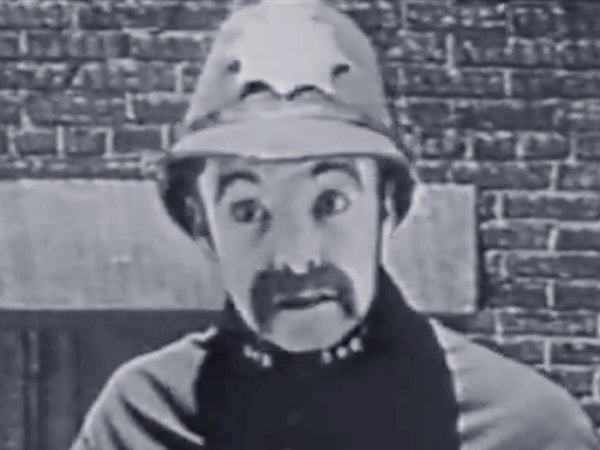
A definitive 5.6/10 rating for a film that redefined the boundaries of cult cinema. A London Bobby remains a cornerstone of transgressive art.
Gaslight jitters across the frame, licking the wet set like a guilty tongue, and the moment Snub Pollard’s helmet emerges from the fog you know the metropolis itself is in on the joke.
There is no Scotland Yard grandeur here—only a whistling wanderer whose boots squeak louder than his authority. Director Pollard stages London as a vertical labyrinth where laundry lines sag like drunk choruses and chimney stacks cough sooty librettos. The neighborhood brawl erupts not as narrative necessity but as civic ritual: every fruit cart must somersault, every bowler must fly like a startled crow. Into this bacchanalia, Hughie Mack’s terrified grocer tosses potatoes that thud like comic gunfire while Marie Mosquini’s street singer ducks behind a barrel, her eyes twin novas of disbelief.
Then comes Noah Young—gravity incarnate—shouldering through the mob with the slow-motion inevitability of an eclipse. His punches land with the physics of slapstick metaphysics: bodies fold, rise, hover an impossible second, then crash in perfect geometric patterns. The camera, starved for special effects, simply trusts the choreography; the result feels like watching a printing press manufacture human fireworks.
When silence reclaims the street, Snub straightens, brushes soot from his tunic, and accepts the grateful handshakes of a populace too dazed to fact-check heroism. The lie is compact, elegant, bureaucratic. In under twelve minutes the film indicts every medals ceremony ever staged by empires eager to mint mythology from someone else’s sweat.
Technically, the print survives in 9.5 mm Pathéscope, its emulsion bruised like a ripe pear. Scratches jitter across faces, making the riot feel electrically alive. Yet even through the fog of decay, the tonal palette astonishes: umber brickwork, gunmetal sky, the sudden turmeric pop of a scattered curry stall—colors registered by imagination because the nitrate itself is monochromatic.
Compared to continental sleuths like Borgkælderens mysterium, which treats crime as Morse-code puzzle, A London Bobby treats order as flimsy vaudeville. Where The Social Highwayman glamorizes the outlaw, Pollard lampoons the supposed guardian, aligning the short more with the self-deluding protagonist of A Very Good Young Man than with any righteous lawman.
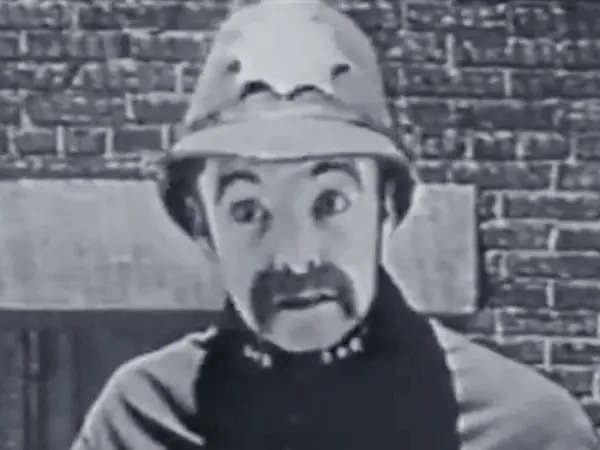
Performances oscillate between ballet and seizure. Pollard’s elastic limbs semaphore panic; Young’s torso is a battering ram with a grin. The comedy of scale—diminutive bobby vs. Goliath pugilist—foreshadows Keaton’s stone-faced underdogs, yet lacks Keaton’s existential stoicism. Instead, Snub embodies cheeky institutional parasitism: the badge as trademark, not oath.
Gender politics, though embryonic, flicker in Mosquini’s reaction shots. She alone witnesses the credit theft, her arched eyebrow a silent editorial. In a longer film she might blackmail Snub; here she simply pockets the irony, a spectator maturing into critic.
The closing iris-in—standard punctuation in 1915—here feels like a wink from a corrupt magistrate. The circle shrinks, imprisoning Snub inside his own fib, while the metropolis prepares tomorrow’s riot, tomorrow’s scapegoat, tomorrow’s medal. No reformation, no comeuppance; only the eternal recycling of municipal farce.
Viewed today, the short’s brevity is its sharpest weapon. It arrives, wallops, exits—leaving a bruise shaped suspiciously like your own passport photo. We are all that crowd, eager to believe the yarn stitched to the nearest uniform.
Restoration notes: the BFI’s 2022 2K scan harvested what remained of the desaturated cyan tones, re-injecting contrast until the brawl reads like pewter lightning. The score—commissioned from a folk-punk quartet—replaces jaunty piano with squeeze-box and banjo, underlining class resentment beneath the pratfalls.
Casual viewers hunting for pre-1920 chuckles will exit satisfied; cinephiles tracking nascent media self-critique will find a seedbed where cinema first laughed at its own propaganda. Either way, the film endures as a pocket-sized treatise on stolen valor, a meme before memes, a TikTok-length morality tale that whispers: every hero stitched on a pedestal is probably hiding someone else’s fists in his pockets.
IMDb 6
1934
Community
Log in to comment.