DbcultAccessing Vault...
5.9/10
Senior Film Conservator
A definitive 5.9/10 rating for a film that redefined the boundaries of cult cinema. The ABC of Love remains a cornerstone of transgressive art.
Stepping back into the flickering glow of early cinema, one often encounters narratives that, despite their age, resonate with surprising contemporary relevance. Such is the case with The ABC of Love (original Danish title: Elskovs ABC), a delightful 1916 comedy that serves as a vibrant showcase for the incomparable talents of Asta Nielsen. This isn't merely a quaint relic; it's a testament to the enduring power of comedic storytelling and the groundbreaking presence of one of cinema's first true international stars. Directed by Martin Jørgensen and penned by Jørgensen and Louis Levy, the film navigates the often-treacherous waters of romance, societal expectation, and personal identity with an effervescent charm that belies its silent nature.
At its heart, The ABC of Love explores the predicament of Lis, a vivacious young woman stifled by the prospect of marrying her fiancé, Philip. Philip, portrayed with a certain earnest dullness by Ludwig Trautmann, embodies the very antithesis of excitement Lis craves. He's stable, predictable, and utterly devoid of the spark she believes essential for a fulfilling partnership. Her solution? An audacious scheme to lure him to the romantic labyrinth of Paris, not for a conventional lovers' holiday, but for an unconventional test of their compatibility. It’s a premise brimming with potential for both comedic chaos and genuine insight into the dynamics of burgeoning relationships.
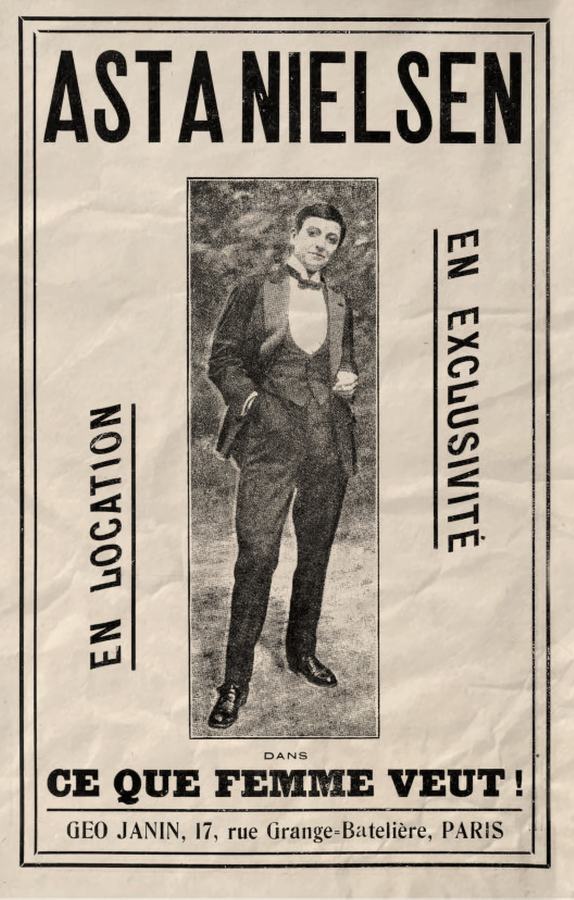
Nielsen, as Lis, is nothing short of captivating. Her expressive face and fluid physicality—hallmarks of her legendary silent film career—are on full display. When Lis decides to don men's clothing and explore Paris as a disguised gentleman, it's more than a mere plot device; it's a profound statement on freedom and societal constraints. In an era where women's roles were rigidly defined, the act of cross-dressing, even for comedic purposes, allowed Nielsen to embody a spirit of rebellion and self-determination that resonated deeply with audiences. She moves through the city with an almost palpable sense of liberation, her gestures broader, her stride more confident, her interactions imbued with a playful audacity that would have been impossible in her feminine guise. This gender-bending escapade isn't just for laughs; it cleverly highlights the stark differences in how men and women could navigate public spaces and social interactions at the turn of the century.
The comedic timing, even without spoken dialogue, is masterfully executed. Nielsen's ability to convey complex emotions and intentions through subtle shifts in posture, a raised eyebrow, or a sudden burst of energy is extraordinary. She doesn't just act; she performs, drawing the audience into Lis's inner world of frustration, mischief, and ultimately, affection. Magnus Stifter, in the role of Lis's father, provides a perfect foil to her youthful exuberance. His discovery of her plot introduces a layer of traditional morality and paternal concern, injecting a dramatic tension that elevates the film beyond simple farce. The ensuing 'trial and tribulation' is a delightful dance between generational values and individual aspirations, underscoring the universal struggle between duty and desire.
What makes The ABC of Love particularly fascinating is its nuanced exploration of gender dynamics. Lis's transformation isn't merely a superficial change of clothes; it's an exploration of identity and agency. As a man, she experiences a freedom of movement and interaction that is denied to her as a woman. This silent commentary on patriarchal society's limitations is remarkably progressive for its time. It subtly asks: what if women were afforded the same liberties as men? What kind of world would that create? The film doesn't offer a didactic answer, but it certainly prompts contemplation, all wrapped in a wonderfully entertaining package. This thematic depth sets it apart from many contemporary comedies that relied solely on slapstick or broad caricature. While other films of the era might touch on romantic entanglements, such as perhaps The Love Tyrant, The ABC of Love distinguishes itself through its specific focus on the individual's active, even rebellious, pursuit of a suitable partner and identity.
The narrative unfolds with a brisk pace, characteristic of many successful silent comedies. Jørgensen's direction ensures that every scene, every intertitle, contributes to the overall momentum and clarity of the story. The Parisian setting, even if conveyed through studio sets and a few stock shots, evokes the city's legendary romantic aura, serving as an ideal backdrop for Lis's adventurous spirit. The visual language of the film, from the framing of Nielsen's dynamic movements to the subtle expressions captured in close-up, speaks volumes without uttering a single word. It’s a masterclass in silent storytelling, relying on the universal language of human emotion and physical comedy to convey its message.
Asta Nielsen's career was defined by her willingness to tackle unconventional roles and her fearless portrayal of complex female characters. The ABC of Love stands as a shining example of her unique screen persona. She was not merely beautiful; she was compelling, intelligent, and often subversive. Her performances often challenged the prevailing notions of femininity, making her a trailblazer for actresses who would follow. Her ability to transition from mischievous imp to vulnerable lover, all within the confines of a single role, demonstrates a range that few of her contemporaries could match. It’s this versatility that allowed her to captivate audiences across Europe and beyond, cementing her status as a global phenomenon during the silent era. Her work here, much like in other films that explored the boundaries of societal norms, like perhaps The Little Mademoiselle, showcases an artist acutely aware of her power to provoke thought and entertain simultaneously.
The eventual resolution, where Lis and Philip finally marry, might seem like a predictable comedic outcome. However, the journey to that conclusion is anything but. It’s a journey of self-discovery for Lis and, presumably, a journey of awakening for Philip. One can infer that his 'boring' nature has been thoroughly shaken by his fiancée's elaborate machinations, hopefully leading to a more dynamic and engaging partnership. The film suggests that true love, or at least a truly compatible partnership, requires more than just societal approval; it demands a deeper understanding, a willingness to challenge conventions, and perhaps, a dash of exhilarating adventure. The tribulations faced by Lis and Philip, though comedic, serve to forge a stronger, more authentic bond between them, a bond tested by deception and ultimately affirmed by affection.
From a technical standpoint, the film's preservation and accessibility allow modern audiences to appreciate the artistry involved in early filmmaking. The clarity of the prints often available reveals the meticulous set design, the thoughtful costume choices, and the nuanced performances that were the bedrock of silent cinema. The work of writers Martin Jørgensen and Louis Levy is particularly commendable for crafting a narrative that, while lighthearted, possesses underlying thematic strength. They managed to imbue a simple premise with layers of social commentary and character development, a skill that remains paramount in screenwriting today. Their collaboration created a script that gave Nielsen ample opportunity to shine, providing her with a character whose journey was both relatable and aspirational.
In an age where cinematic spectacles often rely on elaborate special effects and booming soundtracks, The ABC of Love reminds us of the raw power of pure performance and visual storytelling. It’s a film that speaks volumes without uttering a single word, captivating its audience through the sheer force of its narrative and the magnetic presence of its lead star. For anyone interested in the evolution of comedy, the history of gender representation in film, or simply the unparalleled genius of Asta Nielsen, this film is an absolute must-see. It’s a vibrant, witty, and surprisingly insightful piece of cinematic history that continues to charm and provoke thought more than a century after its initial release. Its lessons on love, identity, and the courage to be oneself remain as pertinent today as they were in 1916, proving that some stories truly are timeless.
IMDb 6.8
1934
Community
Log in to comment.