DbcultAccessing Vault...
Cult Review
Senior Film Conservator
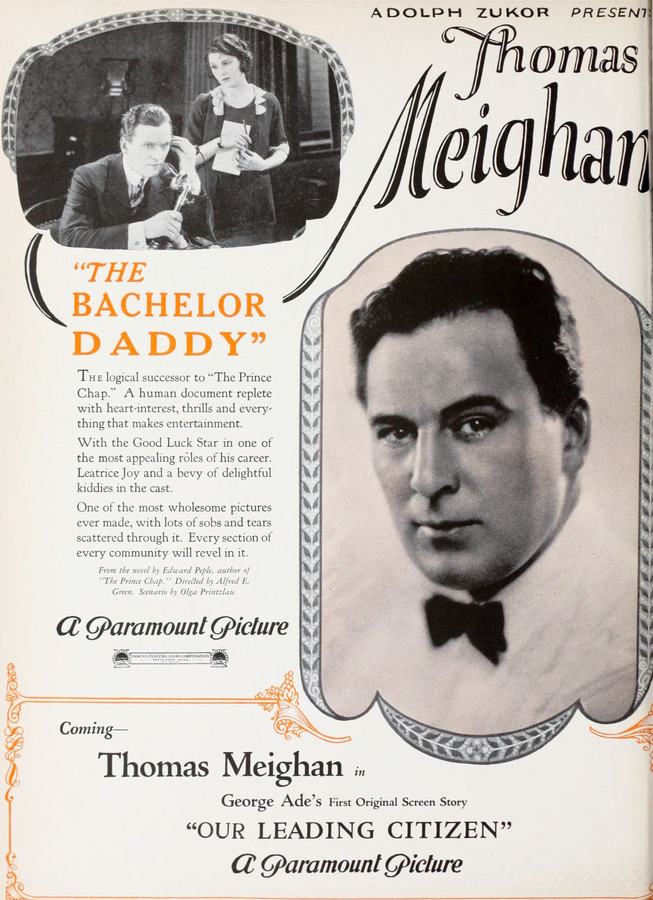
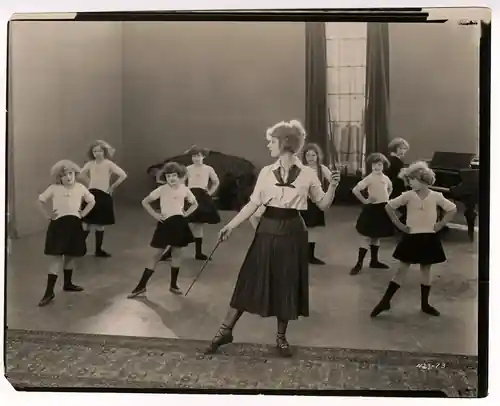
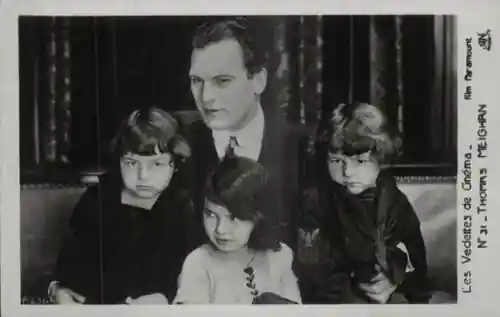
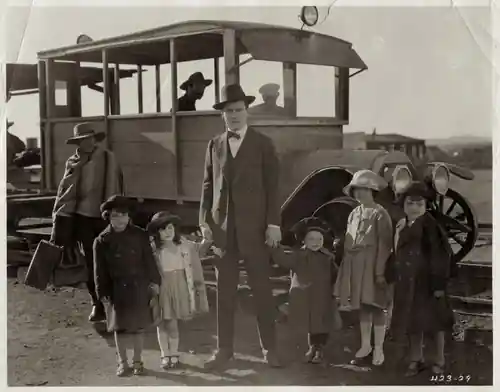
Imagine the roar of a locomotive as it cleaves the continent in half, its brass bell tolling like a death-knell for one man’s solitude. In The Bachelor Daddy, director John S. Robertson straps us to that iron beast, plunging from the frontier’s howling white blankness into the gas-lit labyrinth of Roaring-Twenties New York. The story’s inciting collapse—a mine shaft that gobbles up Joe Pelton—feels almost mythic, a demiurgical hiccup that births a brand-new cosmos for Richard Chester, played with urbane swagger by Thomas Meighan. Overnight, the bon-vivant tycoon becomes reluctant patriarch to five feral cherubs whose collective decibel level could shame a hurricane.
The transition from glacial wilderness to lacquered Pullman is rendered in a flurry of iris-ins, superimposed snowflakes, and a comedic montage of scandalized passengers clutching pearls while banana peels sail like yellow flags of surrender. Robertson’s camera glides through narrow corridors, transforming the sleeper car into a kinetic diorama of social apoplexy. Kids cannonball into berths, a poodle achieves escape velocity, and a preacher’s sermon combusts mid-sentence—each gag timed to the piston-beat of the train itself. It’s Jacques Tati before Tati, Keaton-level physics filtered through Lubitsch’s cosmopolitan venom.
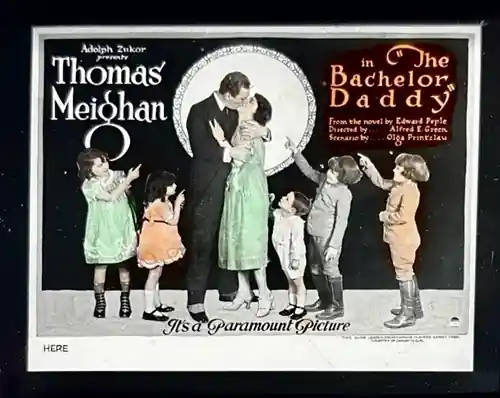
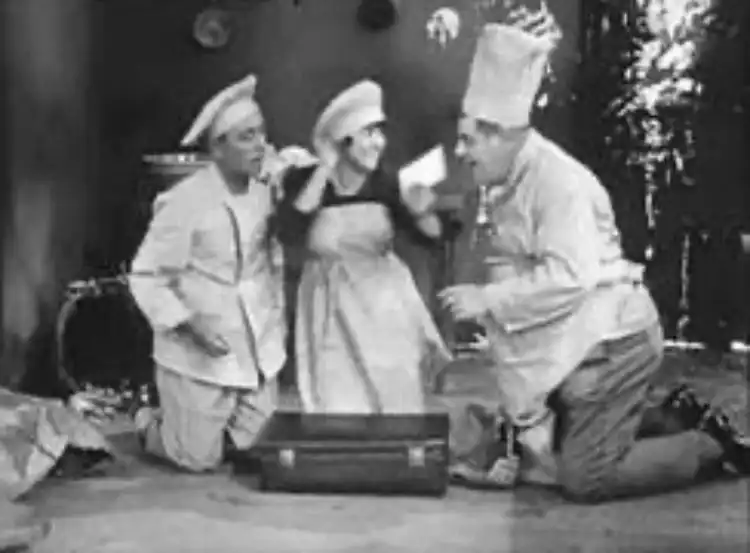
Once the iron horse screeches into Grand Central’s cathedral of steam, the film trades velocity for vertigo. Chester’s Beaux-Arts mansion—painted in shimmering two-strip Technicolor tints on surviving prints—looms like a mausoleum of propriety. The marble foyer becomes a battleground where footmen in white gloves wage guerrilla warfare against peanut-butter fingerprints. In a delicious reversal of Upstairs-Downstairs etiquette, the servants stage a coup d’état of sniffing hauteur while the children weaponize innocence. Note the sequence where little Barbara Maier’s character coaxes the French chef into sampling her mud-pie à la escargot; the ensuing grimace is silent-era slapstick distilled to its essence-of-absurd.
Amid the domestic Sturm und Drang, the script—credited to Edward Peple and Olga Printzlau—threads a scalpel-sharp social satire. Ethel McVae (Maude Wayne), Chester’s fiancée, arrives swaddled in mink, her cheekbones honed to Art-Deco geometry. She embodies the era’s cult of chill perfection, a mannequin of ice who views children as regrettable statistical outliers. Watch how Wayne lets her pupils contract to pinpricks the instant jelly smudges her Parisian gown; the performance is a masterclass in micro-acting under intertitle constraints. When she brandishes the ultimatum—“them or me”—the camera dollies backward as though even the lens cannot stomach her frigidity.
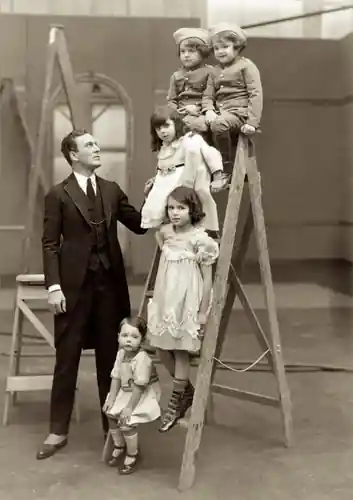
Enter Sally Lockwood, the stenographer with ink-smudged cuffs and a gaze warm enough to thaw permafrost. Leatrice Joy—all sharp bob and proto-flapper insouciance—plays her as a woman who has read every suffragette pamphlet yet still believes in bedtime stories. The pivotal night-watch sequence is a candlelit poem: while the youngest child burns with fever, Sally hums a lullaby that seems to rise from the celluloid itself, her shadow flickering across the nursery wall like a silent promise. Meighan’s face—half in silhouette—registers a hundred emotional time-zones: panic, gratitude, something perilously close to love. It’s the moment the film pivots from screwball entropy to lyrical humanism.
Visually, the picture revels in chiaroscuro. Cinematographer Roy Overbaugh layers shadows so thick you could scoop them with a spoon, then punctures them with butter-yellow lamplight that pools like spilled yolk. During the children’s first banquet, he frames the long table from overhead, transforming silver dominoed place-settings into a chessboard where childhood runs roughshod over protocol. Later, when Chester finally confesses love to Sally, Overbaugh racks focus so that Manhattan’s skyline dissolves into a glitter-bokeh, a distant galaxy irrelevant beside the gravitational pull of two hands almost—almost—touching.
The film’s DNA shares strands with Mother o’ Mine in its valorization of substitute parenthood, yet it refuses rural nostalgia for urban kineticism. Where Through a Glass Window meditates on cloistered grief, The Bachelor Daddy explodes cloisters with cherry bombs. And compared to Crazy to Marry, it reverses the gendered joke: here the man discovers that matrimony is not a trap but a lifeboat.
Scholars often overlook how the picture queers the domestic template. Five orphans, a bachelor, and a secretary cobble together a found-family that bypasses biological imperatives. The children’s genders blur in the chaos—girls scale curtains, boys cradle dolls—hinting at an Edenic world before social scripting calcifies. Even Chester’s valet, a dandy given to lace handkerchiefs and operatic sighs, gets a heroic close-up when he wields a soup ladle like Excalibur against bedtime monsters.
Of course, no review can elide the racial optics of 1922. The Chinese cook is a pidgin-spouting caricature, and a minstrel gag with burnt-cork toddlers makes modern stomachs lurch. These moments land like bile on crêpe paper, reminding us that even progressive silents trafficked in Imperial shorthand. Yet the film’s broader thesis—that love is an anarchic force democratizing class—still crackles through the prejudice, a filament of decency glowing inside a flawed bulb.
The finale, set in a nursery aglow with Christmas tinsel, sidesteps the altar cliché. Instead of wedding bells, we get a cacophony of tin horns as the children pelt Chester and Sally with paper streamers. The last intertitle reads: “A Bachelor is only a Daddy waiting to happen.” The camera iris-shutters on the couple hemmed by riotous offspring, their laughter echoing into the fade-out. It’s less a curtain than a portal—an invitation to imagine seasons of scraped knees, bedtime stories, and the glorious mess of shared mortality.
Viewed today, The Bachelor Daddy feels like a time-traveler’s valentine: a 98-minute reminder that family is forged, not issued. The print survives in 4K restoration, its tints restored to harvest-amber and midnight-teal, each scratch lovingly preserved like laugh-lines on a beloved face. If you crane your ear between the orchestral cue sheets, you can almost hear the children’s footsteps overhead, a gentle haunting that argues the past is not a foreign country but the apartment upstairs, thumping its stories into our ceiling.
So queue it up on some frost-bitten evening when cynicism cakes your ribs. Let Thomas Meighan’s slow-blooming grin dismantle your armor. Let Leatrice Joy teach you that devotion sometimes wears ink on its cuffs. And when the lights rise, notice how the hush feels different—wider, as though five imaginary children have bounded off the screen and taken residence in your marrow, forever muddying the carpets of your private mansion.
IMDb 5.8
1932
Community
Log in to comment.