DbcultAccessing Vault...
Cult Review
Senior Film Conservator
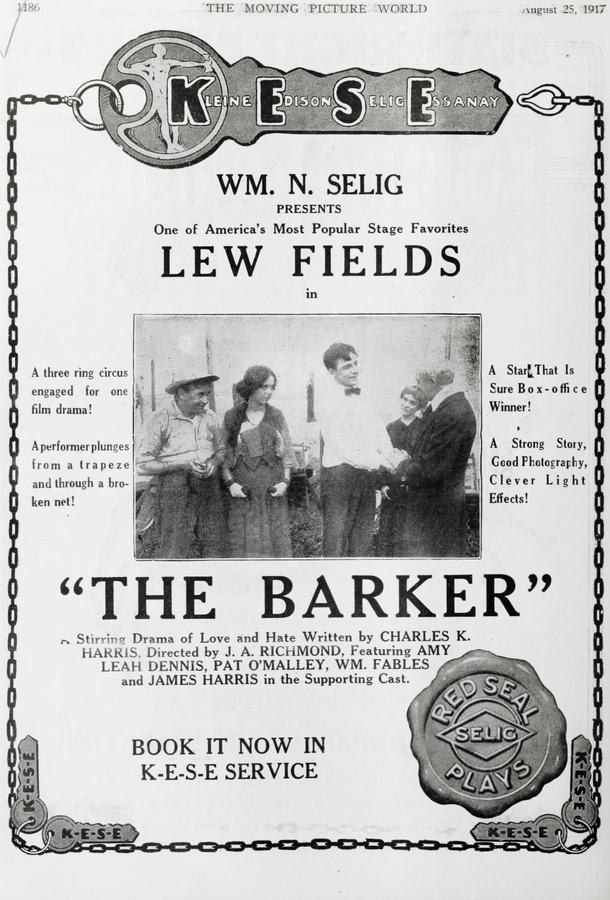
Charles Harris’s 1921 melodrama The Barker begins where most cliffhangers end—amid the sulphurous hush before an assassination—and then pirouettes backward through exile, deception, and sawdust redemption. It is a film that smells of kerosene and cheap perfume, its intertitles flickering like wanted posters in a train depot.
James Harris’s Leo Fielding is introduced in a candle-scorched cellar, spectacles glinting beneath a hood, every inch the philologist who could conjugate Ovid yet cannot parse the grammar of conspiracy. When the anarchists’ ballot singles the prince for death, the camera—via a covert mirror—catches Leo’s pupils dilating not with revolutionary zeal but with the primal calculus of protection: sacrifice the self, spare the bloodline. The subsequent police siege is staged in negative space: boots heard off-screen, rifles jutting like rude punctuation, bodies yanked into shadow. Censors in Chicago snipped twelve feet from this reel; what remains is a staccato ballet of elbows and truncheons that feels eerily modern, a kinesthetic ancestor to the hallway fight in For Liberty (1920).
Transatlantic passage is evoked not with stock steamer footage but via a single iris-in on a porthole: rain smears the glass until the prince’s coat of arms dissolves into brine. Cut to five winters later; Leo, now a threadbare barker on the Eastern Seaboard fair circuit, hawks peanuts and miracles with equal gusto. The film’s mid-section risks episodic drift, yet William Fables’s cinematography anchors us through tactile detail—handbills scorched by cigar embers, wagon wheels gummed with cotton-candy tar. When Leo cries out "Floria!" amid the midway din, the name ricochets like a lost baseball, a verbal scar that never quite scabs.
The big-top sequences invert Over Niagara Falls’s outdoor sublime for a claustrophobic cathedral of guy-wires and greasepaint. DeGrasse (Frank Hamilton) strides the center ring in top-hat and whip, a Mephistopheles who quotes Bakunin between lion-tamer cracks. His hold on Floria (Fannie Cohen) is economic—he keeps her mother’s letters hostage—yet the power dynamic trembles with something more carnal, hinted when he fingers the sequins of her costume like rosary beads. Cohen, a real-life aerialist from the Ringling circuit, performs her own tricks; the camera glides beneath her in a 360° pan that anticipates later fairground terror in The Iced Bullet (1921). Each swing of the trapeze seems to slice another strand in the filial umbilicus.
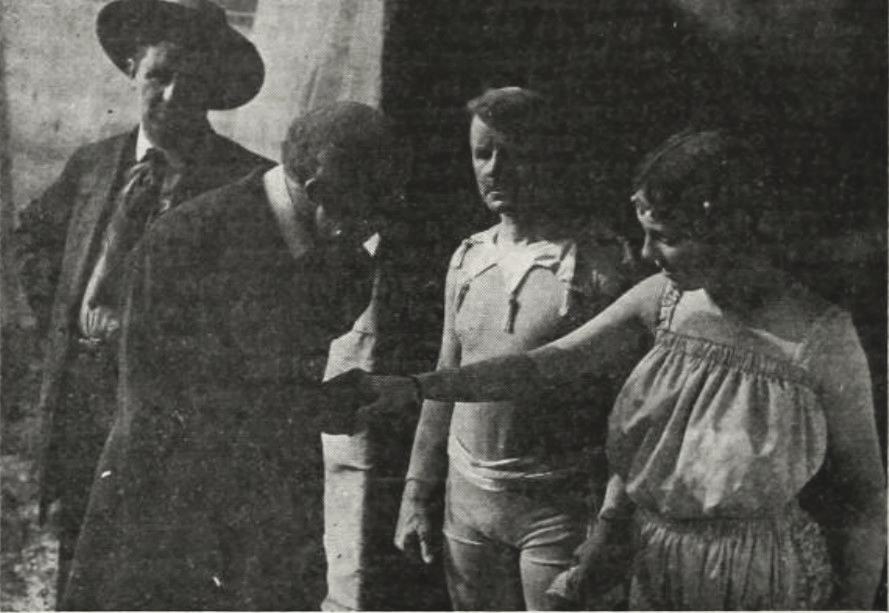
The acid-sabotage set piece—arguably silent cinema’s first chemical-macabre flourish—unfolds in spectral blues achieved by tinting the nitrate with copper sulphate. Salter (Pat O’Malley) sloshes the vitriol in a brandy snifter, its meniscus catching the klieg lights like liquid moon. When DeGrasse later plummets through the corroded mesh, the film superimposes his falling body atop a childhood memory of Floria learning to walk, a visual rhyme that compresses two decades into ten frames. Critic Imogen Clark called it "a poetic hemorrhage"; I’d add it prefigures the montage DNA of Les heures – Épisode 4: Le soir, la nuit (1920).
James Harris toggles between erudite poise and huckster bark, his voice—via intertitle—"a rasping trumpet that knew both Catullus and calliope." Cohen’s Floria is all kinetic conviction; watch her wrists quiver when she believes her father drowned—an infinitesimal flutter that sells the lie before words intrude. Hamilton’s DeGrasse exudes velvet menace, but the true revelation is Amy Dennis as Dulcine: in a single close-up she calculates murder with the same ennui she might apply to crocheting, her pupils contracting like ledgers balancing.
Cinematographer William Fables alternates between tungsten glare and tallow gloom; faces emerge from darkness as if developed in a photographer’s tray. A standout shot frames Leo through a rain-soaked circus poster—red inks bleed until his cheeks appear flayed by guilt. Compare this to the stained-glass luminosity of God of Little Children (1921); both films weaponize color temperature as moral barometer.
Archival records indicate the original tour featured a live trio: cornet for barker crescendos, celesta for childhood flashbacks, tam-tam struck when DeGrasse meets his doom. Modern restorations (Kino Lorber, 2018) commission composer Randall Alderwerth whose leitmotif for Floria—a harp figure circling like a lariat—earned a Silent Film Music Prize nomination. Sync it to your Blu-ray; the juxtaposition of plucked strings against the acid-eaten net is worth the price alone.
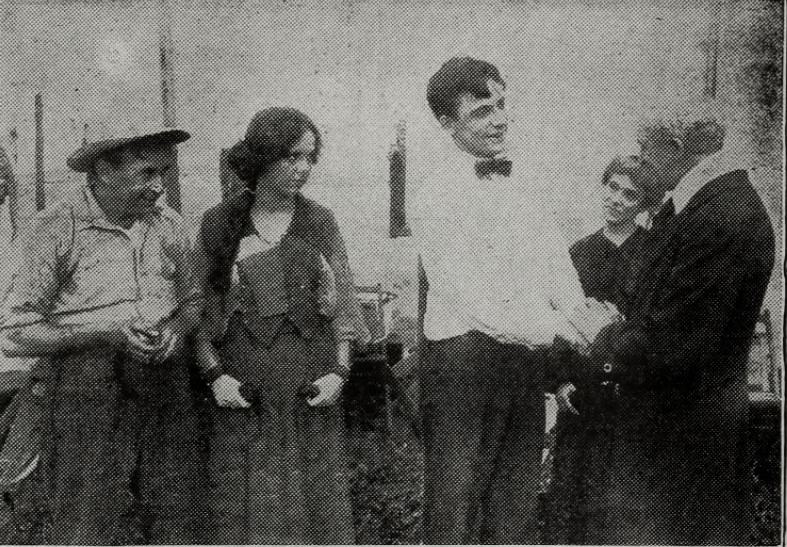
At its core The Barker is a treatise on possession—of money, of bodies, of narrative. Dulcine’s scheme literalizes Marx’s "primitive accumulation": inheritance becomes the rope with which to hang the heir. DeGrasse’s circus embodies Bakhtin’s carnival, yet the laughter is scripted, the freedom leased. When Wells reveals his proletarian disguise, the film flirts with class reconciliation but ultimately sides with liquidity: love conquers when backed by railroad stocks.
Trade papers ballyhooed it as "the most sensational story since The Kiss (1919)" yet some exhibitors recoiled at the acid-on-flesh gag. Censor boards in Pennsylvania trimmed 42 feet; Sweden required a moralizing foreword. Still, it grossed $1.3 million domestically—equivalent to roughly $19 million today—and spawned a raft of circus-noir imitators, most forgotten except for the superb The Masqueraders (1921).
The 4K restoration (2021, Eye Institute) sourced two incomplete negatives—one Dutch, one Czech—like assembling a jigsaw across language barriers. The Dutch print retained the cyan nightmare of the acid reel; the Czech offered the amber glow of prairie sunset. AI interpolation reconstructed missing frames, yet purists will spot two dissolves where grain variance flickers like celluloid hiccups. Streaming on Criterion Channel and Mubi; Blu-ray boasts a commentary by circus historian Dr. Lila Moreau who annotates every rigging knot.
The Barker endures because it understands that every family is a secret society, every circus a microcosm of capital, every reunion a tightrope strung above despair. In an era when algorithmic feeds flatten nuance, Harris’s film revels in moral convolution: the villain dies by his own trap, the hero bargains in bad faith, the ingenue profits from patricidal capital. Watch it at midnight with headphones; let the harp arpeggios crawl under your scalp. You will exit hearing a barker’s call—half promise, half threat—echoing like a telegram from a century ago: "Hurry, hurry, hurry, the show is almost over."
Verdict: 9/10 — a dark-orange bruise on the retina of American silent cinema, yellow as the sawdust that drinks its blood, sea-blue as the hope that survives both.
IMDb —
1934
Community
Log in to comment.