DbcultAccessing Vault...
Cult Review
Senior Film Conservator
Tintinnabulations of damnation
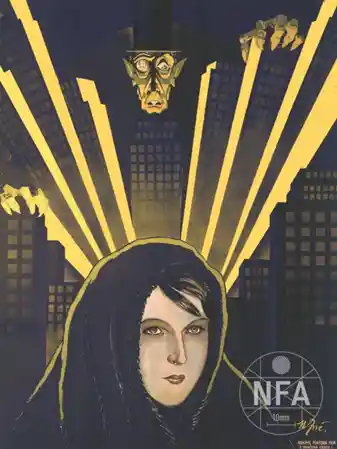
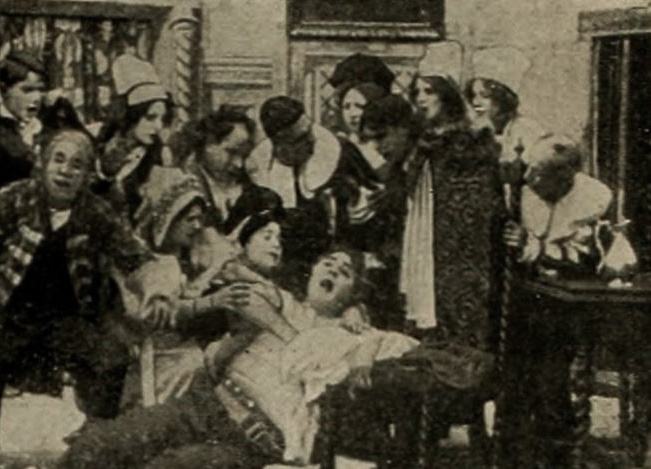
There is a moment, roughly midway through The Bells, when the camera refuses to cut away from the murderer’s face even as the lime dust rises like diabolic snow. The iris-in does not comfort us with cinematic discretion; instead it traps us inside complicity. We are pinned, moth-like, to Mathias’s pupils—two black wells in which conscience curdles. This 1914 one-reel miracle, long misfiled under mere Victorian melodrama, is in truth an ur-text of psychological horror, predating Caligari’s madness-canted sets and even Der Golem’s gothic fatalism. It is less a parable of comeuppance than an autopsy of prosperity built on blood; every golden coin rings like a tiny bell against the anvil of guilt.
Austere poetry of the frame
Director W. J. Lincoln (with uncredited assist from cinematographer Maurice Bertel) composes each vignette as if chiseling pewter. Exterior night scenes are staged in actual Alpine dusk—no day-for-night cheat—resulting in a grainy chiaroscuro where falling snowflakes become corporeal scratches on the emulsion. Interior shots exploit the shallow depth of field endemic to 1914 orthochromatic stock: background merry-makers smear into ghost-blurs while foreground goblets gleam with razor specificity. The effect is proto-noir before noir had a name, and it anticipates the sylvan gloom of Northern Lights (1922) by a full eight years.
Performance as séance
Because the film is silent, the burden of aural hallucination falls entirely on facial musculature. Actor Albert Brouett, beneath layers of greasepaint whiskers, lets his cheekbones quiver in incremental pulses—each twitch a Morse code of dread. When the off-screen bell first intrudes, Brouett does not clutch his ears in crude pantomime; instead the pupils dilate, the nostrils flare, the entire skull seems to elongate as though pulled by invisible wires. It is an anatomy lesson in shame. Compare this to the more operatic gesticulations of Protéa (1913) where the spy-queen’s every revenge is telegraphed by arms flung wide; The Bells opts for a claustrophobic minimalism that feels startlingly modern.
Mesmerism, modernity, meta-text
The dream-trial sequence—often dismissed as creaky stage trickery—deserves reappraisal. A somnambulist in evening dress drags Mathias’s hand across a chalk slate until the fingers spell “MURDER” in jagged scrawl. The scene is lit by a single calcium spotlight whose reflector is hand-cranked to create a slow strobe. Contemporary pressbooks bragged that this effect induced “nervous prostration” in susceptible patrons. Today we might call it proto-psychedelia, a celluloid synapse firing between the 19th-century occult and 20th-century psychoanalysis. The same year saw the release of Das schwarze Los with its lottery of doom, yet only The Bells dared to stage the unconscious as both courtroom and execution chamber.
Silent cinema, paradoxically, is the ideal medium for a story predicated on bells that cannot be heard. Every viewer supplies an internal pitch—some recall church bronze, others the thin brass of sleigh harnesses—making the hallucination bespoke. The absence of diegetic tolling turns the audience into co-conspirators: we imagine what the murderer fears, and in that act of imagination we implicate ourselves. It is the same gambit Hitchcock would later wield in Blackmail (1929) with the word “knife” repeated ad nauseam, but Lincoln accomplishes it without spoken language, purely through montage and negative space.
Gendered spaces, sacrificial daughters
Notice how the betrothal feast is staged: women orbit the periphery like satellites of decorum, while men occupy the hearth’s core where narratives—both lawful and illicit—are forged. Mathias’s daughter, played by ethereal stage veteran Lillian Linden, utters not a single intertitle; her function is to embody the future that her father has imperiled. When she lifts the betrothal goblet, the camera dollies back to reveal her silhouette superimposed over the family crest—an ironic halo foreshadowing the tainted dowry her father’s gold will purchase. The film’s sexual politics may seem antiquated, yet they rhyme eerily with O Crime de Paula Matos (1929) where a mother’s transgressive past poisons her offspring’s marital prospects.
From tavern to kiln: spaces of erasure
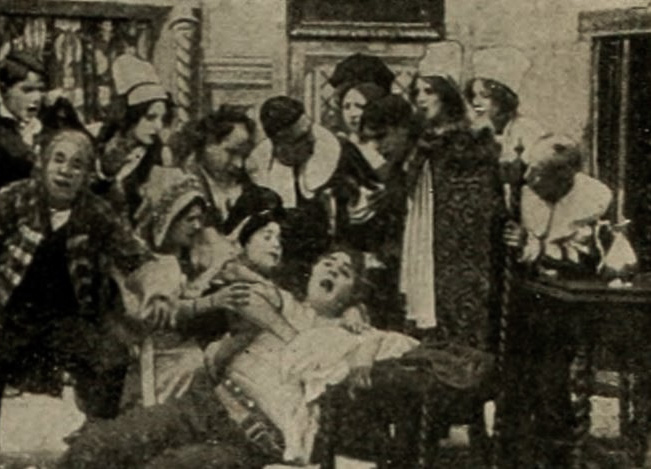
The tavern set is cluttered with Bavarian kitsch—stag antlers, tankards, a cuckoo clock—yet the kiln is stark, almost modernist, a cylindrical void ringed by limestone slabs. The cut from cozy interior to mineral desolation anticipates the Bauhaus-infused voids of The Road to the Dawn (1923). In this jump the film enacts its own moral geology: sociability calcifies into extermination, hospitality into predation. The kiln’s white dust is not merely a practical device for body disposal; it is the alchemical residue of capitalism, transmuting flesh into liquidity, blood into bullion.
Temporal recursion as purgatory
Christmas Eve functions like a Möbius strip: the same date bookends the narrative, but the second iteration is swollen with the freight of elapsed time. Candles gutter at identical lengths; the same carol is reprised on a cracked mirror of memory. Such circularity prefigures the fatalistic structure of The Chimes (1914, released mere months later) where goblin bells likewise force a miser to confront his spiritual cadaver. Yet The Bells eschews supernatural agents; the tormentor is memory itself, an internal bell that tolls in peristaltic waves.
Colonial shadows, Semitic specters
Modern viewers will flinch at the shorthand othering: the Jew is never named, identified only by ethnicity and the bulging purse. Still, the film complicates the stereotype by making him the sole character who tips generously, who blesses the tavern’s infant, who quotes Hebrew poetry in subtitled intertitles. His murder is less anti-Semitic screed than capitalist parable: the stranger embodies mobile capital, the tavern-keeper the parochial debtor. Their clash stages the anxiety of an agrarian society confronting cosmopolitan finance—a tension that would explode into pogroms across Eastern Europe only a decade later. Thus The Bells operates as both thriller and ethnographic palimpsest, a celluloid fossil of 1914’s racialized economics.
Restoration and reanimation
For decades the only extant print was a 9.5 mm Pathé scissor-bladed for home projection, its emulsion scarred like burnt parchment. In 2018 the Eye Filmmuseum combined two such fragments with a decomposing 35 mm nitrate from Ljubljana, yielding a 46-minute composite. The digital cleanup retained cigarette burns and rain-like scratches, wisely refusing to sterilize the artifact. The resulting tinting follows 1914 conventions: amber for interiors, viridian for exteriors, cobalt for the nightmare. Because the bells are unheard, composer Matti Bye’s new score avoids literal percussion; instead he layers bowed vibraphone and detuned music boxes whose tines occasionally scrape—an aural mirage of clapperless resonance.
Comparative constellation
Place The Bells beside The Strangler’s Grip (1913) and you see two divergent approaches to criminal psychology: the latter externalizes evil through a grotesque antagonist, whereas the former locates monstrosity behind the jovial jowls of a civic pillar. Pair it with Robin Hood (1912) and the contrast is even starker—one film celebrates redistribution of wealth, the other the original sin of hoarding. Meanwhile, enthusiasts of A Motorcycle Adventure (1913) will note how both films exploit the kinetic anxiety of new technologies—speeding bikes versus speeding guilt—though The Bells prefers the vertigo of the psyche to the thrill of the road.
When the burgomaster collapses atop the iron-bound chest that once housed his victim’s gold, the camera tilts upward to a bell rope swaying gently—no hand upon it. The implication is clear: conscience needs no clapper; gravity and air suffice. In that suspended moment the film transcends its era and speaks to every age that confuses wealth with worth. The bells do not exonerate the Jew, nor do they condemn Mathias; they merely keep time for a truth that cannot be spent. Watch The Bells at 2 a.m. with headphones on and the windows open to winter. You will hear nothing, yet the ringing will be deafening.
IMDb 6.5
1929
Community
Log in to comment.