DbcultAccessing Vault...
Cult Review
Senior Film Conservator
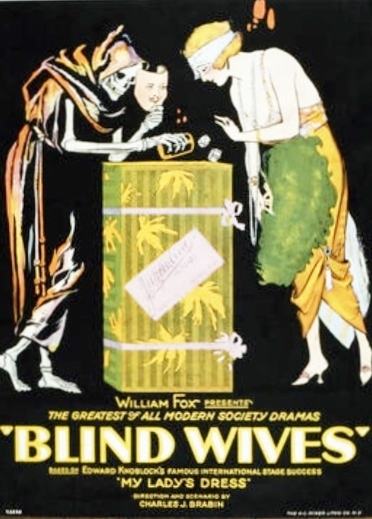
Imagine a film that predates both The Crowd and L’Age d’Or yet already senses the vertigo of commodity fetishism: Charles Brabin’s Blind Wives is that uncanny fossil, a 1920 one-reeler that feels like someone left a Buñuel negative too close to the radiator. What begins as drawing-room bickering—wife covets sable, husband brandishes ledger—mutates into a hypnagogic grand tour of the supply chain, every panel of the dream quilted with the lives that financed her vanity.
The inciting quarrel is almost archetypal: she returns from Fifth Avenue with a frock and a fur, he fulminates over the bill, the marriage cracks like bone china. But Brabin and co-scenarist Edward Knoblock refuse the moralistic punchline you’d expect from Lucille Love: The Girl of Mystery. Instead the camera glides into the wife’s slumber, and the film’s very architecture liquefies. Each dream-fragment is a diorama staged inside a different sinew of the commodity: first the trapper’s tundra, then the auction hall, then a sweatshop where rows of girls feed fabric under needles that click like predator teeth.
Note how the editing anticipates Soviet montage but swaps dialectics for dérive. A whip-pan whisks us from the wife’s boudoir to a St. Petersburg cellar; a match-cut aligns the swirl of her negligee with the arc of a skinning knife. The episodic structure—often derided in 1920 trade papers as “sketchy”—is in fact the point: consumption itself is sketched on the bodies of strangers, a doodle of invisible labor.
Estelle Taylor, later famed as the vamp of The Pride of Jennico, plays the spendthrift spouse with a porcelain hauteur that can shatter into infantile greed in the same frame. Watch her fingers drum the air while the shopgirl boxes the sable—each digit is a little Pac-Man devouring futures. Opposite her, Robert Schable’s husband is less a character than a bookkeeping id, his pince-nez flashing like the blade of a paper cutter.
In the dream sequences the same actors re-appear as avatars: Taylor is now the Siberian child bride traded for a crate of vodka, Schable the auctioneer who hawks her pelt. The re-casting gimmick, lifted from stage revues, here becomes ontological horror: every price tag is a name tag in disguise.
Shot in winter 1919, the film’s two-color Technicolor inserts—now lost—reportedly dyed the sable a radioactive amber against monochrome snow. Even in the surviving b/w prints you sense that chromatic ghost: cinematographer Jacob A. Badaracco lights the fur so that its ridges catch the same halo cinematographers reserve for sacred relics. Meanwhile the dress—an Empire-waist chiffon—is filmed from below through a prism, turning its pleats into a gothic ribcage. The garment eats the woman; the woman eats the world.
Knoblock’s intertitles are haikus of accountancy: “$350—one month of the tailor’s life,” “$2.50—what the weaver earns per day, if she does not cough.” The numbers float without context, like stock-market chyrons, forcing the viewer to supply the moral arithmetic. Try comparing that to the florid exclamations in El protegido de Satán; here minimalism is the sharpest satire.
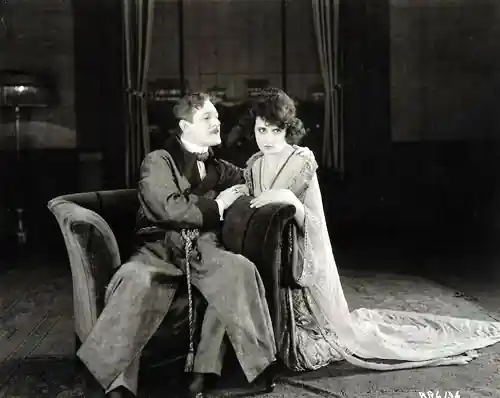
Contemporary critics, if they mentioned Blind Wives at all, filed it under “domestic farce.” Yet the film’s sexual politics feel scalpel-sharp a century on. The wife’s appetite is never shamed as female frivolity; rather, her hunger is the inevitable by-product of a system that equates womanhood with ornament. In one dream she is literally sewn inside the gown, arms pinned to seams, unable to reach the pockets that would let her pay. Meanwhile the husband’s rage is revealed to be less about thrift than about lost mastery: every dollar she spends is a vote in a referendum on his virility.
Where Dalagang bukid uses pastoral bloom to soften class tension, Blind Wives refuses catharsis. Where Castles for Two imagines marriage as real-estate porn, this film imagines it as a ledger whose final balance is tallied in blood. Even In the Spider’s Grip, with its femme fatale, never lets the set itself accuse the viewer; Brabin’s camera does.
Only 42 of the original 68 minutes survive, held in three separate archives: MoMA’s 35 mm nitrate, a 9.5 mm Pathé fragment in Paris, and a 16 mm condensation unearthed in a Dayton attic. The gaps—sometimes mid-sentence—only heighten the dream logic. When the film snaps to white leader just as the wife reaches for the fur’s collar, the absence becomes an ethical ellipsis: you, spectator, must decide what transaction happens next.
Screen Blind Wives beside The True Cost or any exposé on Shein and the temporal vertigo becomes nauseating. The film’s 1920 supply chain—trapper, steamer, sweatshop, showroom—maps almost one-to-one onto today’s algorithmic conveyor belt. The only update is velocity: the sable now moves at fiber-optic speed, but the scar remains analog.
Look for the 3-second insert where the camera tilts down from the fur to the wife’s kid-skin shoes—notice the scuff on the toe. That blemish is not in the script; it’s a documentary intrusion, the actress’s own wear-and-tear seeping into fiction. It’s the kind of contingency digital restorations love to erase, but it’s also the film’s ethical core: someone always scuffs, someone always pays.
In an era when every swipe on a phone is a micro-bet on someone else’s exploited labor, Blind Wives plays like prophecy. It’s not quaint; it’s an unopened invoice slipped under our collective door. Seek it out, project it on a bedsheet if you must, and listen when the silent screen asks, in intertitle silence, whether the thing you wear is wearing someone else’s life threadbare.
Ten out of ten, with a deducted stitch for every worker whose name we’ll never know.
IMDb 6.8
1926
Community
Log in to comment.